
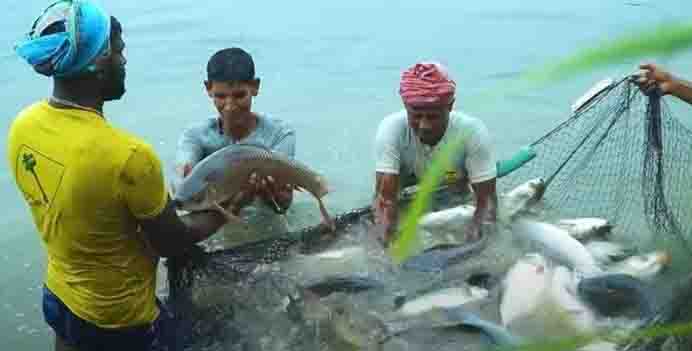
Bangladesh’s fish production surpasses 52 lakh tonnes, driven by aquaculture.
Fish production in the country, including Chattogram and its neighboring districts, has reached an unprecedented level with a total output of 52 lakh tonnes from the ponds, enclosures (ghers), beels, haors, rivers, and the sea.
However, this achievement is increasingly attributed to aquaculture rather than natural sources; concurrently, the production of marine fish and Hilsa is on the decline.
Pointing to the significant transformations in Bangladesh's fisheries economy over the last fifteen years, Abu Tayob, an official of the Department of Fisheries, said that out of the total fish produced, 14.96 lakh tonnes originated from open water bodies, 31.97 lakh tonnes from closed water bodies (aquaculture), and 5.08 lakh tonnes from the sea.
Farmed fish now represent approximately 61 percent of the overall production. Data indicates that fish production was around 27 lakh tonnes during the 2008–09 fiscal year. It has since experienced a steady increase, reaching 36.84 lakh tonnes in 2014–15, 45.03 lakh tonnes in 2019–20, 47.59 lakh tonnes in 2021–22, 49.15 lakh tonnes in 2022–23, 50.18 lakh tonnes in 2023–24, and 51.11 lakh tonnes in 2024–25. By the fiscal year 2025–26, it exceeded the 52 lakh-tonne threshold.
Over the span of 17 years, the country's fish production has nearly doubled. Officials from the Department of Fisheries assert that farmed fish have played a crucial role in this expansion. The rapid increase in fish production can be attributed to the implementation of enhanced fish fry, artificial breeding, high-quality feed, disease management, and modern farming practices in ponds, enclosures, and closed water bodies.
Production in closed water bodies is advancing swiftly, propelled by adaptable technologies and demand-driven extension services. Emphasizing the critical significance of this success in farmed fish for Bangladesh's food and nutritional security, Abu Toyob pointed out that a substantial portion of the country's animal protein is derived from fish.
As a result, the rise in fish production has improved the ability to satisfy dietary preferences and nutritional requirements. Simultaneously, aquaculture has generated new job opportunities within the rural economy. A substantial economic sector has emerged around the fishing industry, which includes fry production, feed, pharmaceuticals, transportation, ice supply, wholesale distribution, marketing, and processing.
While the output of farmed fish has risen, the condition of marine fisheries remains unstable. In the fiscal year 2021–22, marine fish production was approximately 706,000 tonnes. This figure subsequently fell to 679,000 tonnes in 2022–23, 629,000 tonnes in 2023–24, and 568,000 tonnes in 2024–25; in the most recent fiscal year, it was just above 500,000 tonnes. Over a four-year period, marine fish production has decreased by more than 100,000 tonnes.
Bangladesh’s Exclusive Economic Zone (EEZ) in the Bay of Bengal covers around 118,813 square kilometers. Despite having an extensive coastline and a large maritime area, the reduction in marine fish production highlights significant deficiencies in the harvesting and management of marine fishery resources.
Reports indicate that fishing operations were hindered over the past year due to rough sea conditions and various natural disasters. Besides, the enforcement of fishing bans for prolonged periods on two separate occasions adversely affected the industry. Relevant sources have suggested that it is necessary to reevaluate the timing of these fishing bans. A database on marine fish production and stocks is currently being established through the systematic collection of data from 55 upazilas across 14 coastal districts and approximately 212 landing sites.
Sources have indicated that scientific data obtained from this database has validated the reduction in fish catch volumes. Officials from the Department of Fisheries have reported that the pressure on marine fishery resources is increasing due to several factors: overfishing, the capture of juvenile fish and fry, the use of prohibited nets, fishing during breeding seasons, alterations in the marine environment, and the effects of climate change.
As a result, rather than engaging in indiscriminate harvesting, efforts should be focused on establishing sustainable catch levels that enable fish stocks to retain their regenerative capacity. Officials from the Department of Fisheries have described the decline in Hilsa production as regrettable, noting that the government is already executing various initiatives to safeguard the species—such as creating sanctuaries, conserving juvenile Hilsa (jatka) and mother Hilsa, and enforcing seasonal fishing bans.
Additionally, assistance programs have been launched for fishing families who abstain from catching Hilsa during the peak breeding season in the 2025–26 fiscal year; the Department of Fisheries has stated that provisions have been made to support 620,140 such families during this timeframe. Emphasizing the strong fisheries economy of the Chattogram Division, officials have pointed out that fish produced in the region—spanning from Kaptai Lake to the Karnaphuli, Halda, Sangu, Matamuhuri, and Feni rivers, as well as extensive coastal wetlands—have consistently enhanced the area's fishery resources.
So, there has been a focus on developing plans that prioritize Chattogram, with the aim of increasing national production while concurrently conserving natural fishery resources. The Halda River in Chattogram is globally acknowledged as a natural breeding ground for carp-like fish. Stakeholders have noted that if the canals and river flows associated with the Halda are safeguarded, pollution is minimized, sand extraction is controlled, and stringent monitoring is implemented during the breeding season, the river could.
