
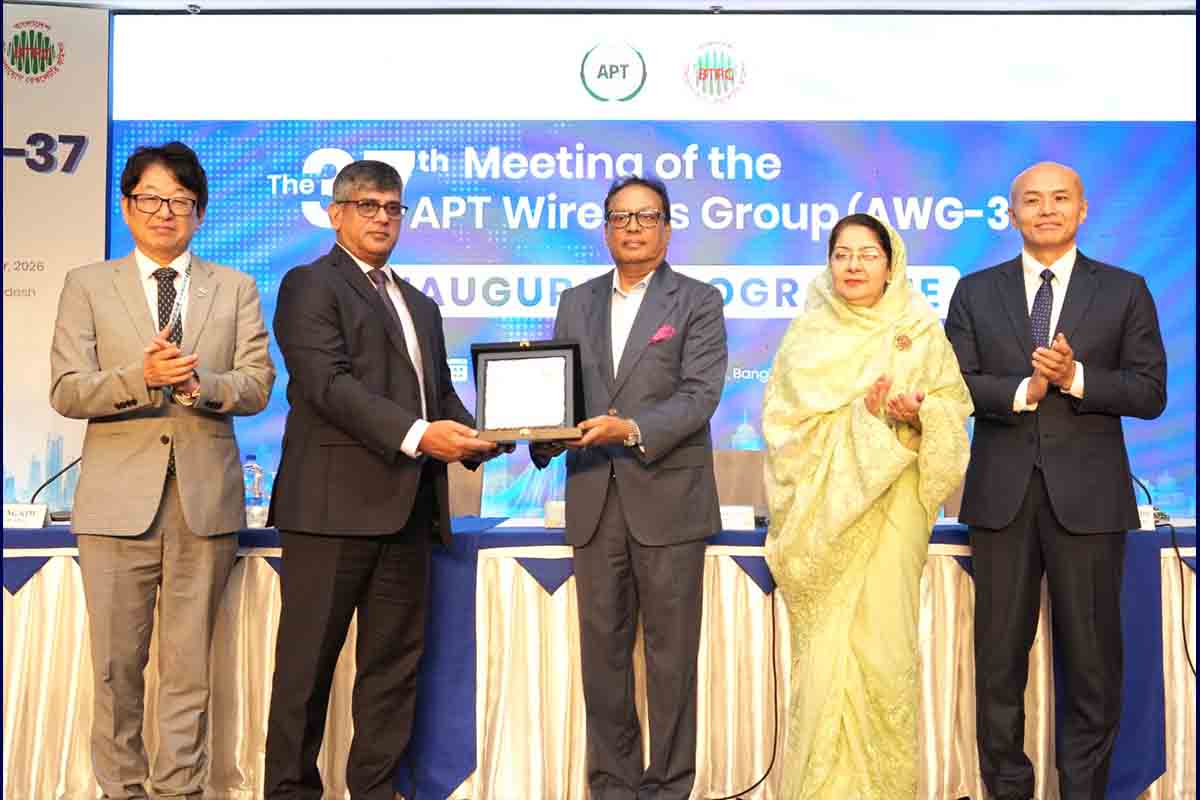
37th Meeting of the APT Wireless Group Begins in Dhaka Focus on Future Wireless Communications, Spectrum Management, Satellite-Based Communications and 6G Technology
The five-day 37th meeting of the Asia-Pacific Telecommunity (APT) Wireless Group, known as AWG-37, began on Monday at Radisson Blu Water Garden Hotel, Dhaka. The meeting, being held from 7 to 11 September 2026 under the auspices of APT and hosted by Bangladesh Telecommunication Regulatory Commission (BTRC) aims to strengthen regional cooperation and technical coordination on the development of wireless communication technologies, spectrum management, emerging technologies and future-generation mobile communications in the Asia-Pacific region.
The inaugural ceremony was attended by the Chief Guest, Posts, Telecommunications and Information Technology Minister Faqir Mahbub Anam, MP; Secretary of the Posts and Telecommunications Division Ms. Bilquis Jahan Rimi; Chairman of BTRC Major General Md. Emdad Ul Bari (Retd.) and senior officials from various government and private-sector organizations.
In his speech, Honorable Minister Mr. Faqir Mahbub Anam, MP said that the next challenge for Bangladesh’s telecommunications sector is not merely to expand connectivity, but to ensure quality, affordability, reliability and meaningful connectivity. He emphasized the need to create new opportunities for citizens through digital connectivity, support economic activities and ensure that people in every part of the country can benefit from technology.
The Minister said that Bangladesh currently has a large and rapidly changing telecommunications market. As of July 2026, the country had approximately 190 million mobile connections, with around 110 million subscribers using 4G services. The telecommunications infrastructure includes more than 49,000 4G sites, 46,000 towers and approximately 173,000 kilometers of optical fiber network. He said these figures demonstrate the scale of the country’s telecommunications sector. However, the government’s focus is now not only on expanding connectivity, but also on ensuring service quality, affordable prices, reliability and meaningful connectivity.
He said plans are underway to further strengthen Bangladesh’s capabilities in artificial intelligence, cybersecurity, software, hardware and other technology-driven industries, with the aim of strengthening the country’s position in the global digital economy. The Minister said spectrum would play an important role in this journey. As demand for data continues to grow, 5G, satellite-based communications, the Internet of Things (IoT) and other future wireless technologies are also developing. Such technologies require forward-looking policies that support innovation, investment and improved services for consumers.
Secretary of the Posts and Telecommunications Division, Ms. Bilquis Jahan Rimi, said that the telecommunications sector is changing rapidly. In this situation, governments and institutions must continuously adapt their policies and activities. While new technologies create numerous opportunities, effective policies and close coordination among the government, regulatory bodies, industry and other stakeholders are essential to ensure that these benefits are realized.
She said the APT Wireless Group works on various aspects of wireless systems to address emerging digital demands in the Asia-Pacific region. At the same time, it plays an important role in developing effective radio communication systems and facilitating technology and knowledge transfer.
APT Secretary-General Masanori Kondo said that the meeting would advance ongoing studies and consider proposals for new work items in response to technological developments and regional needs. He said AWG-37 would include dedicated workshops on AI for 6G, satellite technologies and Ultra-Wideband. These workshops would provide opportunities to exchange experiences, share expert views and discuss the implications of these technologies for the region. He also highlighted the contribution of the AWG community to strategic planning activities.
APT Wireless Group Chairman Daejung Kim said that wireless communications are undergoing a profound transformation. The development of IMT-2030 and future 6G technologies, the growing use of artificial intelligence, the expansion of satellite communications and increasing demand for spectrum are creating both new opportunities and challenges.
He said that in this rapidly changing environment, cooperation among members is more important than ever. No single country or organization can address these challenges alone. Through the AWG, members can bring together their expertise and experience, strengthen mutual understanding and contribute to the development of solutions that are relevant both globally and regionally.
In his address as Chairman of the meeting, BTRC Chairman Major General Md. Emdad Ul Bari (Retd.) said that Bangladesh wants to further strengthen regional cooperation and the exchange of technical knowledge in the information technology and telecommunications sectors. At the same time, the country is interested in playing a more active role in enhancing technological capabilities in the Asia-Pacific region.
He said hosting AWG-37 in Dhaka is an important opportunity for Bangladesh to become more actively engaged in ongoing international technical discussions on wireless communications and spectrum management in the Asia-Pacific region. The event will create opportunities for direct exchanges among Bangladesh’s regulatory authorities, industry, academia and technical experts, as well as APT member countries and international experts.
The APT Wireless Group (AWG) is one of the principal platforms for regional cooperation and technical coordination on wireless communications in the Asia-Pacific region. The group works on the exchange of technical knowledge and experience, research and regional coordination in areas including wireless communications, spectrum management, satellite-based communications and emerging technologies.
The platform brings together countries of the Asia-Pacific region, including Bangladesh, Afghanistan, Australia, Bhutan, Brunei, Cambodia, China, India, Indonesia, Iran, Japan, the Republic of Korea, Laos, Malaysia, Maldives, Mongolia, Myanmar, Nepal, New Zealand, Pakistan, Papua New Guinea, the Philippines, Solomon Islands, Thailand and Vietnam. These countries work together to improve wireless communication systems, develop effective radio communication systems, promote efficient use of spectrum, and exchange technical knowledge and experience. The AWG-37 meetings in Dhaka will include important discussions on future wireless communication technologies, spectrum management and technical activities related to next-generation mobile communication systems.
Over the five-day meeting, a total of 395 participants from APT member countries will attend, including 168 in person and 227 virtually. The programme will feature 52 sessions, including two plenary meetings.The sessions will cover 5G expansion, future IMT/6G systems, spectrum planning, spectrum sharing, satellite and low-Earth-orbit satellite-based communications, railway wireless communications, and the exchange of regional experiences and technical knowledge.
Earlier, an APT Frequency Information System (AFIS) training programme was held in Dhaka on 5-6 September 2026. The training discussed the development of a coordinated understanding of frequency information management among APT member countries and support for updating member countries’ information in the APT Frequency Information System.
