
Govt seeks to utilise elderly people’s experience for youth development
Social Welfare Minister Professor Dr AZM Zahid Hossain, MP, today said opportunities must be created to utilise the wisdom, experience and professional skills of the elderly population for the younger generation of the country.
Retirement from working life by no means the end of a person’s necessity in society rather, opportunities should be created to further accelerate the development of society and the state by utilising the experience of elderly people, he said.
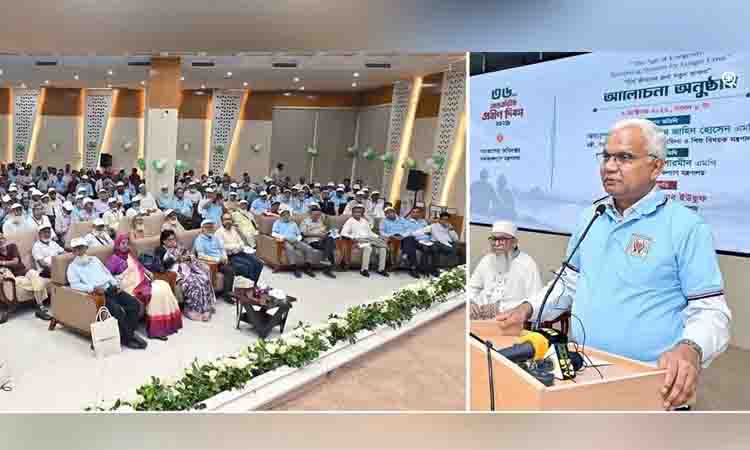
The minister made the remark while addressing a programme as the chief guest organised at the Department of Social Services in Agargaon here marking the International Day of Older Persons.
Mentioning that average life expectancy of people in Bangladesh has increased significantly compared to the independence period, he said at one time, the average life expectancy in the country was between 47 and 48 years and then, living up to the age of 48 to 50 was considered a long life.
But due to socioeconomic development, increased purchasing power of people, expansion of healthcare services and various other factors, the average life expectancy of people in Bangladesh has now crossed 70 years, he said.
The minister said the number of elderly people is also increasing with the rise in life expectancy. Therefore, changes are also needed in the state’s planning and thinking regarding the elderly population.
Currently, government employees have the opportunity to retire at the age of 59, while many private organisations allow retirement at somewhat higher ages.
Suddenly separating a capable person from working life may have negative impacts on his mental health, he opined.
“Until today, a person who has regularly attended office is told from tomorrow that there is no need to come to office anymore. This change is psychologically difficult for a working person. Through this transition, a person should be given the opportunity to gradually adapt to a new life,” he said.
The minister stressed the need for new planning for post-retirement life, saying that even after the end of formal employment, there are many opportunities for a person to work informally, contribute to society and share his experience with others.
In this regard, he said age cannot be a barrier if a person has the desire, ability and opportunity to work.
Many elderly people have long professional experience that cannot be acquired in a day by reading books or obtaining an academic degree, rather this experience is an extremely valuable asset for the new generation of the country, he said.
“Experience has no alternative. A person may obtain a PhD and study extensively, but it takes time to gain real-life experience. Our elderly people have that experience. It is the responsibility of the state and society to create opportunities to utilise their knowledge and wisdom,” he added.
He also said there are many experiences among elderly people that the present generation would not be able to acquire even if it wished to do so.
Citing the experience of the Liberation War as an example, he said the present generation cannot go back to that period even if it wishes to. The experiences of those who directly witnessed the Liberation War are an important asset for the nation.
The Social Welfare Minister also stressed ensuring the wellbeing of elderly people, saying it is essential to ensure specialised healthcare, counselling and other necessary services for elderly people as their age increases.
He said elderly services should not remain limited to one or a few centres in the capital but should be extended to remote areas across the country.
He said efforts should be made to ensure minimum-standard elderly services at district and upazila levels across all 64 districts, stressing that the large elderly population requires coordinated efforts by government institutions, private organisations and people from all sections and professions of society.
The minister said the most important issue in providing services to the elderly population is their availability and accessibility. Necessary services must be taken to the district and upazila levels instead of keeping them Dhaka-centric.
The government is thinking afresh about this issue and initiatives are being implemented gradually, he said.
Regarding social safety net programmes, he said after the present government took responsibility, the coverage of various allowances and social safety net programmes for elderly people has been expanded.
Compared to the fiscal year 2025-26, the amount of various allowances and the number of beneficiaries has been increased in the fiscal year 2026-27, he said.
He said elderly people are being given due importance in the Family Card programme, under which financial assistance through female family members will strengthen household economic security while enhancing women’s financial empowerment.
The government is working to take social protection benefits to the grassroots instead of keeping them city-centric, with initiatives to strengthen implementation through Department of Social Services officials at district, divisional and upazila levels.
He urged elderly people to support the government with their experience and advice, saying their practical knowledge and opinions can make government policies and programmes more effective.
He assured that their views would be given due importance without any political or religious division, and that the government would work for their welfare with advice and cooperation from people of all sections and professions.
Earlier, the Social Welfare Minister took part in a rally organised by the Department of Social Services on the occasion of International Day of Older Persons.
The secretary of the ministry, director general of the Department of Social Services, president and general secretary of an elderly people’s organisation, relevant officials, elderly personalities and people from different sections and professions attended the programme.
This year’s theme of International Day of Older Persons was “New thinking for a long life”.
In line with the theme, the programme emphasised the dignity, rights, healthcare and social security of the elderly population and utilising their experience for national development.
