
High taxes risk shrinking legal market
A realistic and transparent tobacco tax policy is crucial for ensuring long-term revenue stability and market sustainability, experts observed at a dialogue hosted by the Policy Research Institute (PRI) in Dhaka.
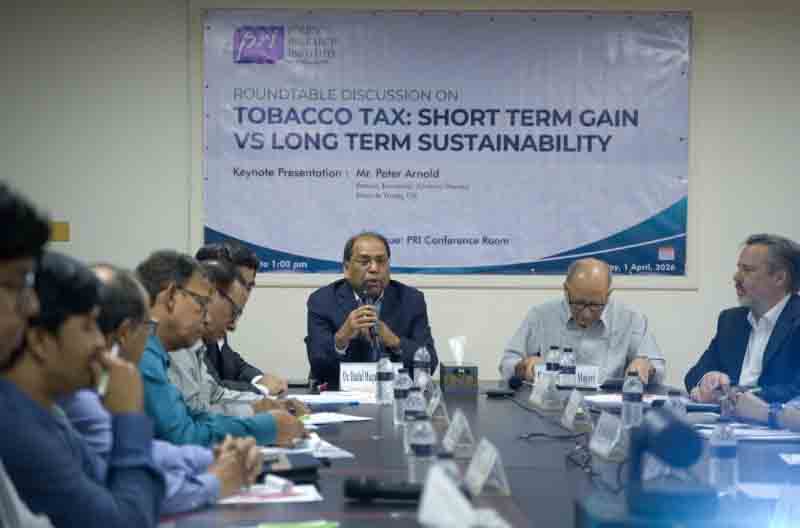
The roundtable, titled “Tobacco Tax – Short-Term Gain vs Long-Term Sustainability,” was held on Wednesday at PRI’s Banani office, bringing together economists, policymakers, and industry stakeholders.
The discussion featured a keynote presentation by Ernst & Young (EY), followed by remarks from PRI Research Director Dr Bazlul Haque Khondker. The session was moderated by PRI Principal Economist Dr Ashikur Rahman.
Participants noted that despite repeated tax hikes, growth in tobacco revenue has slowed in real terms since the 2019–20 fiscal year. EY’s analysis highlighted that sharp increases in prices and excise duties in mid-2024 and early 2025 reduced cigarette consumption, resulting in only marginal gains in revenue.
Speakers pointed out that Bangladesh’s tobacco tax incidence—around 83 percent of retail price—is among the highest globally, limiting further revenue potential through tax increases alone. Frequent adjustments, they warned, may disrupt the market, encourage consumers to shift to cheaper products, and fuel illicit trade.
Concerns were also raised over the complex multi-tier tax structure, which currently applies different rates across four price categories. Experts recommended gradually moving towards a simplified specific excise system to improve predictability and ease of administration.
They also stressed stronger enforcement and modern tracking systems to curb illegal trade and protect government revenue.
The dialogue concluded with a call for a balanced, forward-looking tax framework aligned with economic realities.
