
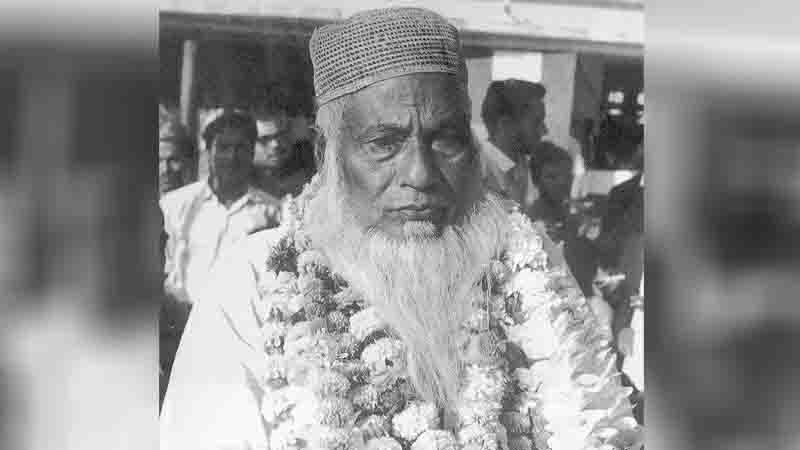
Nation observes 50th death anniversary of Maulana Bhashani nationwide
The 50th death anniversary of Maulana Abdul Hamid Khan Bhashani, popularly known as 'Majlum Jananeta' (Leader of the Oppressed), was observed across the country today in a befitting manner.
Political and social organisations organised various programmes, including placing floral wreaths at his mausoleum in Santosh, Tangail, holding doa mahfils and arranging discussions highlighting his political philosophy, patriotism and contributions to the country's Liberation War.
President Mirza Fakhrul Islam Alamgir paid rich tribute to Bhashani in a message on the eve of the anniversary, describing him as an unforgettable figure in the country's political history.
A large number of people gathered at his mausoleum in Santosh, Tangail, from early morning to pay their respects.
The mausoleum was adorned with floral wreaths as leaders and activists of different political and social organisations, admirers and followers paid tribute to the legendary leader. The area echoed with the slogan, 'Long Live Maulana Bhashani'.
Tangail District BNP organised a memorial meeting at Santosh this afternoon. BNP Standing Committee Member and Prime Minister's Political Adviser Nazrul Islam Khan attended the meeting as the chief guest, while State Minister for Fisheries and Livestock and Tangail-5 lawmaker Sultan Salauddin Tuku attended as the special guest.
BNP Vice Chairman Shamsuzzaman Dudu, BNP Vice Chairman and Tangail-2 lawmaker Advocate Abdus Salam Pintu, and BNP lawmaker Abul Kalam Azad Siddiqui, among others, attended the meeting.
Maulana Bhashani Science and Technology University observed the anniversary through various programmes.
Vice-Chancellor Professor Dr ABM Shahidul Islam and Pro-Vice-Chancellor Professor Anisur Rahman led university officials, teachers, employees and students in placing floral wreaths at the mausoleum in the morning.
Traditional food (tabarruk) was distributed among the participants, while a milad and doa mahfil was organised after Zuhr prayers at the university's central mosque. Essay-writing, recitation and drawing competitions were also arranged for students. A week-long Bhashani Fair was organised on the campus.
In Khulna, BNP leaders observed the anniversary by organising a discussion and doa mahfil at the party office on KD Ghosh Road.
On Monday, BNP Acting Secretary General Ruhul Kabir Rizvi attended a discussion organised by the Bhashani Janashakti Party at the National Press Club in the capital as the chief guest, while State Minister for Planning Zonayed Abdur Rahim Saki and Revolutionary Workers Party of Bangladesh General Secretary Saiful Haque also spoke at the programme.
Five decades after his death, Bhashani's commitment to the rights of the oppressed, social justice, equality and democracy continues to remain relevant in the country's political discourse.
Born on December 12, 1880, in Dhangara village of Sirajganj, Bhashani devoted his entire life to fighting exploitation, deprivation and injustice. His father was Sharafat Ali Khan, and his mother was Mosammat Majiron Bibi.
After receiving religious education, he pursued Islamic studies in Deoband, India. During British colonial rule, he participated in the Khilafat and Non-Cooperation movements and raised his voice against the exploitation of peasants by zamindars and feudal forces.
He played a significant role in defending the rights of Bengali farmers in Assam, particularly their access to land, housing and livelihoods. He gained widespread recognition by leading a farmers' movement against the 'Line System' in Assam. Through his activities in the Bhashan Char region, he became widely known as 'Bhashani'.
After the establishment of Pakistan in 1947, he emerged as a prominent leader in the movement for the political, economic and cultural rights of the people of East Pakistan.
When the Awami Muslim League was founded at Rose Garden in Dhaka on June 23, 1949, he was elected its first president. He strongly opposed the discriminatory policies and economic exploitation of the Pakistani ruling class.
He also played an important role in forming the United Front to contest the Muslim League in the 1954 provincial elections.
Another defining chapter in his political career was the historic Kagmari Conference, held in Santosh, Tangail, in 1957.
He strongly protested against economic disparities between the two wings of Pakistan and the domination of the West Pakistani ruling elite.
His historic utterance of 'Assalamu Alaikum' at the conference was regarded as a significant political statement.
On July 25, 1957, he founded the National Awami Party (NAP) and continued his struggle against imperialism, feudalism and exploitation. For his commitment to the working class and oppressed people, he was also known among his followers as the 'Red Maulana'.
During the military regime of Ayub Khan, Bhashani spearheaded movements demanding democracy and autonomy. He extended his support to the student-led and mass movements during the 1969 mass uprising.
When the Liberation War began in 1971, he took a firm stand in favour of Bangladesh's independence. He played a significant role in building international public opinion against the genocide and atrocities committed by Pakistani forces.
While staying in India, he was associated with the advisory council of the Bangladesh government-in-exile.
After independence, he returned to Bangladesh on January 22, 1972, and continued to raise his voice for people's rights, food security, economic equality and democratic accountability. His hunger strike in 1973, demanding food for the people, reflected his commitment to the welfare of disadvantaged communities.
One of the most significant events in the final phase of his political career was the Farakka Long March on May 16, 1976. He led the march from Rajshahi towards Kansat in Chapainawabganj, demanding a fair share of the Ganges waters and protesting against the adverse effects of the Farakka Barrage.
Bhashani passed away on November 17, 1976.
