
“QR codes are everywhere—but smartphone access, digital literacy, and trust gaps keep Bangladesh’s cashless economy
Bangladesh is witnessing a surge in QR code-based payments, stretching from the upscale streets of Gulshan and Banani in Dhaka to the rural markets of Pirojpur, Rangpur, Cox’s Bazar, and Gaibandha. Platforms like bKash, Nagad, Rocket, Upay, NexusPay, City Touch, EBL Sky, and AstroPay are all chasing the same vision: the end of physical currency, with transactions completed in a single scan. But how far has the country truly progressed toward a cashless economy, question is in all people of the country.
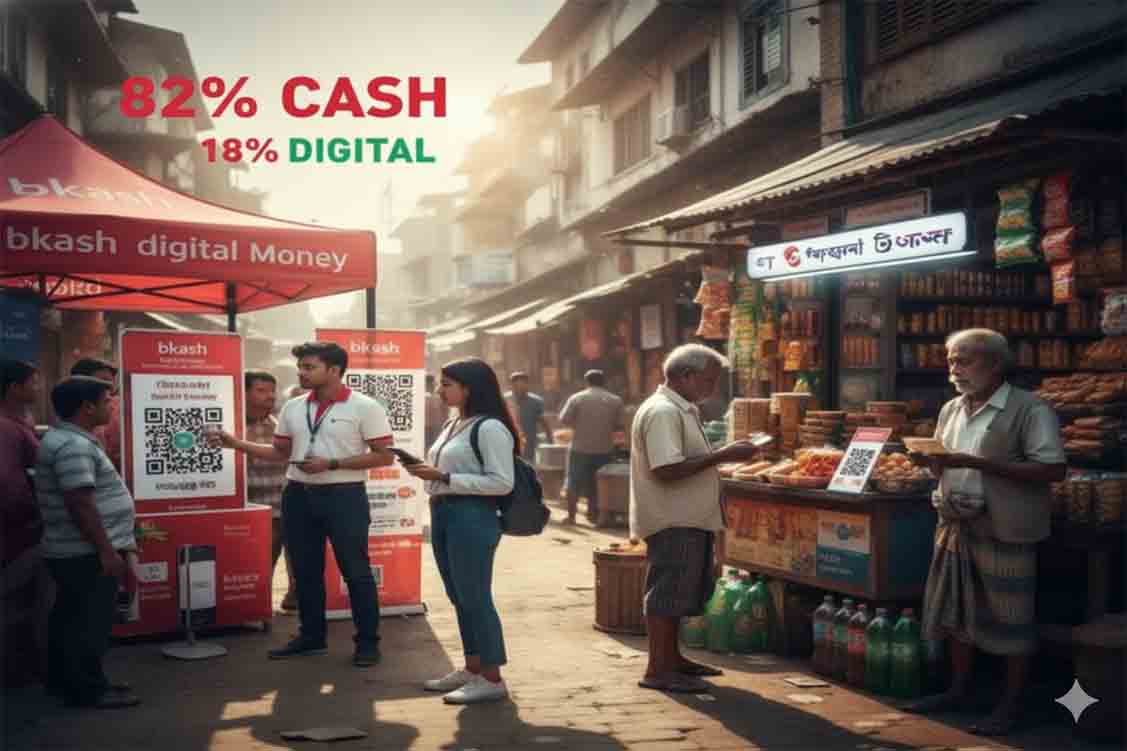
According to the latest data from Bangladesh Bank (October 2025), there are over 2.8 million active QR merchant points, marking an 87% increase in QR-based transactions compared to 2024. Each month, 12–15 million QR transactions take place, totaling approximately BDT 18,000 crore. However, only 18% of total transactions are digital, of which QR payments account for 6–7%, leaving 82% still cash-based.
In Dhaka and Chittagong, QR payments are almost mandatory in shopping malls, cafes, ride-sharing services, and food delivery platforms. Adnan Chowdhury, owner of “Coffee World” in Gulshan, says, “About 85% of my bills are paid via QR. I keep cash only for older customers and foreign tourists.”
The picture is different in rural areas. At Gaibandha’s Gobindaganj market, only 45 out of 100 shops display QR codes, with daily transactions rarely exceeding two or three. Abdur Rahim, a small shop owner in Fulpur, Mymensingh, explains, “I put up the code under pressure from cashless schemes, but barely anyone uses it. Cash is still dominant.”
Mobile Phone Industry Owners Association of Bangladesh President Zakaria Shahid said that still now 40 percent people in the rural areas are using the button phones which may create obstruct to make the fully cashless society.
Dr. Habibur Rahman, Deputy Governor of Bangladesh Bank, says, “‘BanglaQR’ is the world’s largest interoperable QR network. A single QR code can be used by bKash, Nagad, Rocket, and banks alike. It is a major achievement, but reaching rural areas will take another 2–3 years. We aim to add 5 million more merchants by 2026.”
Chairman of the governing board, Kaiser Ahmed Chowdhury, adds, “Over the past year, we’ve onboarded 1.5 million merchants, 60% of them in rural areas. But without smartphones and digital literacy, transactions won’t increase. We’re organizing digital fairs and training programs across villages.”
Kamal Qadir, CEO of bKash, states, “We train rural agents to guide customers through scanning. Our goal is to achieve 50% QR adoption in transactions by 2027.”
Former BASIS president, Russell T. Ahmed, notes, “Our survey found that 72% of small shop owners have near-zero digital literacy. BASIS plans to train 50,000 shopkeepers for free starting 2026.”
Dr. Saif Uddin Ahmed, e-CAB administrator, highlights that online QR payments account for 90% of digital transactions, but offline retail lags at 12%, with a target to reach 50% by 2027.
Prof. Moinul Islam of Dhaka University comments, “Countries like China achieved 90% cashless adoption in five years. Bangladesh could reach 60–70% in ten years if infrastructure, training, and trust-building advance simultaneously.”
Rural shopkeeper Sohag Hossain (27) shares, “I accept both cash and bKash. The younger generation scans, elders pay cash. Out of 30–40 daily transactions, 10–12 are QR, adding 7–8 thousand taka monthly.”
Others, like a rickshaw driver in Banani, Rafik (45), remain cautious: “I accept QR if passengers want, but many avoid it because of charges.” In Sylhet, tea stall owner Zahid Hasan notes, “A 10-taka biscuit—if paid by QR, a 1-taka fee applies. Customers prefer cash to save that 1 taka.”
Smartphone & Internet access – Nearly 48% of rural people still use feature phones.
Digital literacy – Both merchants and customers lack training.
Trust deficit – Concerns over delayed payments or loss of funds.
Joint public-private initiatives like “Digital Shopkeeper” training programs are underway. Nagad and bKash are conducting QR fairs across villages, while Bangladesh Bank targets 10 million merchants by 2027.
As small merchant Jahangir Alam from Gobindaganj observes, “Rural people fear new things. But when the younger generation scans and pays digitally, it feels like one day, paper money might truly disappear.”
