
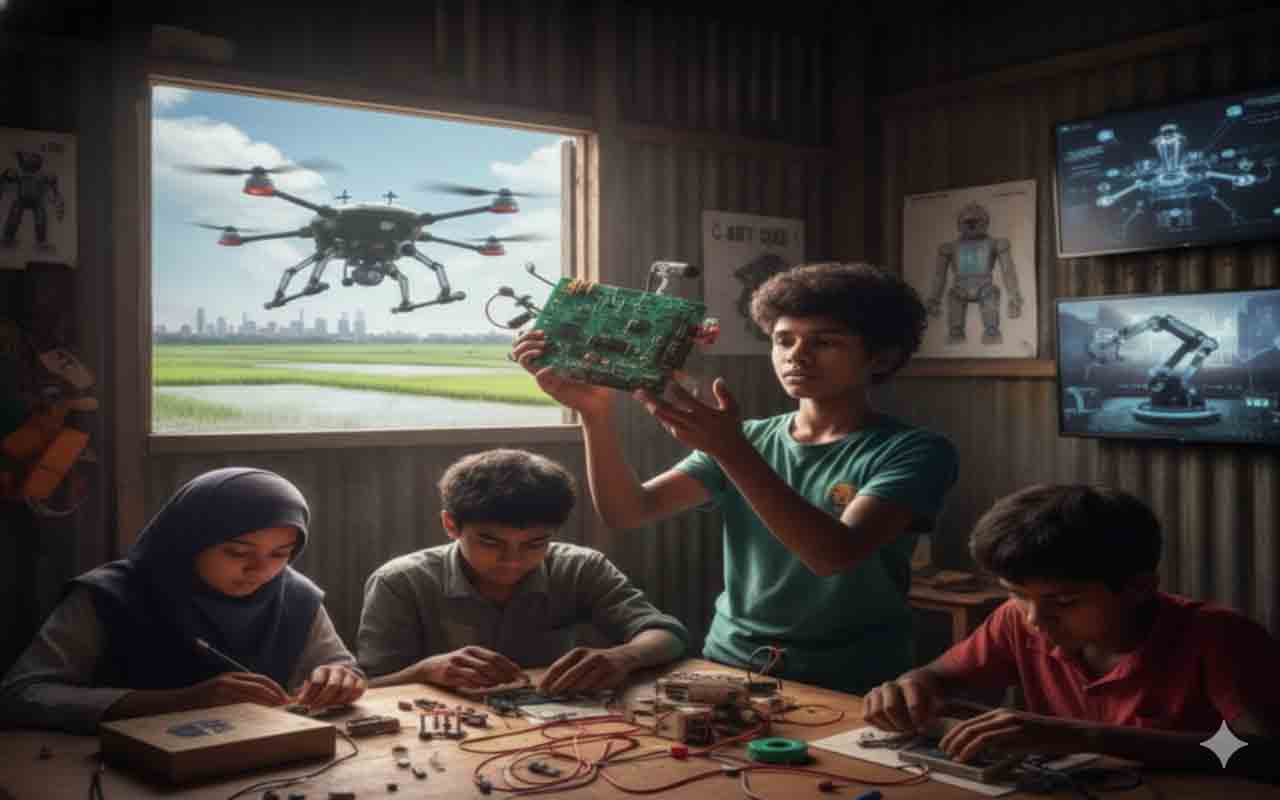
Rural Bangladesh sparks global Robotics success
Bangladesh’s robotics landscape is undergoing a dramatic transformation. What was once considered an urban, high-tech frontier is now being reshaped by young innovators from rural villages—many of whom have never stepped inside a formal lab.
Armed with YouTube tutorials, local hackerspaces, and discarded electronic parts, these youths are building robots that are now competing with global giants and winning top international awards.
This unexpected rise comes at a time when the global robotics scene is dominated by world-renowned creators such as Boston Dynamics, Hiroshi Ishiguro Laboratories (Japan), KAIST Robotics Team (South Korea)—makers of world champion humanoid “DART”—and the acclaimed ETH Zurich Flying Machine Arena.
Yet, despite such formidable competition, Bangladesh’s rural innovators are carving out a place for themselves, drawing international attention with their low-cost, high-impact creations.
In just the last two years, Bangladeshi teams have bagged more than 50 international awards, including 10 gold medals—a remarkable achievement that now places them in the league of elite global teams like FIRST Global Team USA, Singapore’s TechnoBots, India’s Supernova Robotics Team, and South Korea’s RoboMaster champions.
Seventeen-year-old Nahid Hasan from Ataikula, Pabna, stands at the forefront of this revolution. Born into a farmer’s family, Nahid built a “Rice Monitoring Robot” that can detect field moisture and pests, sending alerts via SMS. The cost just Tk 5,000—built entirely from e-waste, broken machines, and salvaged motors.
“I download videos at night because the mobile network is too weak during the day,” Nahid said. “We don’t have a hackerspace here, so I break old devices and use whatever parts I can find.”
His invention won the Best Low-cost Innovation Award at the National Robotics Challenge 2025, placing him in a similar bracket with global frugal innovators like Bots for Good (Kenya) and Team LATRA (Greece).
In Barishal, a group of village youths including Manwarul Islam Haque, Hemayat Hossen and Jisan Ahmed, student of Barishal Zilla School, funded and built a disaster-response drone named Tanvin 1.0, raising Tk 200,000 from their community.
In Rajshahi, Rafiul Islam, a farmer’s son, developed an AI-powered UAV recognized as one of the country’s best innovations, echoing the work of sustainability-driven teams such as the NTU EcoBot Team (Singapore) and Brazil’s RoboIME, both known for world-class inventions built from minimal resources.
In Sitakunda, a small tin-shed structure—known locally as the “garage lab”—has become a powerhouse of innovation. Inside the two-room workshop, college students build line-following robots, delivery bots, and basic drones. Despite the humble setting, one of their teams secured the Judges’ Award at the World Robot Olympiad 2025.
Their story closely mirrors that of globally recognized grassroots innovators like:
The Afghan Dreamers, Afghanistan’s trailblazing all-girls robotics team,
T-Bots Zimbabwe, known for rural tech excellence,
Lithuania’s RoboVikings,
Rwanda’s K-Lab Robotics community.
All began in modest spaces—just as rural Bangladeshi youths are doing today.
Beyond Dhaka, Rajshahi, and Khulna, new hackerspaces have sprung up in Cumilla, Mymensingh, Jhenaidah and Lakshmipur. Over 25 rural hackerspaces have launched in the last two years, offering free workshops and mentorship—similar to global youth innovation hubs such as MIT FabLabs, Japan’s Maker Faire Network, and Germany’s Fraunhofer Tech Labs.
Globally, institutions like Carnegie Mellon Robotics Institute, Toyota Research Institute, KUKA Robotics (Germany), and DJI Innovation Labs (China) advocate for precisely this kind of bottom-up ecosystem. Bangladesh is now witnessing the same.
Tech leaders believe Bangladesh is entering a pivotal decade.
BASIS Senior Vice President Farhana A. Rahman said: “Building robotics clubs at school level is critical. The sooner we scale this, the faster we can prepare a skilled workforce.”
Former BCS President MD Sabur Khan added: “Robotech City is offering rural youths a platform to learn robotics and AI. This is how digital Bangladesh becomes a reality.”
Bangladesh Robotics Foundation Chairman Engr. Almgir Kabir stressed the importance of a unified research community: “We want young innovators from every village to join the robotics ecosystem and help Bangladesh achieve technological self-reliance.”
JBRATRC founder Mohammad Farhan Fardous highlighted the importance of collaboration with international experts, especially in robotics, drones, AI and IoT.
Sirena Technologies CEO Rahat Khan emphasized how humanoid robots and rural robotics labs are shaping future leaders.
Frontech Limited’s MD Saiful Islam noted how AI- and IoT-driven rural entrepreneurship is helping youths turn e-waste into world-class inventions.
Bangladesh’s Global Success Bangladesh is now a consistent presence in global competitions. At the Robotics for Good Youth Challenge 2025 in the US, 17 Bangladeshi teams participated—and all 17 won awards, including special recognition for AI-based design.
Bangladeshi teams also secured: Triple Gold at Malaysia’s WICE 2024,
Medals at Japan’s World Robot Summit,
Top positions at India’s TechX,
Repeated success at Singapore’s FIRST Global Competition,
10 medals, including 2 gold, at the International Robot Olympiad 2025,
Many of these competitors came from district schools, small-town clubs and rural colleges.
An all-girls Bangladeshi robotics team even won gold at the World Science, Environment and Engineering Competition 2024, positioning them alongside celebrated global female tech groups like Girls Who Code Robotics (USA) and TechGirls Africa.
Experts say Bangladesh’s robotics wave resembles the early journeys of global disruptors like Arduino Italy, the Raspberry Pi Foundation (UK) and India’s IIT Robotics Clubs—all of which began with low-cost experimentation before becoming global forces.
Robotics trainer Mahbubul Hasan said: “Countries spend millions to build competitive robots. Our kids do it with e-waste. That’s the strength of Bangladeshi innovation.”
Robolife Technologies founder Joy Barua Lablu pointed out how Bangladeshi innovators created robotic prosthetic hands for students injured during political unrest—similar to humanitarian robotics groups such as MIT Assistive Tech and BioRobotics Italy.
Rural schoolteacher Rahima Begum shared: “My students used to shy away from science. Now they build drones and compete globally. Their confidence has changed.”
A farmer’s son, Ahmed, said: “By building robots with e-waste, we’re proving that technology is possible even in the village.”
To sustain this momentum, experts insist on school-level robotics labs, district hackerspaces, expanded mentorship networks and innovation funds. With more than 100 robotics clubs already active—and expected to double by the end of 2025—the next decade could redefine Bangladesh’s position in global tech.
This is no longer an urban story.
It is a rural tech revolution, powered by dreamers who—armed with scrap electronics, determination and imagination—are placing Bangladesh on the world robotics map alongside Boston Dynamics, ETH Zurich and KAIST.
