
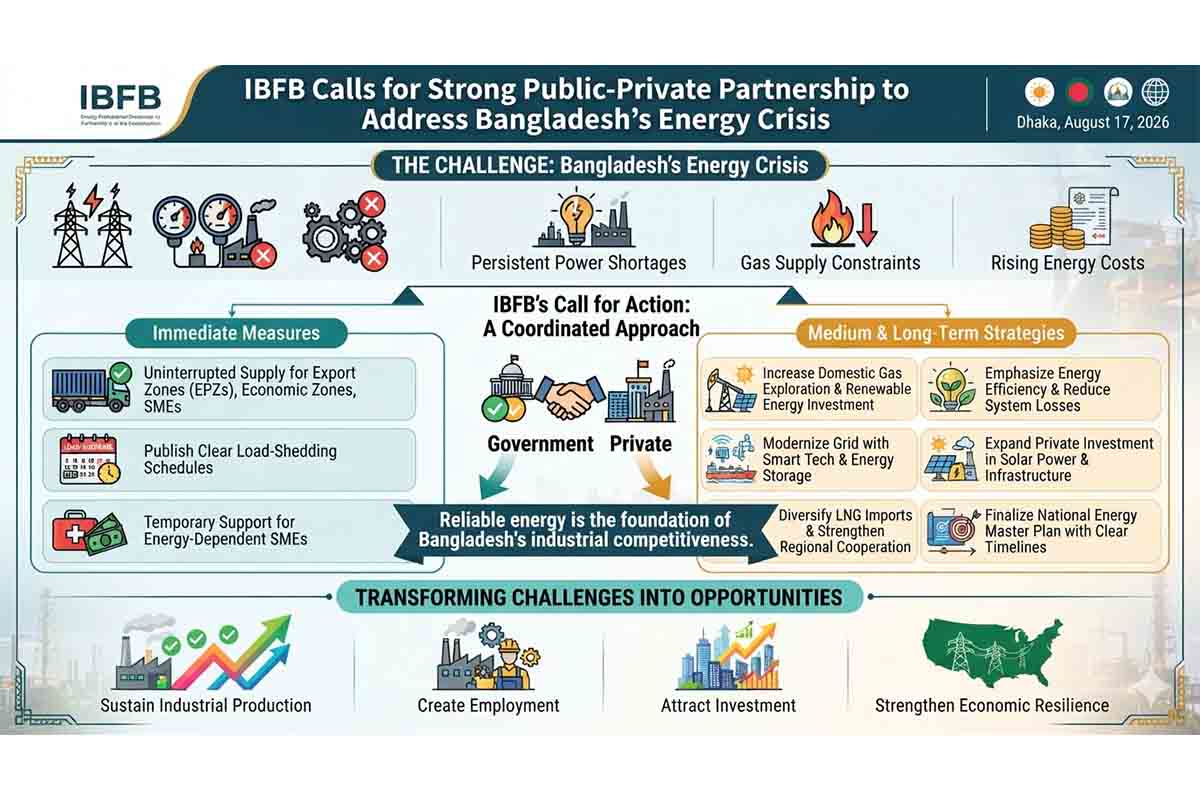
Reliable energy is the foundation of Bangladesh’s industrial competitiveness
Dhaka, August 17, 2026: The International Business Forum of Bangladesh (IBFB) has called for stronger public-private cooperation to address Bangladesh’s ongoing energy crisis, warning that persistent power shortages, gas supply constraints and rising energy costs are putting pressure on businesses, investment and economic competitiveness.
In a statement, the business forum said frequent load-shedding and inadequate gas supplies are disrupting industrial production, increasing operating costs and weakening business confidence. The situation is also creating challenges for investors and energy-intensive industries already facing a difficult economic environment.
IBFB welcomed the government’s initiative to formulate a comprehensive energy policy with greater private sector participation, describing it as a timely move toward improving energy security, encouraging investment and strengthening cooperation between the government and businesses.
The organisation urged the authorities to take immediate measures to ensure uninterrupted electricity and gas supplies for export-oriented industries, export processing zones (EPZs), economic zones and small and medium-sized enterprises (SMEs).
It also recommended publishing clear and predictable load-shedding schedules so that businesses can plan production and minimise operational disruptions. Temporary support measures for energy-dependent SMEs were also proposed to help them withstand the impact of higher energy costs and supply shortages.
For the medium and long term, IBFB called for increased domestic gas exploration alongside greater investment in renewable energy. It also stressed the need to modernise the national electricity grid through smart technologies and energy-storage systems.
The business forum further recommended diversifying sources of liquefied natural gas (LNG) imports and strengthening regional energy cooperation to improve supply security and reduce vulnerability to external shocks.
IBFB also called for greater emphasis on energy efficiency and reducing system losses. It urged the government to expand opportunities for private investment in solar power, captive generation and energy infrastructure.
The forum recommended finalising a National Energy Master Plan with measurable targets, clear implementation timelines and effective monitoring mechanisms.
According to IBFB, a coordinated approach involving the government, private sector, regulators and development partners can transform the current energy challenge into an opportunity to build a more resilient and sustainable economy.
The organisation stressed that ensuring reliable and affordable energy is critical to sustaining industrial production, creating employment, attracting investment and strengthening Bangladesh’s long-term economic resilience.
