
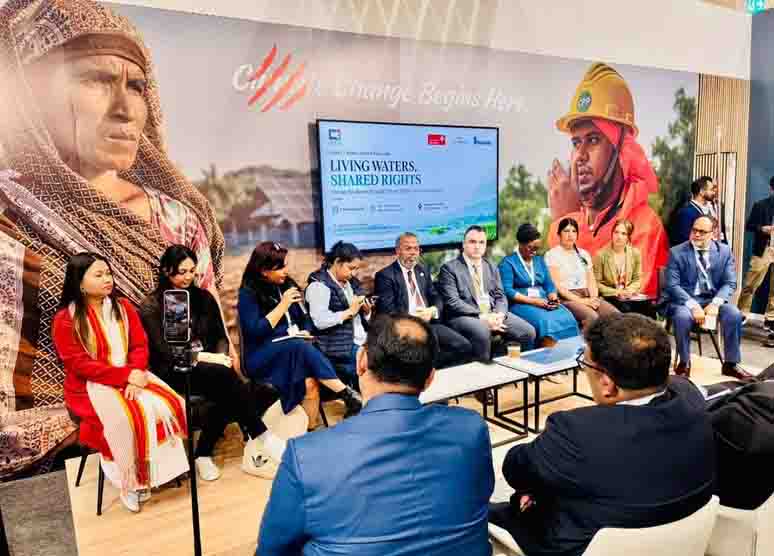
Climate-vulnerable nations urged to unite for water security.
State Minister for Environment, Forest and Climate Change Shaikh Faridul Islam has emphasised the urgent need for collective action by climate-vulnerable countries to address the adverse impacts of climate change.
He said rising sea levels caused by climate change are posing serious threats to Bangladesh's access to safe drinking water, food security, housing and infrastructure.
He said strengthening collective efforts and effective international cooperation among Global South nations and climate-vulnerable countries is essential to addressing these growing challenges.
Faridul said if climate-vulnerable countries collectively raise their concerns and priorities at international forums, meaningful progress can be achieved in improving the living standards of affected communities, ensuring access to safe drinking water and strengthening food security.
He made the remarks while delivering the opening address at a high-level policy dialogue titled "Living Waters, Shared Rights: Climate Resilience through Natural Rights-Led Governance", at the Bangladesh Pavilion on Monday afternoon, the opening day of the 31st Conference of the Parties (COP31) to the United Nations Framework Convention on Climate Change (UNFCCC) in Antalya, Turkiye, according to a message received here today.
The dialogue, organised by Change Initiative in collaboration with the Embassy of Switzerland and WaterAid Bangladesh, emphasised natural rights-led water governance, the protection of transboundary rivers, enhanced climate resilience and equitable access to water for local communities.
Shaikh Faridul Islam, who also serves as the Convener of the Nature and Governance Policy Platform (NGPP), said the impacts of climate change are increasingly threatening the lives and livelihoods of people, particularly in developing and climate-vulnerable countries.
He said the international climate agenda must give due priority to addressing people's fundamental needs, particularly access to safe drinking water and food security.
He also called for coordinated initiatives to safeguard the common interests of climate-vulnerable countries and strengthen effective international cooperation.
During the dialogue, speakers noted that the natural flow of rivers is not confined by political boundaries.
They said transboundary river management must take into account the natural characteristics of rivers, ecosystem protection and the rights of communities dependent on shared water resources.
The speakers also underscored the need to formulate effective water governance policies by integrating scientific evidence, natural rights principles and international cooperation.
Delivering the keynote presentation, M Zakir Hossain Khan, Co-Founder and Chief Executive of Change Initiative, highlighted the global water crisis, changes in natural river flows and persistent inequalities in climate finance.
He noted that Bangladesh shares 54 transboundary rivers with India and that the 1996 Ganges Water Sharing Treaty is set to expire on 12 December 2026.
Against this backdrop, he emphasised the importance of effective cooperation and coordinated policy initiatives for sustainable transboundary water governance.
According to research conducted by Change Initiative and presented during the dialogue, Bangladesh received US$ 7.78 in loans for every US$ 1 in grants in climate finance for the water supply sector between 2002 and 2023.
The findings highlighted the need to increase grant-based climate financing instead of loans for climate-vulnerable countries and local communities.
Mansura Akter, Member of Parliament of Bangladesh and Core Member of NGPP, stated that ordinary people experience the impacts of climate change primarily through shortages of safe drinking water, inadequate water for agriculture and damage caused by floods.
She stressed the need for effective and long-term policy measures to ensure people's right to water.
Dr Mustafa Berk Duygu, Head of the Drinking Water Department, General Directorate of Water Management, Ministry of Agriculture and Forestry of T rkiye, highlighted the importance of cooperation and technical knowledge-sharing among countries sharing common river basins to ensure sustainable water resource management.
Chitembo Kawimbe Chunga, Head of Adaptation and Resilience at the Climate Investment Funds (CIF), emphasised the importance of implementing locally led climate adaptation initiatives and improving the effectiveness of climate financing.
Dr Manohara Khadka, Country Representative for Nepal at the International Water Management Institute (IWMI), called for climate finance justice and the effective integration of scientific research into policymaking and investment planning.
Sejal Patel, Senior Researcher at the International Institute for Environment and Development (IIED), emphasised the importance of long-term investment in protecting rivers, wetlands and groundwater resources, while advocating grant-based financing for local communities.
Shirin Sultana Lira, Senior Programme Manager at the Embassy of Switzerland in Bangladesh, shared experiences of sustainable water management through joint participation by local governments and communities.
International experts on climate finance and water governance, development partners, and representatives of Indigenous communities from Bangladesh and Chile also participated in the dialogue.
