
Bangladesh plans to reduce freight costs for mango export expansion
Fisheries, Livestock and Agriculture Minister Mohammed Aminur Rashid today said the government will try to remove all the barriers particularly the higher freight charge to export mangoes.
“The present government in line with its electoral manifesto will try to expand all the facilities including to reduce exorbitant fright charge in export agro products and mangoes in line with the government’s commitment to make the country’s exports easier and smooth,” he said.
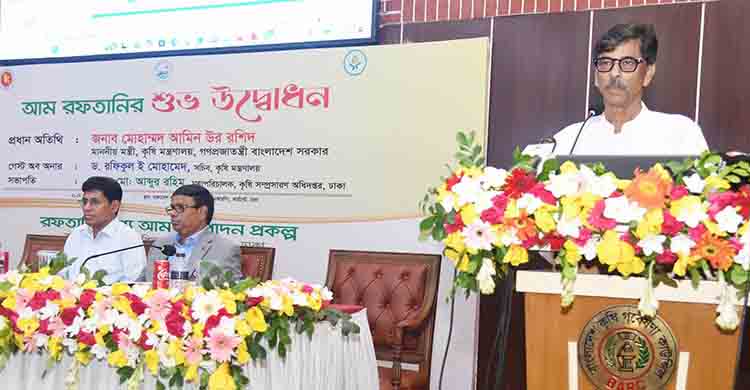
The minister came up with the assurance while he was inaugurating mango export, organized by Exportable Mango Production Project (EMAPP), under the Department of Agriculture Extension (DAE) at Bangladesh Agricultural Research Council (BARC) here.
He said although the Bangladeshi mangoes which are comparatively better in taste than the mangoes produced in Thailand and Pakistan but the export volume over the years is not increasing due to the policy and legal complications.
Terming the higher freight charges as a major issue for exporting agricultural products abroad, the minister said although there is no other way except the air to shift agro commodities abroad.
“So we have to reach a solution on higher fright charge,” he added.
Even Bangladesh stands seven among the mango producing countries in the world while the export volume of the juicy fruit is not more than 1 percent of the local production of 25-27 lakh tonnes annually due to lack of infrastructural facilities from production level to reach the airport for shipment.
Agriculture secretary Dr Rafiqul E Mohamed attended the function as the guest of honor while Additional secretary of the Ministry of Agriculture Selim Khan spoke at the function as the special guest.
Director General (DG) of the Department of Agriculture Extension (DAE) M Abdur Rahim presided over the function.
EMAPP project director Arifur Rahman presented the keynote paper at the function.
The agriculture minister said as BNP has announced that the agriculture and the growers will get priority, so, the government after coming to power has taken three biggest programmes like Farmer Card, Family Card and the canal excavation programme, which are interlinked with the agriculture.
According to the demand of the global market, he urged the scientists to improve the color and shelf life of the mango through unchanging the gene of the original varieties.
Highlighting the potentiality of increasing volume of mango export, Project Director of DAE’s Exportable Mango Production Project Arifur Rahman said the government is trying to increase mango export through strengthening good agricultural practice (GAP).
Of the total 72 varieties, only seven or eight varieties go abroad, with Amrapali alone accounting for about 80 percent of shipments. Other varieties include Himsagar, Langra, BARI-4 and Fajli.
Rahman said, "By promoting advanced techniques and supporting farmers with resources, we have been able to meet growing demand in international markets."
He, however, admitted the export challenges, especially high air freight charges that limit the country's ability to realise its full potential.
Mohammad Mansur, general secretary of the Bangladesh Fruits, Vegetables and Allied Products Exporters Association, said freight costs rose two to three times last year compared with normal rates, causing exports to fall.
He said Bangladesh's fruit and vegetable export sector, including mangoes, has significant potential but faces obstacles that need urgent attention. "High freight costs and inadequate infrastructure, such as the absence of vapour heat treatment facilities, limit our ability to compete in key international markets," he added.
For shipment, he said, “We have to reach the mangoes and other agro-commodities to the airport before eight hours and the quality of most of the commodities deteriorated due lack of cooling house and other storage facilities”.
The government support in setting up modern processing and treatment plants is crucial to improve both the quality and quantity of exports, he added.
In 2025, Bangladeshi mangoes reached 26 countries. The UK imported the largest volume at 686 tonnes, followed by Saudi Arabia with more than 356 tonnes, Italy with over 264 tonnes, Kuwait with over 167 tonnes and Qatar with 163 tonnes. China joined as a new destination importing 5 tonnes.
"Bangladeshi mangoes may not always look perfect, but their taste is superior; this is why demand is so strong," said DAE official Rahman.
