
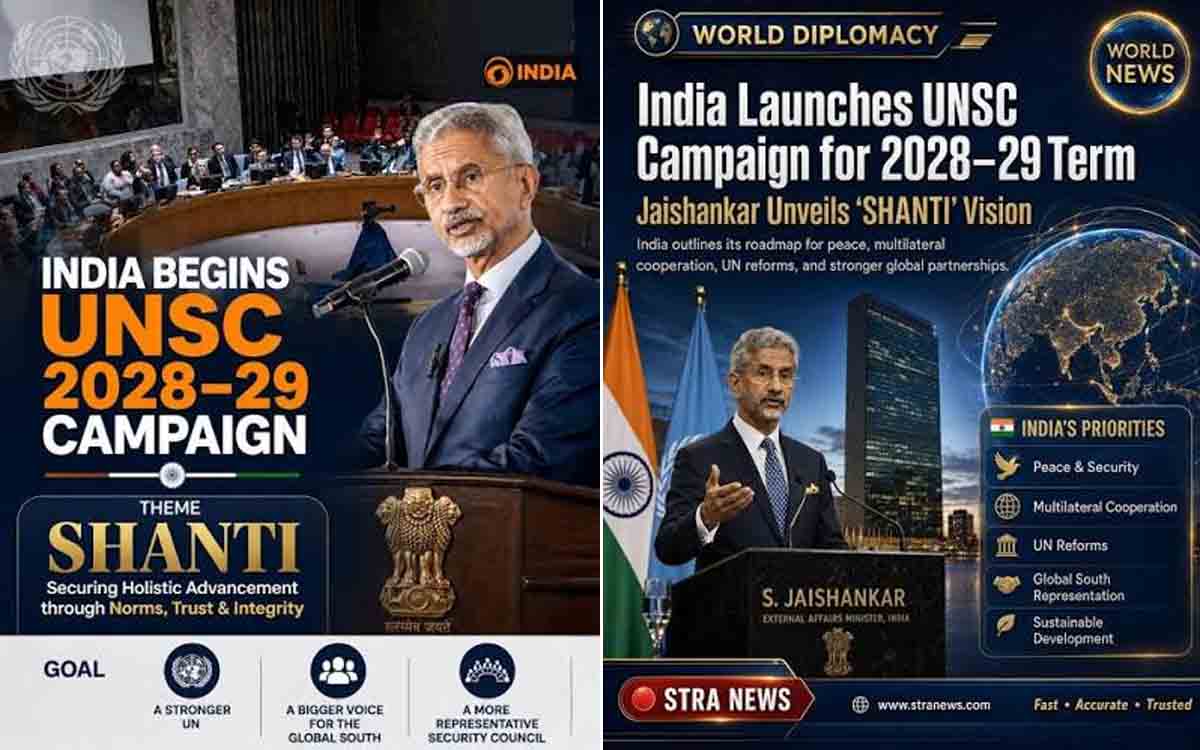
Jaishankar Launches India’s UNSC 2028-29 Bid with SHANTI and MANAV Frameworks
NEW DELHI, July 14: India has formally launched its campaign for a non-permanent seat on the United Nations Security Council (UNSC) for the 2028-29 term, with External Affairs Minister Dr. S. Jaishankar outlining an ambitious vision centred on peace, responsible technology governance and stronger representation for the Global South.
Addressing diplomats and senior international representatives in New Delhi, Jaishankar presented India as a bridge-builder in an increasingly polarised world and introduced two policy frameworks—SHANTI and MANAV—as the guiding principles of New Delhi’s approach to global governance.
He argued that the world faces a profound contradiction: despite unprecedented technological and economic progress, conflicts, instability and humanitarian crises continue to intensify.
"The United Nations must take the lead, and the Security Council must show the way," Jaishankar said, stressing that India seeks to offer practical solutions rather than what he described as passive multilateralism.
Central to India's UNSC campaign is the SHANTI framework, which reflects New Delhi's vision of strengthening international peace and security through cooperation and trust. The acronym stands for:
Jaishankar said sustainable peace can only be achieved through inclusive participation rather than domination.
He also reaffirmed India's commitment to amplifying the voice of developing nations, highlighting its successful efforts during the G20 Presidency to secure the African Union's permanent membership in the grouping and its continued organisation of the Voice of Global South Summits.
Recognising the growing impact of artificial intelligence on international peace and security, Jaishankar introduced MANAV, India's framework for responsible AI governance.
The framework calls for AI systems guided by:
Referring to India's recent AI Impact Summit under the theme "AI for All," Jaishankar said New Delhi would work within the Security Council to harness AI's benefits while preventing its misuse in ways that threaten international peace and security.
Highlighting India's longstanding contribution to UN peacekeeping operations, Jaishankar said nearly 300,000 Indian personnel have served in around 50 UN missions over the decades.
India currently deploys approximately 4,300 peacekeepers across 10 active UN missions, most of them in Africa.
Drawing on this experience, India intends to advocate for more effective peacekeeping by ensuring mandates are matched with available resources, improving troop safety, integrating advanced technologies and advancing the Women, Peace and Security (WPS) agenda.
To strengthen India's candidature, Jaishankar pointed to the country's record as a first responder during humanitarian crises and its expanding international development partnerships.
He cited Operation Amistad, under which India deployed a field hospital and medical teams following the earthquake in Venezuela. He also highlighted India's emergency assistance following Cyclone Ditwah in Sri Lanka and Hurricane Melissa in Jamaica.
On West Asia, Jaishankar reiterated India's support for a two-State solution and noted that India has emerged as one of the leading contributors to the United Nations Relief and Works Agency (UNRWA). He announced plans to establish a specialty hospital, an artificial limb fitment centre and a vocational training institute for Palestinians.
The minister also underlined India's growing maritime security role through anti-piracy, counter-narcotics and maritime security operations across the Indo-Pacific, Gulf of Aden and Gulf of Guinea, supported by India's International Fusion Centre.
Beyond security, India currently supports development projects in 79 countries across Asia, Africa, the Pacific, Latin America and the Caribbean.
Concluding his address, Jaishankar urged UN member states to back India's candidature, arguing that the country's record of consensus-building, humanitarian assistance and advocacy for developing nations makes it well placed to contribute to a more representative and responsive Security Council.
"In a world with too many conflicts and tensions, India has consistently espoused dialogue and diplomacy," Jaishankar said. "We believe that India's presence in the Security Council will help strengthen decision-making in this vital body."
