
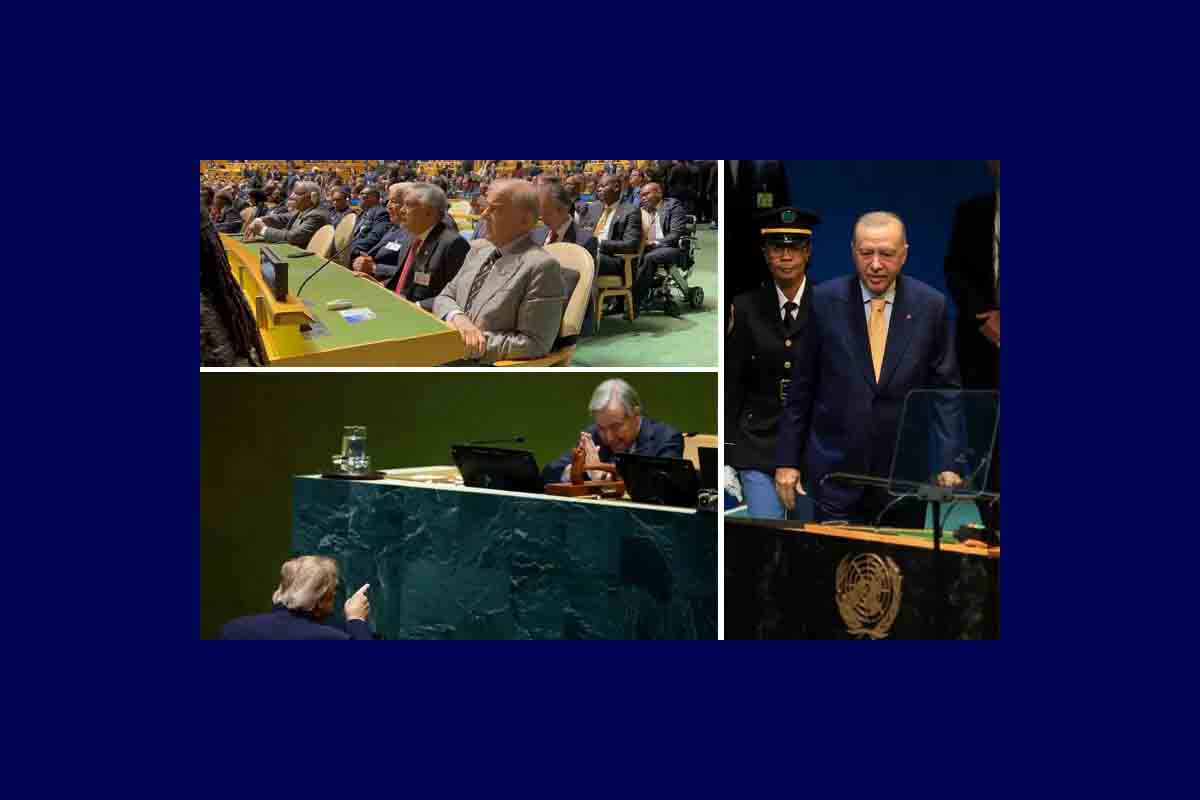
US president hails PM Shehbaz as ‘terrific man’; diplomatic efforts win praise from UN chief
NEW YORK: Pakistan remained front and centre on Tuesday, amid a flurry of diplomatic activity at UN Headquarters, as world leaders came together to address the 81st General Assembly session.
Both PM Shehbaz Sharif and Deputy PM Ishaq Dar spent a busy day filled with whirlwind meetings, engaging with leaders from around the world, as they continued to push for a diplomatic solution to the US-Iran war, which has taken a toll on global trade and energy markets, reports The Dawn.
Although he is scheduled to address the UNGA tomorrow (Thursday), PM Shehbaz was mentioned by US President Donald Trump in his speech, who called him a “terrific man”.
“The prime minister of Pakistan — terrific man — said that Donald Trump was responsible for saving 30 million lives and probably many more than that,” he said as he rattled off a list of conflicts that he claimed to have helped settle: Pakistan-India, Thailand-Cambodia, Armenia-Azerbaijan, and the Gaza conflict, among others.
Pakistan has been vigorously pursuing diplomacy to help bring the United States and Iran back to the negotiating table, even as uncertainty clouded a possible meeting between Trump and Iranian President Masoud Pezeshkian on the sidelines of the UNGA.
Those efforts seem to have borne fruit when, after sending mixed signals during his UNGA speech, President Trump said that his team had met an Iranian delegation on the sidelines of the General Assembly.
“It was a meeting that lasted for three hours; it ended an hour ago,” Trump told reporters after a meeting with Ukrainian President Volodomyr Zelensky. “It was a very good meeting. I can’t imagine why they wouldn’t want to do it; it’s greatness or obliteration.”
He added that the meeting was “productive” and that “They have another one scheduled in the very near future”.
According to diplomatic sources at the United Nations, Pakistan has been “quietly but persistently urging” both Washington and Tehran to maintain indirect contacts and “remain positively open” to direct talks.
A day earlier, Interior Minister Mohsin Naqvi had travelled to Tehran and met Iranian President Masoud Pezeshkian and Iranian Interior Minister Eskandar Momeni, with the mediation process among the issues discussed.
During the visit, Iranian officials expressed appreciation for Pakistan’s continuing efforts to promote regional peace and stability.
The diplomatic efforts were also appreciated by Secretary-General António Guterres, whose spokesperson said a day earlier that the outgoing UN chief was “very grateful and appreciative” of the efforts by Pakistan’s leadership to mediate between Washington and Tehran and help end the violence.
Guterres’ spokesman Stéphane Dujarric told a news briefing in New York that Pakistan’s role was “critical”, and described the understanding reached in Islamabad as “a great achievement.”
He said Guterres had remained in close touch with the Pakistani leadership as part of efforts to achieve the shared objective of ending the conflict.
Asked about the efforts of Prime Minister Shehbaz Sharif and Pakistan’s army chief to mediate between Iran and the United States, Dujarric said the UN chief appreciated the Pakistani leadership’s efforts to bring an end to the violence.
“Other countries have also been involved,” he said, “but I think Pakistan’s role has been critical.”
Dujarric also endorsed renewed direct engagement between Washington and Tehran, saying the UN “always” supports dialogue.
“Diplomacy is our middle name, so to speak,” he said, adding that any re-engagement between the United States and Iran, as they had previously pursued, could help bring an end to the conflict, which he said was “hurting a lot of people.”
Iranian President Pezeshkian is expected to address the UN General Assembly today (Wednesday) and hold bilateral meetings with world leaders.
Marco Rubio said on Tuesday that no meeting with Iranian representatives was currently scheduled, but that Washington was open to such talks if they had the prospect of producing a positive result.
Iran, meanwhile, has signalled that its delegation in New York has authority to pursue diplomacy. Tehran has also conveyed proposals to Washington through mediators, keeping open the possibility of a return to negotiations.
Sideline meetings
On Tuesday, Deputy PM Dar participated in a key ministerial meeting of the Regional-4 (R-4) group, where he was joined by the foreign ministers of Turkiye, Saudi Arabia, and Egypt.
The R-4 group has been focused on regional security and emerged in March amid efforts for mediation between the US and Iran.
As the group met in New York, DPM Dar reaffirmed “Pakistan’s strong commitment to the R-4 framework and expressed the need for continued engagement for enhancing regional peace and prosperity”, the Foreign Office (FO) said in a statement.
It added that the participants exchanged views on the latest situation in the region and expressed full support for efforts aimed at a peaceful resolution of the situation.
A statement issued by the Permanent Mission of Pakistan to the UN said that the ministers’ consultative meeting on Sept 21 on the sidelines of the session also discussed recent regional and international developments.
“The ministers underscored that dialogue and diplomacy remain the only path towards sustainable resolution, and in this context they underscored the need for upholding the Islamabad Memorandum of Understanding for lasting peace and stability,” the statement said.
Meanwhile, PM Shehbaz met with several world leaders, including President of Somalia Hassan Sheikh Mohamud, Austrian Chancellor Christian Stocker, Kenyan President William Ruto, and Kuwaiti crown prince Sheikh Sabah Khaled Al-Hamad Al-Sabah.
