
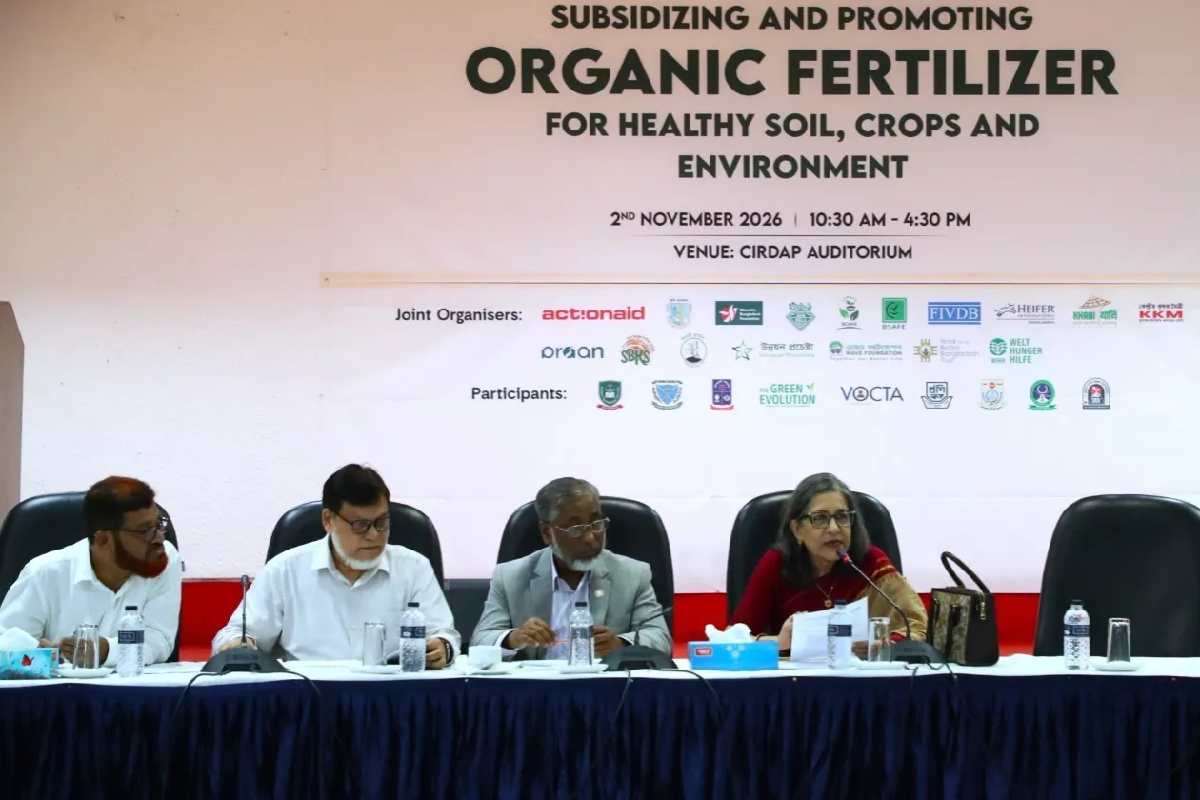
Experts seek subsidies to promote organic fertiliser, protect soil health
Experts and policymakers on Monday called for subsidies to encourage the production and use of organic fertiliser, warning that prolonged reliance on chemical fertilisers was damaging soil health and undermining sustainable agriculture.
They made the call at a round-table titled “Subsidising and Promoting Organic Fertiliser for Healthy Soil, Crops and Environment” at the CIRDAP auditorium in the capital.
Speakers urged simpler registration for organic fertiliser entrepreneurs, effective quality monitoring and coordinated action to protect soil health and promote sustainable agriculture.
They noted that Bangladesh ranked 84th among 122 countries in the Global Hunger Index (GHI) 2026, pointing to a gap between food production and nutrition.
ActionAid Bangladesh and the Bangladesh Agricultural Research Institute (BARI) jointly organised the event in association with 20 national and international development organisations and five universities.
Agricultural experts, government and non-government representatives, farmers and organic fertiliser entrepreneurs discussed barriers to production, registration, marketing and use, as well as ways to make subsidies easier to access.
Marginal farmers and entrepreneurs spoke of administrative hurdles in registering organic fertiliser products. They also pointed to the lack of effective quality assessment and monitoring.
Speakers acknowledged that organic fertiliser may lower crop yields in some cases compared with chemical fertilisers. But they stressed its importance for soil health and crop quality, and called for a balanced approach based on soil conditions and crop requirements.
Executive Chairman of the Bangladesh Agricultural Research Council (BARC) Abdus Salam, who attended the first technical session as the chief guest, outlined the existing registration process for organic fertiliser entrepreneurs and invited recommendations on how to simplify it.
Anwar Faruk, director of Bangladesh Krishi Bank, attended the second technical session as the chief guest, proposing a district-level registration system to ease the process for entrepreneurs.
"There is no alternative to natural methods if we are to make agriculture sustainable," he said.
"Maintaining soil health and the desired pH level requires a balanced use of organic pesticides and organic fertilisers. However, one of our major challenges is the inability to deliver accurate, science-based information to farmers in a timely manner," Faruk added.
He also called on research institutions to develop clear standards for organic fertiliser application rates according to soil conditions and crop requirements.
Special guest Mst. Sabira Sultana, MP, said she would take the proposals to the relevant parliamentary standing committee, Parliament and the Prime Minister if they were submitted to her.
She urged participants to prepare specific proposals and an action plan for the balanced use of organic and chemical fertilisers.
Farah Kabir, country director of ActionAid Bangladesh, stressed the need for coordinated action to strengthen quality control, address marketing irregularities and reduce administrative barriers faced by entrepreneurs.
In her closing remarks at the first session, she expressed ActionAid Bangladesh's willingness to work with the government on the necessary policy changes.
Discussions also covered the availability of raw materials, soil testing to determine application rates, fair prices for farmers and curbing the influence of middlemen.
Speakers emphasised the need for effective mechanisms to regulate fertiliser quality.
