
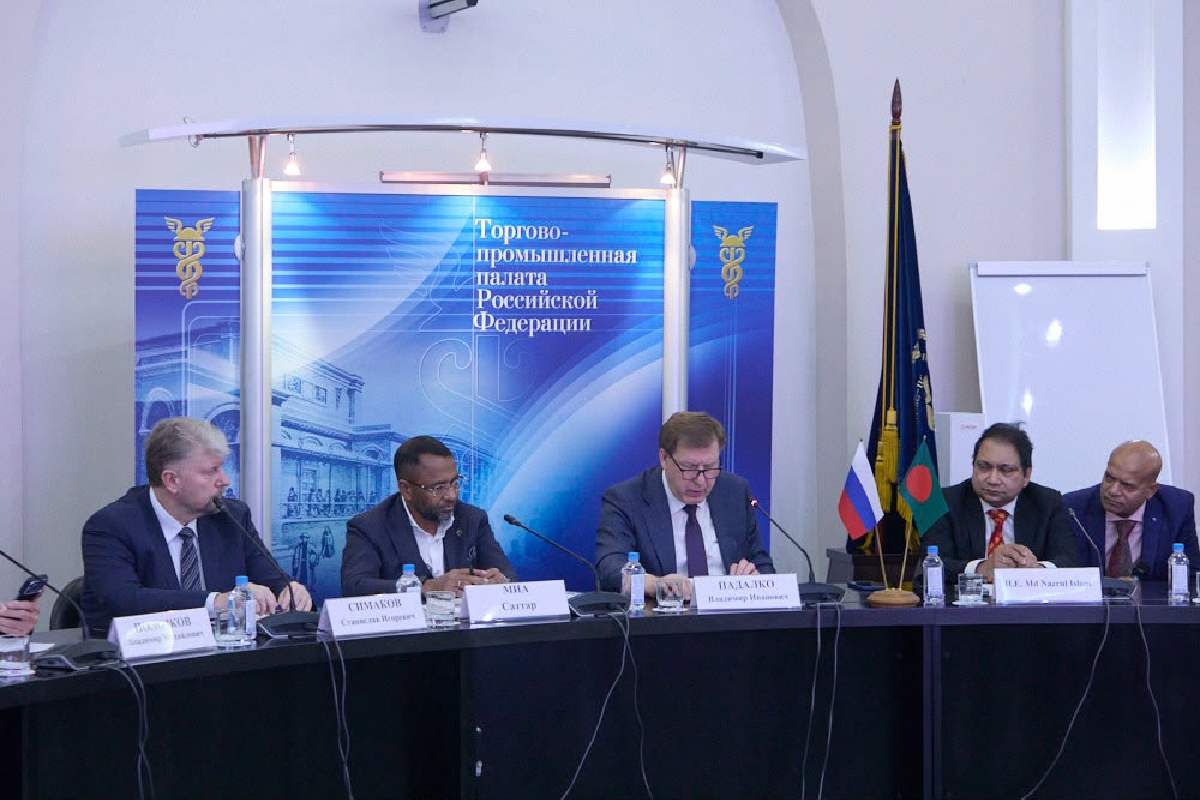
Mia Sattar named chairman of Russia-Bangladesh Business Council
Bangladeshi-born Russian businessman Mia Sattar has been appointed chairman of the Russia-Bangladesh Business Council (RBBC), with the new platform set to focus on expanding bilateral trade and easing market access for Bangladeshi products in Russia.
Sattar, head of National Group and an established entrepreneur in Russian business circles, was appointed at the council’s organisational meeting held on Thursday at the Chamber of Commerce and Industry of the Russian Federation in Moscow.
The council aims to identify barriers to trade, explore new areas of economic cooperation and strengthen business-to-business (B2B) ties between the two countries.
Vladimir Padalko, vice president of the Russian chamber, chaired the meeting and congratulated Sattar on his appointment. He said the council’s activities should reflect the practical needs of businesses, including market research, identifying investment opportunities and providing tailored support to companies seeking to operate in Bangladesh.
Padalko said the council would also serve as a link between businesses and the Russia-Bangladesh intergovernmental commission, helping entrepreneurs raise specific trade and investment problems at the government level.
Mohammad Nazrul Islam, Bangladesh’s ambassador to Russia, highlighted the historic friendship between the two countries, recalling the Soviet Union’s support for Bangladesh during its Liberation War.
He expressed hope that the council would strengthen mutually beneficial economic cooperation and assured that the Bangladesh embassy was ready to support its activities.
Vyacheslav Ermolaev, head of the Second Asia Department at Russia’s foreign ministry, described Bangladesh as Russia’s second-largest trading partner in South Asia after India.
He highlighted the Rooppur Nuclear Power Plant as a major example of bilateral cooperation, while pointing to challenges surrounding financial transactions and the need to diversify the range of goods traded between the countries.
Anastasia Romanova, head of the South Asia division at Russia’s economic development ministry’s bilateral cooperation department, said the council could help expand the agenda of the intergovernmental commission in line with private-sector priorities.
She identified energy, chemicals, agro-industry and information technology as promising areas for cooperation.
Outlining his priorities, Sattar said there was considerable scope to expand cooperation in energy, agriculture, digital technology, transport infrastructure and light industry.
Potential initiatives include establishing a solar power plant and a grain warehouse in Bangladesh, as well as developing an industrial park in Dhaka at the site of Russia’s former trade representation.
He said Russian companies were already working with Bangladeshi garment manufacturers and importing ready-made garments and food products from Bangladesh.
Efforts are also under way to secure accreditation for Bangladeshi fish and seafood suppliers seeking access to the Russian market and the wider Eurasian Economic Union.
Sattar identified lengthy and costly product certification procedures in Bangladesh as a major obstacle to expanding bilateral trade.
He proposed that relevant agencies in both countries work towards harmonising quality standards and mutually recognising product certificates to reduce barriers and make trade more efficient.
Sattar said many Russian small and medium-sized enterprises continued to associate Bangladesh mainly with textiles and the Rooppur nuclear power project, limiting their understanding of the country’s wider economic potential.
To address the gap, he proposed establishing a unified information portal, organising sector-specific business missions and maintaining regular communication between entrepreneurs with support from the Russian chamber and the Russian Export Center.
“We do not need a single forum; we need regular B2B contact,” Sattar said.
He also proposed forming permanent, sector-based working groups under the council to review business proposals and advance joint projects.
Alexander Sirtsev, general director of Prodintorg, proposed establishing an agro-industrial working group, drawing on his experience in supplying Russian fertiliser and grain to Bangladesh.
The initiative could provide a platform to explore opportunities for expanding agricultural trade and strengthening cooperation in food security.
The meeting presented the council’s executive directorate and a proposed work plan for 2026-27. Stanislav Simakov has been appointed executive director.
Interested organisations have been invited to submit proposals for the council’s activities.
A business meeting involving entrepreneurs from both countries is also planned in Dhaka on the sidelines of the Russia-Bangladesh intergovernmental commission meeting in November.
The initiative is expected to provide an opportunity for businesses to discuss trade barriers, identify investment opportunities and develop practical proposals for expanding economic engagement.
Other participants included Vladimir Polzhkov, general secretary of the Russian Association for International Cooperation; Evgenia Igorova of the SME Corporation; Tatiana Belkevich, president of the Russian Association of Fashion Industry; and Saltanat Sakambayova of NOVATEK.
