
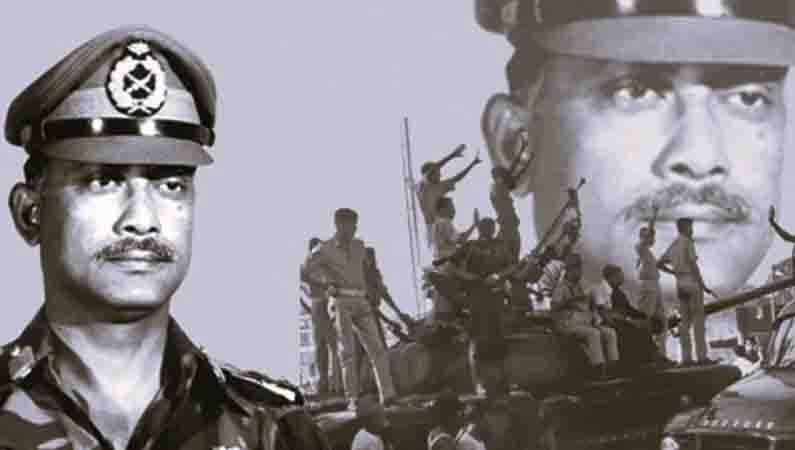
7 November 1975 marked a turning point in Bangladesh’s political and military history.
7 November 1975 is an important and widely discussed day in the history of Bangladesh. Known as National Revolution and Solidarity Day, it is not merely a reminder of a political changeover; it is a significant chapter marked by a national crisis, internal divisions within the armed forces, the uprising of the sepoys and the people, and the determination of the country’s future leadership. Particularly within the political tradition of Bangladeshi nationalism, 7 November is regarded as a historic turning point associated with independence, sovereignty, national self-respect and the emergence of the leadership of Shaheed President Ziaur Rahman.
However, to understand the true significance of 7 November, it is essential to analyse the sequence of events from 3 to 7 November. This is because the political and military turmoil of these five days profoundly influenced the structure of state power, military leadership and the subsequent political course of Bangladesh.
Following the change of power on 15 August 1975, a new government was formed under the leadership of Khondaker Mostaq Ahmad, Commerce Minister in Sheikh Mujib’s government. However, discontent within the armed forces over leadership, discipline and authority continued to intensify. The influence of different military factions over state power and the power struggle centred on Bangabhaban pushed the country towards deep uncertainty. After Mostaq assumed the presidency, Ziaur Rahman took over as Chief of Army Staff. At the time, the army was experiencing intense instability and divisions among various factions.
Against this backdrop, a military coup led by Brigadier Khaled Mosharraf was staged in the early hours of 3 November 1975. The coup plotters placed Army Chief Major General Ziaur Rahman under house arrest and disconnected his telephone line at 1 am. At around 4 am on the same day, four leaders of the then ruling party were brutally murdered inside Dhaka Central Jail. Yet, disregarding the historical context of these events, a section is spreading a distorted interpretation seeking to implicate Shaheed President Ziaur Rahman in the jail killings-- an allegation that has given rise to concerns about misleading the nation. The ultimate basis for uncovering historical truth should not be conjecture or political interpretation, but rather reliable documents, judicial evidence and an impartial analysis of the sequence of events.
While he was under house arrest, Ziaur Rahman had no possibility of exercising control over any individual or unit at any level of the army. The four national leaders killed that night were Syed Nazrul Islam, Tajuddin Ahmad, Captain Mansur Ali and AHM Qamaruzzaman. The following day, Deputy Inspector General of Prisons Kazi Abdul Awal filed a case with Lalbagh Police Station.
According to the case statement, several army personnel led by Risaldar Mosleh Uddin (Moslem Uddin) carried out the killings using firearms and bayonets. According to the court verdict and investigation, those involved in the killings were primarily military officers associated with the events of 15 August and their accomplices. On 20 October 2004, the Dhaka Metropolitan Sessions Judge’s Court sentenced three of the 11 accused-- Moslem Uddin, Marfat Ali Shah and Abul Hashem Mridha-- to death and the others to life imprisonment.
On 4 November, Khaled Mosharraf further consolidated his military authority, and steps to establish him as Army Chief were put into effect. Meanwhile, Ziaur Rahman remained under house arrest. Arrangements were made for the military officers involved in the 15 August coup to leave the country. Even after these measures, however, discontent within the army did not subside. Rather, distrust, anxiety and divisions over the question of leadership continued to grow among officers and soldiers at different levels.
The political crisis deepened further on 5 November. The balance of power between Bangabhaban and the cantonment continued to shift. Khaled Mosharraf did not enjoy the support of all sections of the armed forces. At the same time, the loyalty of a significant section of the army to the house-arrested Army Chief, Major General Ziaur Rahman, and their demand for his release began to take the situation in a new direction.
On 6 November, Khondaker Mostaq Ahmad’s rule came to an end, and Justice Abu Sadat Mohammad Sayem assumed the office of President. However, the change of President did not bring an end to military instability. Discontent spread through the cantonments, while various military and political groups sought to consolidate their respective positions. The role of retired Colonel Abu Taher and the Revolutionary Soldiers’ Organisation associated with the Jatiya Samajtantrik Dal (JSD) also became important at this stage.
Finally, from late on 6 November until the early hours of 7 November, a widespread revolt by lower-ranking members of the army changed the course of events. The rebellious soldiers freed Army Chief Major General Ziaur Rahman from house arrest. Marches and scenes of jubilation involving soldiers and ordinary people were witnessed in different parts of Dhaka. These events subsequently became known as the Sepoy-People’s Revolution.
However, the events of 7 November were not entirely bloodless. Several military officers, including Brigadier Khaled Mosharraf, Colonel ATM Haider and Colonel Nazmul Huda, were killed by soldiers of their own units. The prospect of a breakdown in army discipline also became increasingly acute. Therefore, any assessment of the day must acknowledge not only the release of Major General Ziaur Rahman and the rise of his leadership, but also the loss of life, the revolt and the crisis of military discipline.
After his release, courageous officers and soldiers escorted Ziaur Rahman safely to the headquarters of the 2 Field Regiment. For the next few days, the office of the Commanding Officer of 2 Field Regiment Artillery effectively served as the office of the Chief Martial Law Administrator and the de facto command centre of the country. It played an important role in restoring discipline, stability and confidence in the armed forces and across the country.
After 7 November, Major General Ziaur Rahman returned to the centre of military leadership. Subsequently, he emerged as the leading figure in the governance of Bangladesh. His leadership became associated with Bangladeshi nationalism, self-reliance, a production-oriented economy, rural development and a new political interpretation of national identity.
An important lesson can be drawn from this historic sequence of events: when the military and political institutions of a state lose mutual trust, national security and stability are put at risk. Personal ambition, factional rivalry and power-centred conflict can never serve as substitutes for the national interest. The stability of a state depends on constitutional order, institutional accountability and public confidence.
For those who regard 7 November as a symbol of national unity, the principal lesson of the day is that, at a moment of national crisis, the relationship of trust between the people and the state’s defence and security institutions is of utmost importance. However, the true strength of this relationship must rest on allegiance to the Constitution, the law and the sovereign rights of the people. National unity can never be synonymous with party allegiance or personality-centred power.
The mass uprising of 5 August 2024 also brought the significance of the collective strength of the people into renewed focus in Bangladesh’s political history. In the context of a massive student-led and popular movement, the long-ruling government fell. Although the historical contexts and characteristics of 7 November 1975 and 5 August 2024 were different, both events offer profound lessons about the legitimacy of state power, public participation and the importance of political accountability.
The relevance of Shaheed President Ziaur Rahman’s vision of a self-reliant Bangladesh lies here as well. To build a self-reliant state, priority must be given to increasing production, modernising agriculture and industry, creating employment for young people and developing the rural economy. Foreign assistance is certainly necessary, but it must be based on mutual respect, equality and Bangladesh’s national interests.
At the same time, the foundations of national unity must be broadened further. The Bangladesh National Cadet Corps (BNCC), Bangladesh Scouts, voluntary organisations and the younger generation can be actively engaged in disaster response, social service, environmental conservation and nation-building. Developing discipline, leadership, integrity, empathy and a sense of national responsibility among young people is the long-term strength of a self-respecting state.
The history of 7 November reminds us of another truth: when determining friends and adversaries in matters of national interest, the basis must be actual conduct, mutual respect and the sovereign rights of the state. Blind allegiance to any foreign state is unacceptable, just as unreasonable hostility does not protect national interests. The guiding principles of Bangladesh’s foreign policy must be the capacity to make independent decisions and maintain dignified relations with all.
At the same time, learning from history requires acknowledging the mistakes of the past. The events from 3 to 7 November have shown how power struggles, military intervention and institutional weaknesses can quickly plunge an independent state into a dangerous situation. To prevent such crises from recurring in Bangladesh in the future, it is essential to strengthen democratic institutions, an independent judiciary, a professional armed forces and an accountable administration.
National unity does not mean holding identical views on every question of history; rather, it means remaining united, despite differences of opinion, on matters concerning the country’s independence, sovereignty and the fundamental rights of its people. The true strength of nationalism lies not in division but in inclusion; not in vengeance but in justice; and not in the cult of personality but in building strong state institutions.
The time has come to appreciate anew the significance of 7 November. If the day is viewed merely as a reminder of a political victory or defeat in the past, its lessons will be limited. Instead, drawing on both the achievements and the painful experiences of history, we must pledge that the future of Bangladesh will be determined by the will of its people; that national institutions will function on the basis of the Constitution and the law; and that the country’s independence, sovereignty and public welfare will take priority in all decisions of the state.
7 November reminds us that unity is indispensable in times of national crisis; but transforming that unity into enduring strength requires justice, discipline, democracy and self-reliance. The true lesson of history is not to perpetuate the divisions of the past, but to build a stronger Bangladesh for the future.
Bangladesh first, Bangladesh for all-- let this be the pledge of national solidarity, the resolve to safeguard sovereignty and the commitment to building an independent, democratic, self-respecting and prosperous state for future generations.
