
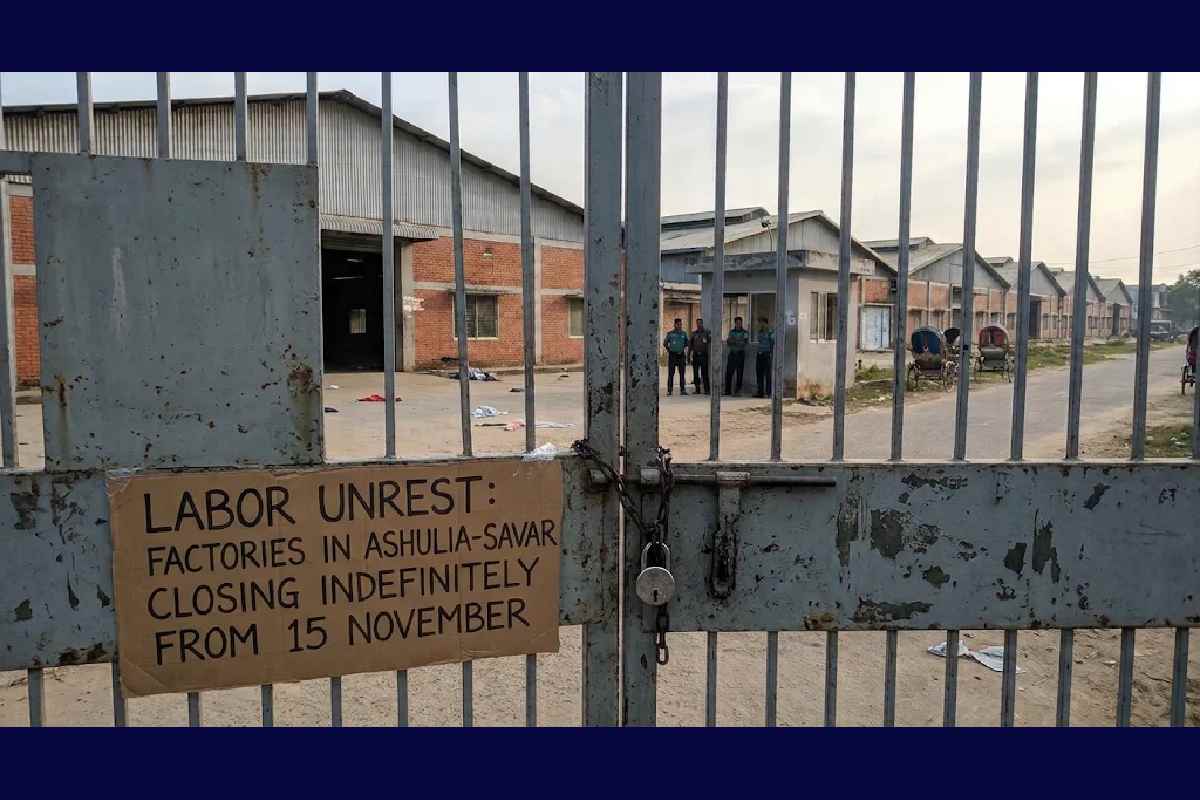
147 factories face production disruption amid labour unrest; owners seek security guarantees
DHAKA, November 14, 2026: Garment factories affected by labour unrest in Ashulia and Savar will remain closed indefinitely from November 15, following growing concerns over factory security and disruptions to production, the Bangladesh Garment Manufacturers and Exporters Association (BGMEA) and the Bangladesh Knitwear Manufacturers and Exporters Association (BKMEA) have announced.
The decision will be implemented under Section 13(1) of the Bangladesh Labour Act, 2006, BGMEA President Mahmud Hasan Khan said at a joint press conference at the BGMEA Complex in Dhaka on Saturday.
He said attempts to create instability in the garment industry over the minimum wage issue had disrupted normal production for the past seven to 12 days, particularly in industrial areas of Ashulia, Savar and Gazipur.
Warning that prolonged unrest could push one of Bangladesh's major export sectors into a serious crisis, he called for urgent measures to restore security and a stable working environment.
The BGMEA president said most workers wanted to return to work and continue production in a peaceful environment. However, he alleged that some workers, instigated by outside groups, were creating disorder inside factories and preventing others from joining their workplaces.
He also alleged that groups of workers were leaving their factories and throwing bricks and other objects at the gates of neighbouring industrial units, forcing workers at those factories to stop working.
Such incidents have further aggravated the security situation across the industrial zones, he added.
According to Mahmud Hasan Khan, 147 BGMEA member factories have been unable to maintain full-scale production because of the unrest, affecting the industry's international reputation, export earnings and the broader economy.
He also expressed concern that the situation was disrupting the normal activities of the Minimum Wage Board.
Referring to media reports, he said the workers' representative on the Wage Board had stated that no labour organisation was involved in the ongoing vandalism and disorder.
However, he questioned the effectiveness of labour organisations in addressing the crisis, saying many field-level labour leaders and representatives had failed to exercise sufficient influence over workers.
At an emergency joint meeting of BGMEA and BKMEA members on Saturday, factory owners also questioned the rationale for continuing discussions at the Wage Board without first ensuring security across industrial areas, he said.
"Without ensuring overall security and a production-friendly environment, it is not possible to keep factories in the affected areas operational," Mahmud Hasan Khan said, explaining the decision to suspend operations indefinitely.
He stressed that garment factories in Ashulia and Savar make a significant contribution to Bangladesh's economy and export earnings, while providing livelihoods for hundreds of thousands of people.
Protecting these industrial establishments and safeguarding the jobs linked to them should therefore be a shared responsibility, he added.
The BGMEA president urged the government to restore law and order in the affected industrial zones and ensure effective enforcement of the law.
BGMEA and BKMEA also called on factory owners, labour organisations, the government, civil society and the media to play constructive and responsible roles in resolving the crisis and restoring stability to the garment industry.
