
Bangladesh wants market access, not one-way trade and $9.2bn trade gap puts Bangladesh-India commerce under scrutiny
DHAKA, Oct 8: Bangladesh is set to push for trade barriers and greater access to the Indian market as the two neighbours’ growing trade imbalance continues to raise concerns among local businesses.
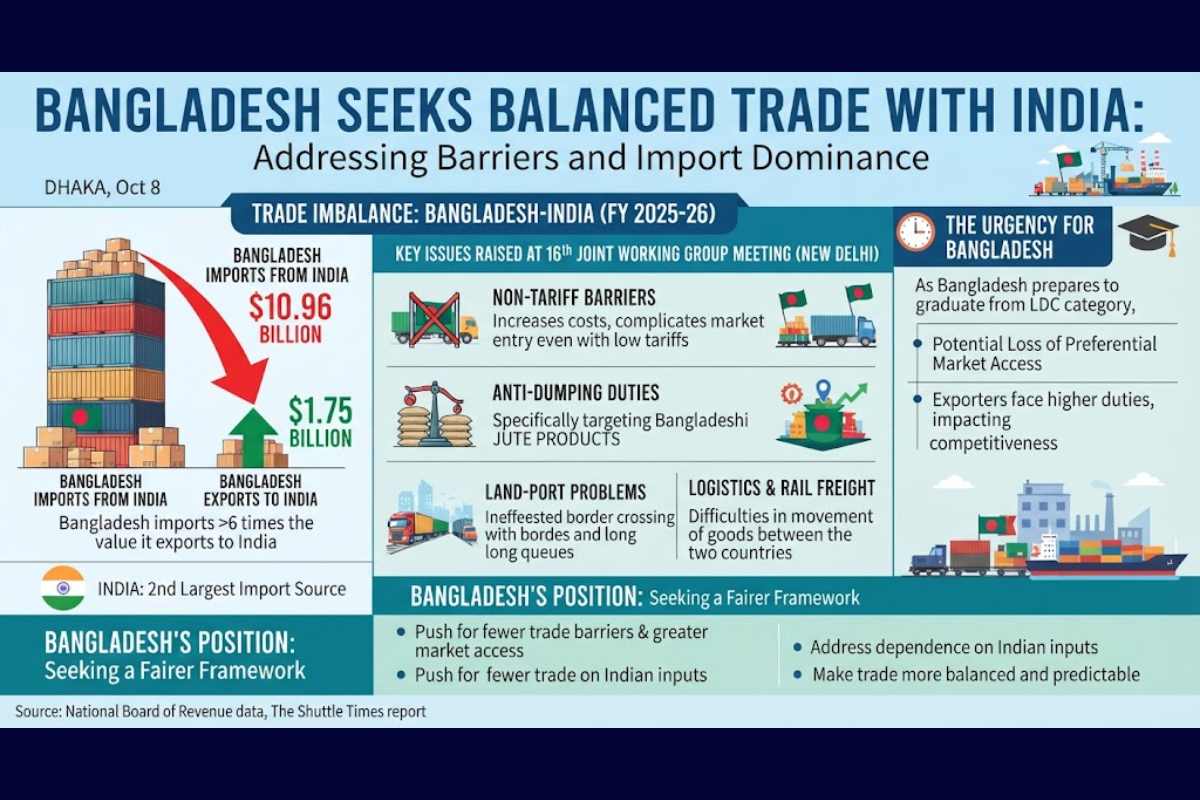
At the 16th Bangladesh-India Joint Working Group on Trade in New Delhi today and tomorrow, Dhaka will raise non-tariff barriers, anti-dumping duties on Bangladeshi jute products, land-port problems and difficulties surrounding the movement of goods between the two countries.
The Bangladesh delegation, led by Commerce Ministry Additional Secretary Ayesha Akther, will also discuss rail freight and other issues affecting cross-border trade.
A member of the delegation told The Shuttle Times that Bangladesh would raise almost all major trade-related concerns, although the working group is primarily a platform for discussion rather than decision-making.
The scale of the trade imbalance is likely to add weight to Bangladesh’s position.
According to National Board of Revenue data, Bangladesh exported goods worth only $1.75 billion to India in fiscal 2025-26, against imports of $10.96 billion.
That means Bangladesh imported more than six times the value of goods it exported to India during the fiscal year.
The imbalance is particularly significant because India is also Bangladesh’s second-largest source of imports after China. Local industries depend heavily on Indian supplies of cotton, yarn, fabrics and other industrial raw materials.
For Bangladeshi businesses, the challenge is therefore twofold: dependence on Indian inputs on the import side, while exporters face barriers when attempting to gain greater access to the Indian market.
Non-tariff barriers are among the issues Dhaka wants to address, as such measures can increase costs and complicate the entry of Bangladeshi products into India even when formal tariffs are low or zero.
Anti-dumping duties on Bangladeshi jute goods are another concern for exporters seeking to expand their presence in the Indian market.
Economist Mohammad Abdur Razzaque, chairman of the Research and Policy Integration for Development (RAPID), said trade relations between the two countries should be normalised because Bangladesh and India are important sources of raw materials and finished products for each other.
India could become a much larger market for Bangladeshi products if trade barriers are reduced, he said.
The issue is becoming more urgent as Bangladesh prepares to graduate from the LDC category.
The loss of preferential market access could make Bangladeshi products less competitive in India, with exporters potentially facing significantly higher duties after existing preferences expire.
“It will come as a shock for Bangladeshi exporters,” Razzaque said.
Bangladesh’s export basket to India is led by garments, while agricultural and fisheries products also contribute to exports.
The latest trade figures underline the asymmetry in bilateral commerce. While Bangladeshi consumers and industries absorb billions of dollars worth of Indian goods every year, Bangladeshi exporters continue to seek wider and easier access to the Indian market.
For Dhaka, the immediate challenge is therefore not simply to increase trade with India, but to make bilateral trade more balanced and predictable for Bangladeshi businesses.
The New Delhi talks are unlikely to produce immediate decisions, but Bangladesh is expected to use the platform to press for removal of barriers that exporters say limit their ability to compete in the neighbouring market.
