
Bangladesh Ranks 51st Globally in Online Services Index and 97th in E-Government Index
Dhaka, 23 November 2026: Bangladesh has made significant progress in improving the quality of government online services and expanding digital service delivery. The country has achieved its highest-ever score in the United Nations Online Service Index (OSI) and risen to 51st place globally. Behind this achievement, alongside the coordinated efforts of various ministries, divisions, and government departments and agencies, Aspire to Innovate (a2i) played an important role in collecting, verifying, and coordinating information. As a result, citizens’ access to digital services has expanded, while Bangladesh’s position in international indices has also strengthened.
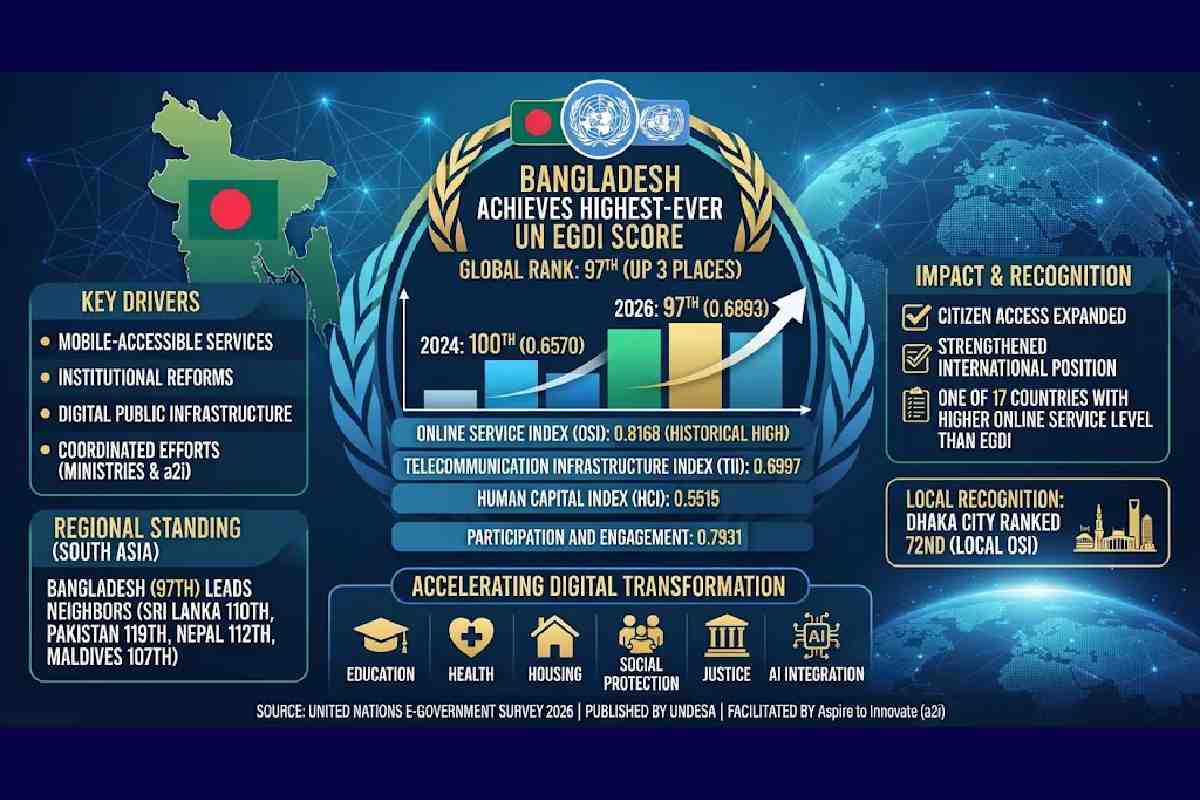
According to the United Nations E-Government Development Index (EGDI) 2026, Bangladesh has moved up three places to 97th among 194 countries. In 2024, Bangladesh ranked 100th. Over the same period, the country’s EGDI score increased from 0.6570 to 0.6893. The United Nations Department of Economic and Social Affairs (UNDESA) published the report on 19 November. Bangladesh has retained its position in the High EGDI group in this year’s assessment as well.
The EGDI is determined on the basis of the average of three equally important sub-indices: the Online Service Index (OSI), the Telecommunication Infrastructure Index (TII), and the Human Capital Index (HCI). In this year’s assessment, Bangladesh’s Online Service Index score increased from 0.7374 to 0.8168, its highest ever. During the same period, the Telecommunication Infrastructure Index score rose from 0.6485 to 0.6997. A new “E-Government Infrastructure” component has been added to this index this year. Meanwhile, Bangladesh’s Human Capital Index score stands at 0.5515. In the “Participation and Engagement” dimension, which assesses citizen participation, Bangladesh scored 0.7931.
The United Nations report identifies Bangladesh as one of 17 countries where the level of online services is higher than the overall EGDI level. The report notes that despite various challenges in infrastructure and other areas, these countries have continued to invest consistently in improving online services.
Bangladesh’s progress is also notable at the regional level. According to the United Nations report, South Asia recorded the highest average improvement among Asia’s subregions in 2026. The report highlights mobile-accessible services, institutional reforms, and Digital Public Infrastructure as key factors supporting this progress. In the EGDI ranking, Bangladesh is ahead of Sri Lanka (110th), Maldives (107th), Nepal (112th), and Pakistan (119th) in South Asia. Meanwhile, in the Local Online Service Index, Dhaka city (Dhaka North City Corporation) ranked 72nd with a score of 0.7228.
a2i played an important role in preparing for the United Nations Survey and coordinating information. As part of the preparatory activities, a2i organised consultation meetings with various ministries, divisions, and government departments and agencies. During these meetings, officials concerned were informed about the United Nations assessment methodology and criteria, while they were also encouraged to regularly update information on government websites and portals. At the same time, a2i played an active role in collecting, verifying, and coordinating the information required for the United Nations Member State Questionnaire. The coordinated efforts of the relevant ministries, divisions, and departments and agencies helped Bangladesh achieve this record score in the Online Service Index.
The United Nations E-Government Survey assesses various areas, including online services, institutional frameworks, citizen participation, telecommunication infrastructure, and human capital capacity. In this year’s Survey, the scope of assessing life-event-based services in key areas of citizens’ lives, including education, health, housing, social protection, and justice, has been expanded. In addition, questions related to the use of artificial intelligence in government activities have been included for the first time.
Since 2003, the United Nations Department of Economic and Social Affairs (UNDESA) has published the E-Government Survey every two years to support progress toward achieving the Sustainable Development Goals (SDGs) by 2030 and to assess the advancement of digital government systems in Member States. Bangladesh’s progress in this year’s report reflects the digital transformation of public services, the expansion of citizen-friendly online services, and the coordinated initiatives of the institutions concerned.
