
Bangladesh to receive $30m climate resilience funding from CIF
Minister of Environment, Forest and Climate Change Abdul Awal Mintoo has said Bangladesh will receive US$30 million from the Climate Investment Funds (CIF) to strengthen climate resilience, particularly in coastal areas.
The fund will be used to address the adverse impacts of climate change, strengthen coastal infrastructure and expand climate-friendly agricultural activities. Bangladesh is among five countries initially considered for the financing.
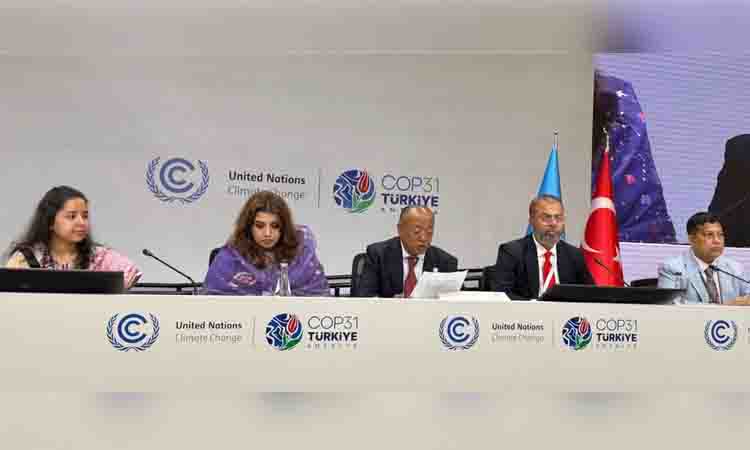
The minister made the remarks at a press briefing organised for the Bangladesh delegation at the United Nations Climate Change Conference (COP31) in Antalya, Turkey, today.
The briefing was held at 3pm local time at Press Conference Room-1 in Zone D-3 of the conference's Blue Zone. The Ministry of Environment, Forest and Climate Change and the Ministry of Foreign Affairs jointly organised the event, according to a press release.
State Minister for Foreign Affairs Shama Obaed Islam, State Minister for Environment, Forest and Climate Change Shaikh Faridul Islam, MP Mansura Akter and Additional Secretary Mohammad Navid Shafiullah were present.
Abdul Awal Mintoo said Bangladesh contributes less than 0.5 percent to global greenhouse gas emissions but remains highly vulnerable to the impacts of climate change.
Cyclones, floods, rising salinity and heatwaves are increasingly threatening people's livelihoods, agriculture, infrastructure and the country's development achievements, he added.
Referring to updated 2026 data from the World Meteorological Organization (WMO), the minister said the global average temperature from January to September this year was around 1.47 degrees Celsius above the pre-industrial level.
Despite limited resources, Bangladesh has taken ambitious initiatives to address climate change, he said.
Under the country's third Nationally Determined Contribution (NDC 3.0), Bangladesh has set a target of reducing greenhouse gas emissions by 6.39 percent through its own efforts and an additional 13.92 percent with international support by 2035, compared to the business-as-usual scenario.
To achieve these targets, the government is promoting renewable energy, rooftop solar power generation, tree plantation, canal restoration, stronger early warning systems and community-based adaptation initiatives, he added.
Highlighting the importance of climate finance, the minister said developed countries must urgently ensure the financing they have pledged to help vulnerable nations tackle climate change.
The Least Developed Countries (LDCs) group has called for tripling annual adaptation financing to US$120 billion before 2035, a demand Bangladesh supports, he said.
He also called for simplifying access to funds from the Green Climate Fund, the Global Environment Facility and the Adaptation Fund, while expanding direct and grant-based financing opportunities for climate-vulnerable countries.
Climate adaptation efforts should go beyond planning and ensure effective implementation at the grassroots level, he said, stressing the need to accelerate the National Adaptation Plan and expand community-based initiatives.
The minister also underscored the importance of implementing the Belem Adaptation Index and the Belem-Addis Vision to achieve the global adaptation goal, saying international finance, technology transfer and capacity-building support are essential in this regard.
On climate-induced loss and damage, Mintoo said the impacts of climate change were no longer a future threat but a present reality.
He said the resources available under the Fund for Responding to Loss and Damage were inadequate compared to the project proposals submitted.
The minister called for increased contributions from developed countries, simplified fund-access procedures and faster disbursement to ensure effective support for addressing both economic and non-economic losses and damages.
