
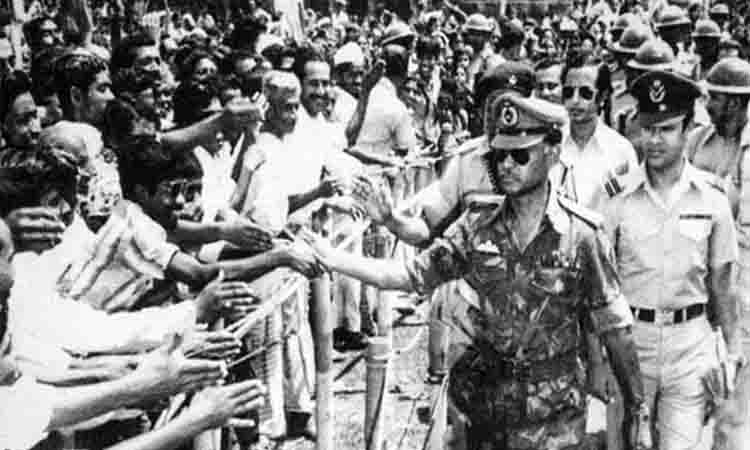
Article portrays November 7 as pivotal in Ziaur Rahman's rise and Bangladesh's history
November 7, 1975, was a very important day in the national life of Bangladesh. Just as in 1971, the nation found its great leader. On November 7, the nation united in the same way under Ziaur Rahman’s leadership, just as it had done in 1971 in response to his call.
To analyse the significance of November 7, one needs to go a little further back in history. In 1971, the Pakistani occupation forces, with the assistance of their local collaborators, carried out brutal killings, torture and destruction. The political leadership demonstrated utter failure. The nation was bewildered.
At that time, the nation was looking for a leader in whom it could place its trust and around whom it could envision a new Bangladesh. At that very moment, Major Zia appeared before the nation as a saviour. He declared Bangladesh’s independence from the Kalurghat radio station in Chattogram, and the declaration spread across the country and abroad within moments. The nation regained its bearings.
Following Ziaur Rahman’s declaration of independence, people across the country united and plunged into the Liberation War. Ziaur Rahman did not stop at declaring independence; he himself fought on the battlefield as a sector commander.
Through nine months of bloody war, a new state named Bangladesh was born on the world map. December 16 is our Victory Day.
Bir Uttam Major Ziaur Rahman had no ambition for high office. This man, who believed in democracy, returned to the barracks.
The country was liberated on the basis of equality, human dignity and social justice. However, the rule of Sheikh Mujibur Rahman (1972–1975) was the exact opposite.
During this period, corruption, black marketeering, smuggling, plunder and administrative irregularities became the norm. The Rakkhi Bahini carried out repression in various forms, including the arrest and torture of opposition political activists, extrajudicial killings and enforced disappearances.
Bangladesh became a discriminatory state. As famine struck the country, many people died because they could not find food.
In such circumstances, alongside the establishment of a one-party system, press freedom was curtailed and political rights were restricted. The nation became divided along various lines. Amid this situation, Sheikh Mujibur Rahman was killed along with his family on August 15, 1975.
From then on, various forms of instability emerged in the country. One group engaged in conspiracies to turn the country into a subservient state.
Early in the morning on November 3, Army Chief Ziaur Rahman was confined to his residence in the cantonment under the leadership of misguided Brigadier Khaled Mosharraf. At the same time, ambitious Khaled Mosharraf declared himself Army Chief.
A frightening situation emerged. Under these circumstances, the country effectively had no government on November 3, 4 and 5. At around 2 am on November 6, Major Zia was freed from confinement through the Sepoy-People’s Revolution.
Radio Bangladesh broadcast the news that Major Ziaur Rahman, a leading figure in the struggle for independence, had assumed the responsibilities of Chief Martial Law Administrator of the People’s Republic of Bangladesh and Chief of Staff of the Army.
As soon as the news was broadcast, a spontaneous tide of hundreds of thousands of people, filled with applause and slogans, poured onto the streets like an overflowing flood. Soldiers and civilians became one.
The nation witnessed the people and the army coming together on the streets of Dhaka for the first time since December 16, 1971. On November 7, a familiar voice came over the radio: ‘I am Zia speaking.’
He called on everyone to unite and work hard to move the country forward. His brief address brought a divided nation together. The scene of national unity and solidarity came vividly to life through his speech.
Newspaper accounts of the day remain vivid testimony to the events. This man, who genuinely believed in democracy, was freed from confinement by the soldiers and the people, who placed him in power.
Political analysts believe that November 7 provided the right direction for Bangladesh after its independence in 1971
In his book Ziaur Rahman's Bangladesh (1979), American researcher Marcus F. Franda demonstrated that Ziaur Rahman’s political rise was inseparably linked to this important turning point in Bangladesh’s history.
His leadership as a sector commander and commander of Z Force during the Liberation War, his declaration of independence and his military contribution on the battlefield gave him a distinct identity and acceptance at the national level. Through the Sepoy-People’s uprising of November 7, he once again emerged at the centre of national politics.
During the 1965 India-Pakistan War, Ziaur Rahman had demonstrated his courage and leadership as a company commander of a battalion at the Bedian sector of the Khemkaran battlefield. He demonstrated them again on November 7 after the Liberation War.
In an article entitled ‘Zia and November 7’ in his book titled 'Some Memories, Some Words', former Army Chief Lieutenant General Mahbubur Rahman wrote: ‘I remember that he (Ziaur Rahman) came to a soldiers’ assembly at Dhaka Cantonment at that time. There was a crowd of unruly soldiers in the field, raising their weapons. Slogans of 'Zia Bhai, Zia Bhai' were resounding everywhere. The air of Dhaka Cantonment was filled with their voices.
‘Leaving his flag-bearing vehicle on the road, he walked straight into the middle of the soldiers. Taking the microphone, he began shouting, 'Shut-up. I am not Zia bhai. I am bloody well your chief. Behave properly.' He said in Bangla, 'All of you, be quiet. I am not your brother. I am your Army Chief. Speak carefully. I will never tolerate a breach of military discipline.'
Mahbubur Rahman further wrote in the book: ‘He (Ziaur Rahman) ordered everyone to return to their barracks. He told them to surrender their weapons and return to the chain of command.
‘To my astonishment, I noticed that within moments all the noise had subsided, and the soldiers, in orderly lines, were moving quietly towards their respective units. To me, Zia seemed that day like the Pied Piper of Hamelin, whose flute had made all the children of the city of Hamelin follow him wherever they had been.’
The account written by former Army Chief Lieutenant General Mahbubur Rahman gives an idea of Ziaur Rahman’s personality and the extent of his popularity within the army.
Zia, who believed in religious values, had unwavering faith in genuine democracy. Driven by the spirit of democracy, he had called the people to the Liberation War and led the war effort.
His outstanding contributions included declaring independence, rebuilding war-ravaged Bangladesh, establishing multi-party democracy and strengthening the foundations of agriculture and the economy.
Upon assuming state power, he first repealed the Fourth Amendment to the Constitution and reintroduced multi-party democracy. He restored freedom to the media.
Under Ziaur Rahman’s epoch-making leadership, a battered Bangladesh experienced an extraordinary revival. Ending the divisive system imposed after independence, he introduced ‘Bangladeshi nationalism’—a universal philosophy of bringing every citizen of this land together under the same flag.
Through this philosophy, everyone from the hills to the plains, from Teknaf to Tetulia, and from Rupsha to Pathuria shares the national identity of being Bangladeshi.
Bangladesh’s economy today rests on three pillars—agriculture, the garment industry and remittances from expatriate workers. Ziaur Rahman’s contributions to strengthening the foundations of all three sectors were remarkable.
He increased agricultural production, undertook canal-digging programmes, promoted rural development and worked to build a self-reliant economy. Strengthening local government, engaging young people in productive activities, improving foreign relations and expanding overseas labour markets were also initiatives of Ziaur Rahman.
Broadly speaking, Major General Ziaur Rahman came to be recognised internationally as a successful statesman politically, economically and diplomatically.
Through the establishment of the Bangladesh Nationalist Party (BNP) on September 1, 1978, he gave institutional form to a new political movement centred on nationalism, independence and sovereignty, and Bangladesh’s distinct state identity.
Ziaur Rahman, the architect of modern Bangladesh, was martyred on May 30, 1981, at Chattogram Circuit House at the hands of a group of misguided members of the armed forces.
With the loss of this extraordinary statesman, Bangladesh seemed to fall silent. He sought to build the country through honesty, courage, intelligence, creativity and deep patriotism.
Following the path shown by this immensely popular statesman, the architect of modern Bangladesh and proponent of multi-party democracy, his wife Begum Khaleda Zia fought for nine long years, bringing down the autocratic Ershad regime and restoring democracy.
Under her leadership, BNP formed the government three times through popular votes.
Sheikh Hasina kept the country under her control for a continuous period of more than 15 and a half years through forced rule, killing, enforced disappearance and murder of opposition activists, sometimes with military support, sometimes through one-sided elections and sometimes by holding votes at night for elections scheduled during the day.
The struggle to establish democracy and voting rights, led from within the country by Begum Khaleda Zia and from abroad by Tarique Rahman, succeeded on August 5, 2024.
In the face of the united movement of students and the public, Sheikh Hasina fled and took refuge in neighbouring India.
Mother of Democracy, Begum Khaleda Zia, died on December 30, 2025. BNP won the 13th parliamentary elections held on February 12 this year under the leadership of Tarique Rahman.
On February 17, BNP formed the government under his leadership. However, the fragile economy, weakened by corruption, plunder and money laundering during Sheikh Hasina’s prolonged rule, alongside the conflict in the Middle East, has pushed the country into a major crisis.
In this situation, by following the path shown by his father Ziaur Rahman and mother Khaleda Zia, Tarique Rahman has been able to earn the people’s confidence through his planned approach to governing the country.
In this context, it can be said that from the 1971 Liberation War and November 7, 1975, to the mass uprising of 1990, the Zia family has stood by the nation as a saviour during times of crisis, and the nation, in turn, has placed its trust in the Zia family.
Prime Minister Tarique Rahman is working tirelessly day and night to repay that trust. Conspiracies against the country and nationalist forces are still continuing.
In this context, st a rally in Nayapaltan on November 7, 2026, Prime Minister and BNP Chairman Tarique Rahman said: ‘The students and people of Bangladesh did not merely restore independence and sovereignty. The people of the country drove autocrats and conspirators out of the country.
‘Just as those evil forces were defeated on November 7, 1975, they were similarly defeated on August 5, 2024, through the participation of the people and a movement.’
Referring to the fact that a section of people is still engaged in conspiracies, the Prime Minister said: ‘Once again, they want to undermine Bangladesh’s sovereignty; once again, they want to introduce the system of sham elections in which the candidates and the outcome are predetermined. They will no longer be given that opportunity.’
Nazrul Islam is Executive Editor of the Daily Amader Shomoy.
(The article is originally written in Bengali and translated into English by Harun Al Nasif, City Editor, BSS.)
