
Health state minister calls for national diabetes survey, screening programme
State Minister for Health and Family Welfare Dr MA Muhit today stressed the need for conducting a comprehensive, science-based national survey and launching an effective screening programme to address the growing diabetes burden in the country.
He also underscored the need to strengthen the Non-Communicable Disease (NCD) corners at the upazila level, proposing an increase in the current allocation of Tk 300 crore for medicines to Tk 3,000-5,000 crore.
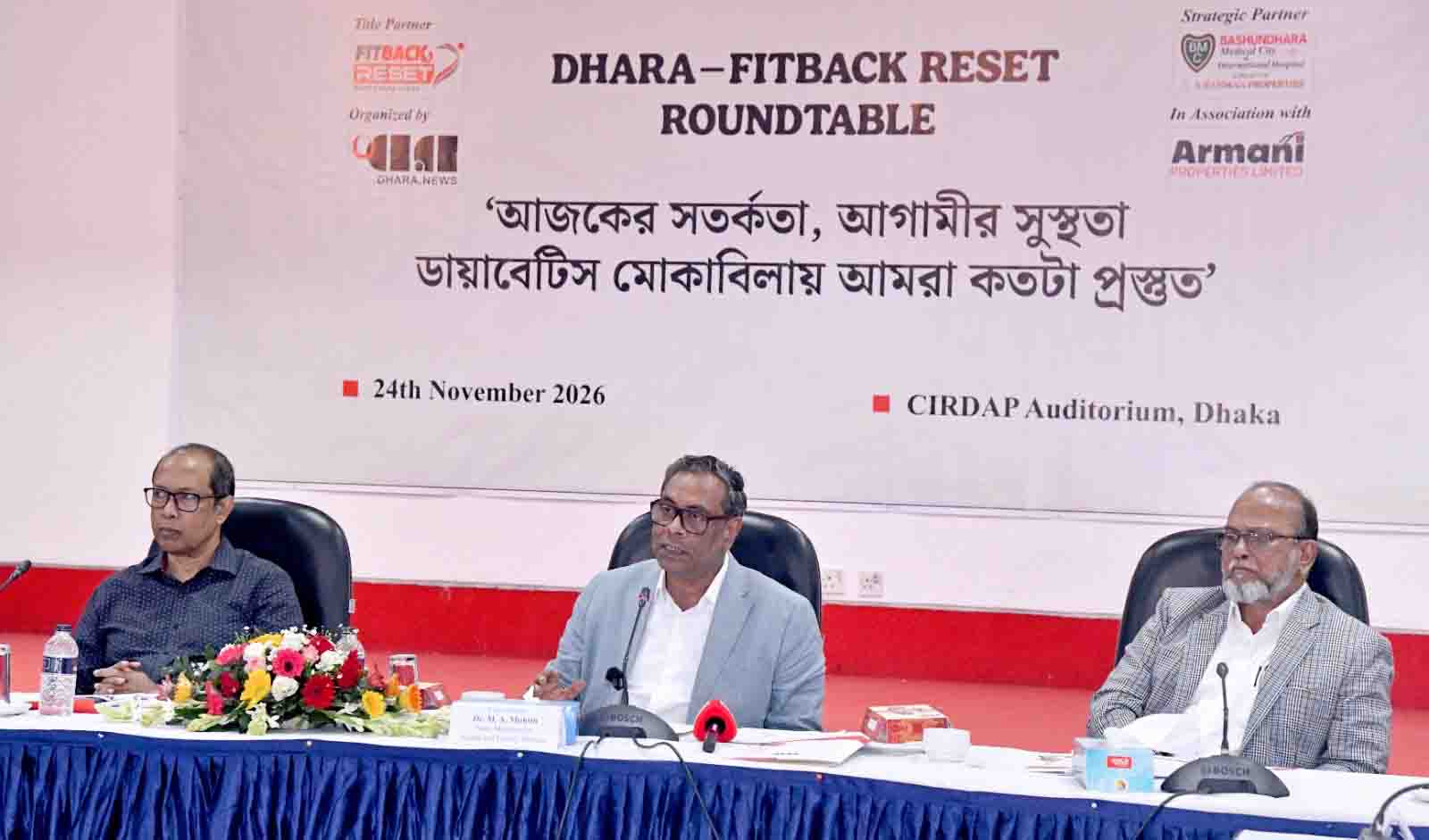
The state minister made the remarks while addressing a roundtable discussion on diabetes at the CIRDAP auditorium in the capital this morning, said a press release.
Food-focused multimedia platform Dhara News organised the event titled 'Dhara-Fitback Reset Roundtable'.
The event brought together health experts and other stakeholders to discuss the country's preparedness to address the growing disease burden.
Dr Muhit said around 1.39 crore people in Bangladesh are currently living with diabetes.
Without effective interventions, the number could nearly double to around 2.61 crore by 2050, he added.
Expressing concern over the extent of undiagnosed cases, the state minister said nearly 40 percent of people with diabetes are unaware of their condition, apprehending that the actual number of affected people can be close to 3 crore.
He said only 20 percent of diabetes patients have their condition under control, while the remaining 80 percent are either unable to manage the disease or not receiving treatment.
Dr Muhit said around 31,000 people die prematurely from diabetes in Bangladesh every year, accounting for five percent of all deaths among people aged 20 to 79.
Despite the growing burden, he said, the country has no specific national survey to establish the actual prevalence of diabetes or assess related complications, including blindness, kidney disease and nerve damage.
Emphasising evidence-based policymaking, the state minister said a comprehensive national survey following international standards is essential to collect accurate data and formulate appropriate policies.
Highlighting the government's approach to healthcare, Dr Muhit, also an international public health expert, said the government wants to move away from a treatment-centred healthcare system towards one focused on disease prevention and health protection.
"To achieve this, we are working through a multisectoral approach involving the ministries of Food, Agriculture, Industries, Commerce, Science and Technology and Education," he said.
Referring to the Prime Minister's initiatives, Dr Muhit said the premier himself is encouraging cleanliness, the development of playgrounds for children and the adoption of healthy lifestyles.
He said developing healthy eating habits and encouraging physical activity among children from an early age through school curricula and extracurricular activities could help protect future generations from non-communicable diseases such as diabetes and hypertension.
Outlining the ministry's future plans, the state minister said his ministry is going to launch an integrated pilot project in 20 to 25 selected upazilas across the country.
Under the initiative, the government will strengthen NCD corners and place special emphasis on community-level mental healthcare, counselling, specialised healthcare services for persons with disabilities and women's health, he added.
Dr Muhit also announced plans to establish specialised Women's Health Institutes in at least four divisional cities to provide integrated treatment for women's cancer, diabetes and kidney diseases.
Dhara News Editor Khairul Bashar Shamim moderated the event while Associate Professor of the Department of Endocrinology at Bangladesh Medical University (BMU) Dr Shahjada Selim presented the keynote paper.
Doctors Association of Bangladesh (DAB) President Professor Dr Harun Al Rashid, Professor of the Institute of Nutrition and Food Science at Dhaka University Dr Khaleda Islam, Professor of the Institute of Health Economics Dr Abdul Hamid, Associate Professor of Gynaecology and Obstetrics at Anwer Khan Modern Medical College Dr Sharmin Abbasi, Deputy Director of the Centre for Health Research and Implementation of the Bangladesh Diabetic Samity Dr Navid Ahmed, Chief Nutritionist of Fitback Reset Fahmida Hashem, and Health Editor of the Daily Kalbela Rashed Rabbi attended the event, among others.
