
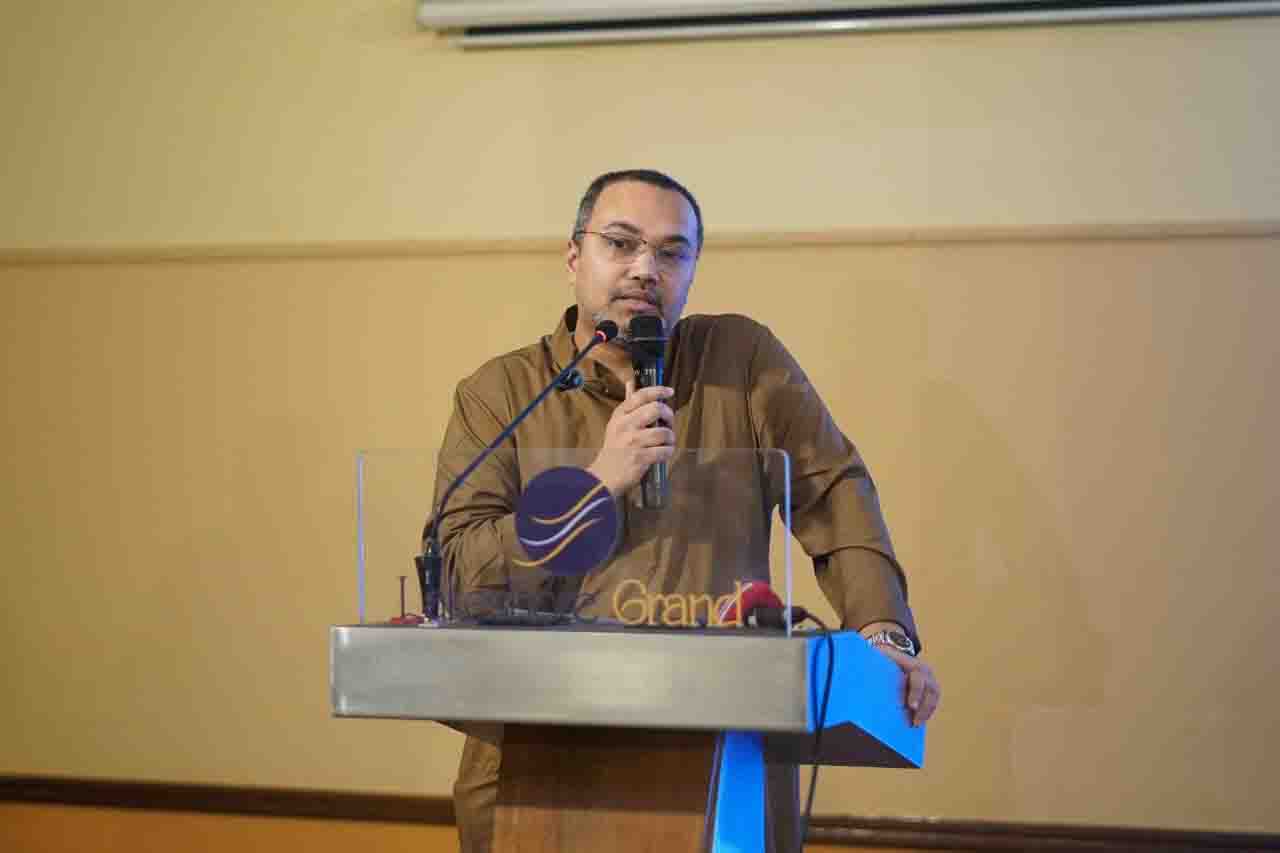
Mahdi Amin calls for coordinated efforts to eliminate child labour
Prime Minister's Adviser on Education and Primary and Mass Education Mahdi Amin today said child labour can be eliminated through proper policies and a coordinated social movement.
"The new government had been in office for nine months, having assumed responsibility amid complex circumstances, including the Middle East war and various global instabilities. However, as a government elected by the people's votes, its greatest strength was its utmost accountability and responsibility to the people," he said.
He made the remarks while addressing a programme as the chief guest at a city hotel.
The event was jointly organised by the Bangladesh Labour Foundation (BLF) and the International Labour Organization (ILO).
Mahdi Amin said the government was running the state on the basis of its election manifesto and the mandate received from the people. As the issues of eliminating child labour and protecting workers' rights were directly linked to the manifesto, the government was giving them the highest priority despite various limitations, he added.
The programme was titled "Inception of the Project: Reduction of Child Labour in the Informal Ready-Made Garment (RMG) Sector at Keraniganj Upazila of Dhaka District, Through a Holistic Approach".
Mahdi Amin said the five-year National Action Plan formulated to eliminate child labour has already made considerable progress, and its implementation will be ensured in a sustainable and practical manner with everyone's participation.
However, he said, child labour can't be completely eliminated through isolated initiatives confined to labour-intensive areas, as the issue is directly linked to the education system.
He said primary and secondary education is being revamped to ensure that no family is encouraged to send its children to work. Programmes to provide mid-day meals, school uniforms, jute-made school bags and shoes have been undertaken from the pre-primary level, he added.
He expressed the government's determination to extend these facilities to more than 10 million primary school students within its five-year tenure.
Mahdi said the number of scholarships and the amount of financial assistance provided through them have been substantially increased across the country. In line with the election manifesto, the government has also announced free education for girls up to the undergraduate level and work on implementing the initiative has already begun.
Referring to the introduction of free education for girls up to Class XII during the government of Begum Khaleda Zia, he said the initiative is now being extended to the undergraduate level. Besides, a policy is in place to ensure free education up to Class VIII, which will begin to be reflected from the next fiscal year.
Mentioning the Prime Minister's directives, he said investment should focus not merely on infrastructure development but also on areas whose benefits directly reach students. In line with a policy decision, efforts are underway to gradually raise the education budget to five percent of GDP.
He said when families see that sending their children to school brings financial support and education doesn't become a burden, they will naturally send them to schools instead of factories.
The Prime Minister's Office spokesperson called for developing an education-oriented ecosystem to ensure that school-age children remain in educational institutions rather than entering factories.
He stressed the need for a broader social movement to eliminate child labour, similar to the efforts to prevent child marriage, alongside enhancing teachers' skills to ensure the quality of education.
To remove the fear of unemployment after completing studies, he said, technical and vocational education is being made compulsory from Class VI. Technical education is also being ensured for all students in Classes IX and X so that the education system can be connected with real-life needs, he said.
Identifying family poverty and the lack of employment opportunities for parents as major causes of child labour, Mahdi Amin said employment opportunities have to be created through macroeconomic growth, attracting foreign investment and expanding industries to ensure the empowerment of parents.
He expressed optimism that a prosperous Bangladesh will be built by creating the necessary platforms and ecosystem to develop the creativity and talent of its young generation.
Former adviser to the caretaker government and Executive Director of Campaign for Popular Education (CAMPE) Rasheda K. Choudhury, human and women's rights activist Advocate Salma Ali, Head of International Partnerships of the European Union Delegation to Bangladesh Michal Krejza, Additional Secretary of the Ministry of Labour and Employment Abdur Rahim Khan, Director General of the Central Fund under the Ministry of Labour and Employment and National Project Director of the ADWIB project Abdus Samad Al Azad, Executive Director of the Bangladesh Institute of Labour Studies (BILS) Syed Sultan Uddin Ahmed, Labour and Workplace Relations Adviser to the Bangladesh Employers' Federation (BEF) Mahfuzur Rahman Bhuiyan, and President of the Somajtanthrik Sramik Front Rajequzzaman Ratan, among others, spoke at the programme.
