
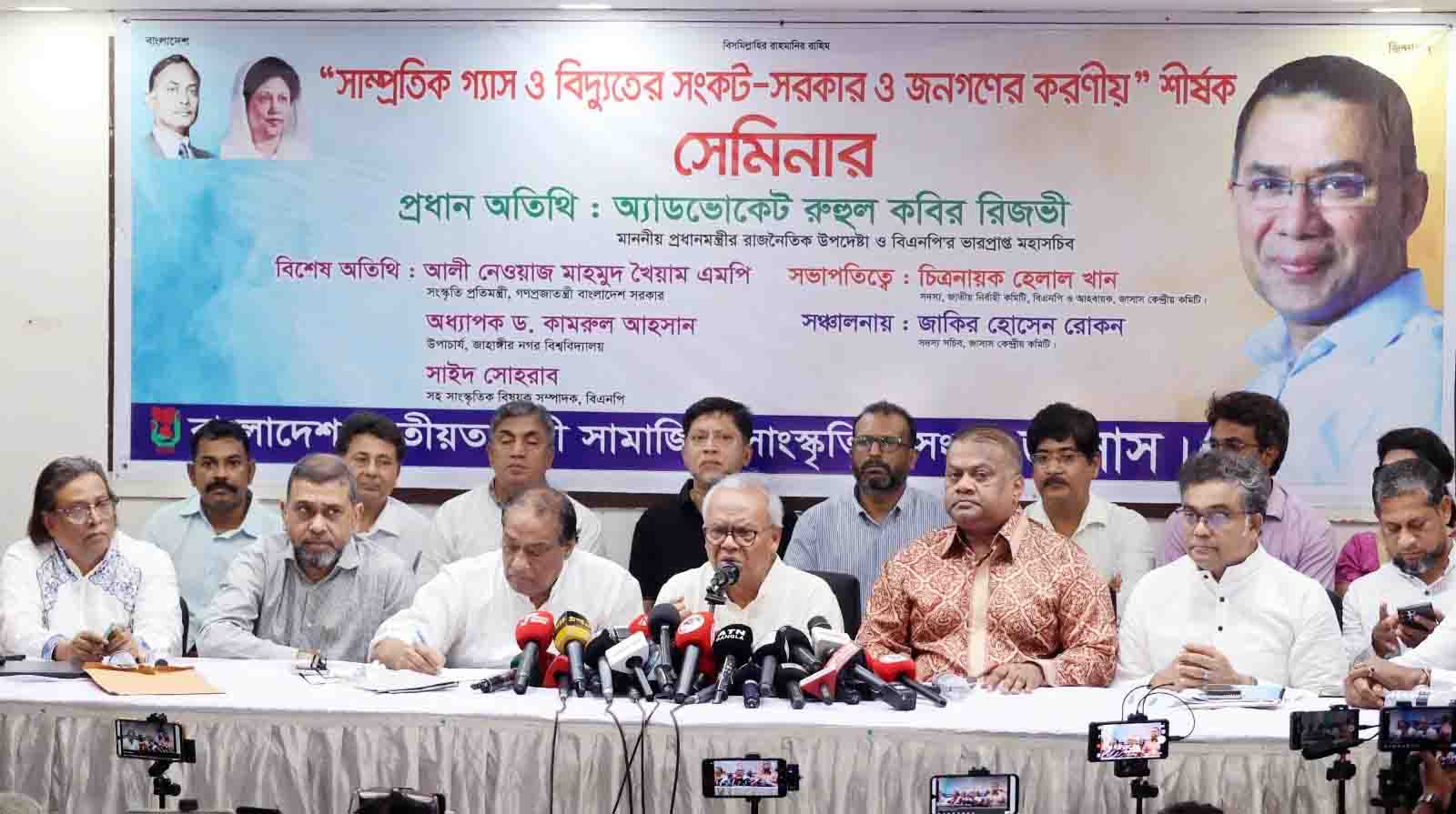
Rizvi urges strong institutions to safeguard sustainable democracy.
BNP Acting Secretary General and Prime Minister’s Political Adviser Ruhul Kabir Rizvi today said that every state institution must be given the opportunity to function effectively and independently to ensure sustainable democracy in the country.
“If institutions are not strong, democracy is repeatedly attacked, creating opportunities for fascism to come back,” he said while speaking as the chief guest at a seminar titled “The Recent Gas and Electricity Crisis: What the Government and the Public Should Do.”
The seminar was organised by the Bangladesh Jatiyatabadi Sanskrtik Sangstha (JASAS) at the National Press Club this afternoon.
Rizvi said, “Attempts to bypass the government’s own initiatives and activities, create chaos on the streets and confuse the public are unacceptable in any way. In a democratic system, the opposition has the right to criticize every action of the government. However, such criticism must be responsible.”
“Threats are being made to occupy the streets through various programmes, including ‘Long Marches.’ But to establish a true democratic system, it is necessary to play a responsible political role while showing respect for the achievements gained through a long history of struggle and sacrifice,” he added.
Rizvi further said that the people of the country have struggled for democracy both before and after independence. Following a series of movements and struggles spanning 17 years, the July Uprising created expectations of building a truly democratic system. In this context, the opposition must play a responsible role, and the government must also act responsibly.
He said, “The opposition has the right to criticize the government. If every action of the government is criticized, the government can understand its own mistakes and take necessary measures. This is a characteristic of a democratic government and a democratic society.”
Noting the weaknesses of the country’s institutions, Rizvi said that as the institutions are not strong, Bangladesh’s democracy has been repeatedly attacked, broken and undermined.
“If key state institutions, including the higher courts and the media, remain strong, it will not be possible to topple democracy and establish fascism,” he added.
Regarding the current energy crisis, he said, “Tarique Rahman’s government did not create this crisis. The current crisis is mainly caused by the global situation. The situation surrounding the Strait of Hormuz and the Persian Gulf due to global conflicts has disrupted energy supplies.”
He added, “The war between the US-Israel and Iran has complicated the situation in oil-producing countries in the Middle East. About 140 to 145 ships travel through the Strait of Hormuz into the Persian Gulf. Most of the ships carrying the LNG imported by Bangladesh also pass through this route. But the route is being disrupted by the war.”
The Acting Secretary General said the government is not sitting idle by only blaming past failures. Instead, it has allocated an additional Tk 40,000 crore outside the budget to expedite gas imports.
Additionally, arrangements are being made to bring gas from neighboring and nearby countries such as Myanmar, Malaysia and Indonesia, Rizvi said.
Mentioning the technical glitch at the Maheshkhali gas terminal, he said that a problem had occurred there and it was taking time to repair. The current situation has resulted from the global war on the one hand and a technical glitch at the country’s gas terminal on the other.
He said many of the activities in the power sector over the past 17 years are questionable in the eyes of the people.
“Even though power plants were set up in the private sector and could not generate electricity, payments still had to be made to the plants. This resulted in a massive outflow of money from the state treasury,” Rizvi said.
Emphasizing the need to fulfill social responsibility by conserving electricity in the current situation, he said the government is doing whatever it can. Beyond that, the public must also be conscious of their electricity usage. Various ways of saving electricity should be followed in accordance with the advice of experts and engineers.
State Minister for Cultural Affairs Ali Newaz Mahmud Khaiyam and Jahangirnagar University Vice-Chancellor Prof Dr Mohammad Kamrul Ahsan spoke as special guests at the seminar.
