
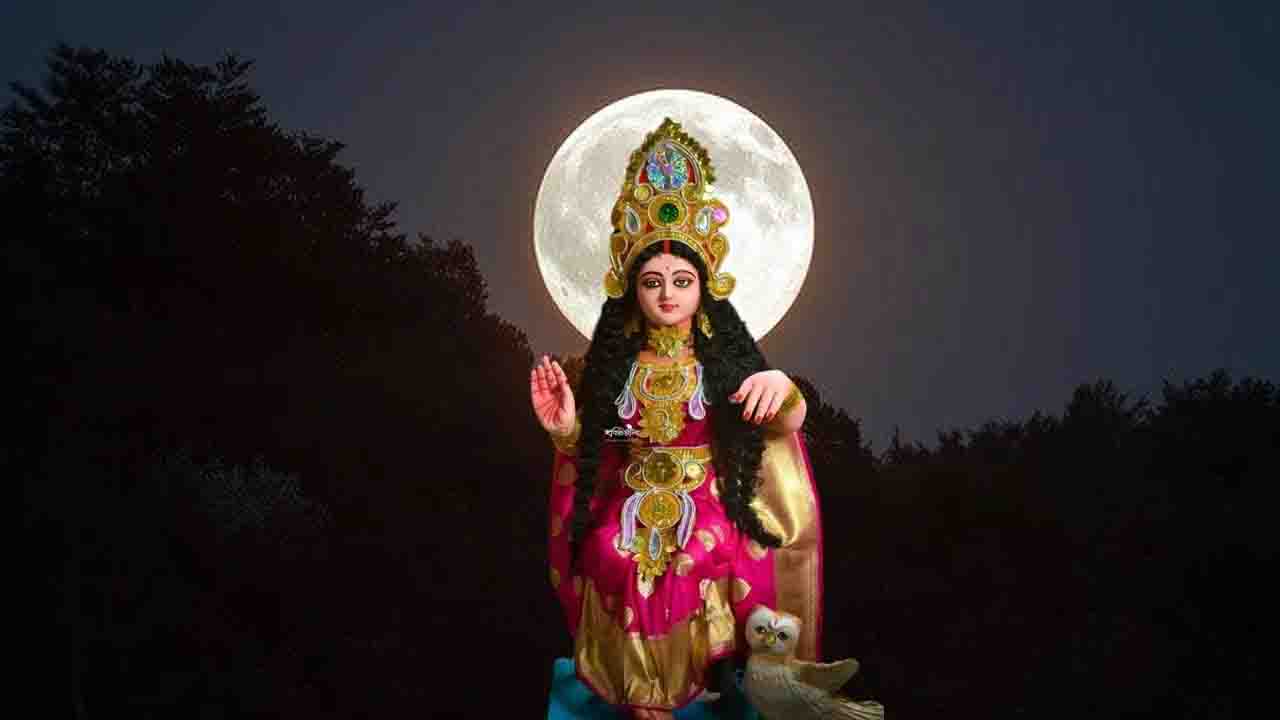
Hindus celebrate Lakshmi Puja nationwide with religious fervour
Lakshmi Puja was celebrated today with due religious fervour and enthusiasm as it took place on the first full-moon night after the end of Sharadiya Durga Puja, the largest religious festival of the country's Hindu community.
This full-moon night is also called Kojagari Purnima, and that is why this festival is also known as Kojagari Lakshmi Puja.
Marking the festival, courtyards were adorned with mangalghat (a sacred pot) and sheaves of paddy, alongside alpona (traditional decorative patterns) made from rice flour, which often depict the footprints of Goddess Lakshmi. Women observed a fast.
It is customary to stay awake throughout the night during the puja.
According to the Vishuddha Siddhanta Panjika (the authoritative Hindu almanac), tithi of the puja (lunar day of the full moon) began at 11:55am today and conclude at 9:41am tomorrow.
Various rituals including worshipping of Goddess Lakshmi, offering of anjali, prasad distribution and recitation from Lakshmi Panchali were held in the evening at temples and residences of the Hindu community across the country.
In addition to the religious rituals, alpona patterns specifically the footprints of Goddess Lakshmi were drawn in the courtyards of homes as per the tradition.
In Bengali society, there are various popular tales centered about the Goddess Lakshmi. These stories, composed in the form of Panchali (narrative verses), are recited on the day of the Puja; this practice is known as 'Lakshmi'r Panchali'.
Essential items for Lakshmi Puja include vermilion (sindoor), a consecrated pot (ghat), unhusked rice (dhan), earth, mango leaves, flowers, durva grass, tulsi leaves, haritaki (myrobalan), sandalwood, incense, diya (lamps), naivedya (offerings of food), atap rice (sun-dried rice) and water.
The term 'Kojagari' is derived from the question, "Who is awake?" According to the scriptures, Goddess Lakshmi visits every home on this night. If the doors of a house are closed and the residents are asleep, she turns back.
For this reason, the observance is known as 'Kojagari' Lakshmi Puja and there is a tradition of keeping an all-night vigil. Goddess Lakshmi is worshipped in the homes of Bengali Hindus, many families also perform a ritual worship of the Goddess every Thursday.
Dedicated to Goddess Lakshmi, the Hindu deity of wealth and prosperity, the word Kojagari comes from "Ko Jagarti" ("Who is awake?"), based on the belief that Lakshmi roams the earth at night blessing those who stay awake in devotion.
According to Hindu tradition and cultural folklore, Kojagari Purnima (also known as Sharad Purnima) is traditionally celebrated as the brightest and most auspicious full moon of the year.
The Hindus believe that Goddess Lakshmi arrives to receive worship on the night of Purnima to give blessings of prosperity. In this belief, Bengali Hindus perform Lakshmi Puja in each of their houses.
According to the scriptures, Goddess Lakshmi is the embodiment of wealth and prosperity. She is revered as the deity of progress, light, knowledge, good fortune, fertility, generosity, courage and beauty truly the Goddess of Opulence.
The owl is the Bahan (divine vehicle) of Goddess Lakshmi. When Lord Vishnu incarnated as Rama and Krishna, Lakshmi accompanied him as Sita and Radha, respectively. On the night of Kojagari Purnima, it is believed that the Goddess Lakshmi visits the homes of her devotees to bless them with abundance and prosperity.
Since ancient times, everyone from kings and monarchs to merchants and ordinary householders has worshipped Goddess Lakshmi.
