
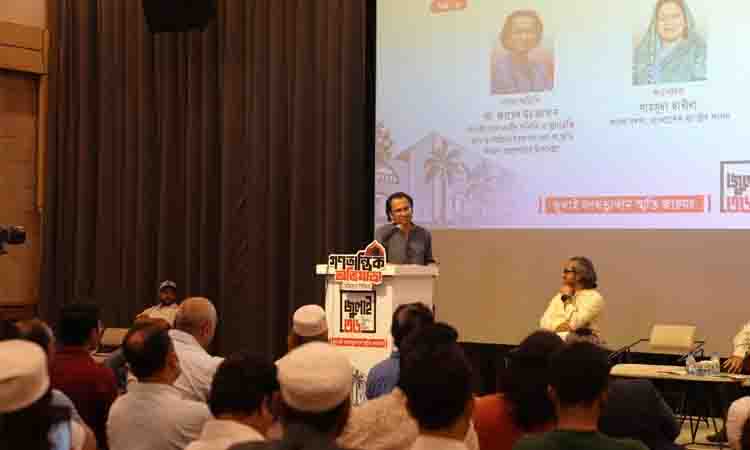
Zahed Ur Rahman accuses AL of rigging 1973 election.
Prime Minister's Adviser on Information and Broadcasting Dr Zahed Ur Rahman today said undermining the electoral system deprives ordinary citizens of their democratic rights and leaves them with nowhere to turn.
He said the country's electoral system was undermined in the first general election in 1973 through vote rigging by the then ruling Awami League, despite Sheikh Mujibur Rahman's immense contributions to the Pakistan movement and the Liberation War.
He made the remarks while addressing a discussion titled "The 1973 Election: The Genesis of AL's Vote-Rigging Model" at the July Uprising Memorial Museum.
The discussion was organized as the third episode of the museum's Democratic Journey Seminar Series.
"Sheikh Mujibur Rahman had virtually no chance of losing the 1973 election, yet he rigged the votes," Zahed Ur Rahman said.
He said Sheikh Hasina knew she would lose a fair election against the opposition, prompting her to manipulate elections to retain power. In contrast, Sheikh Mujib undermined the country's first election despite being certain of his victory.
"Although Sheikh Mujibur Rahman contributed immensely from the Pakistan movement to the Liberation War, he destroyed Bangladesh's democratic practice through electoral fraud in the first general election," he said.
Referring to criticism of the BNP for allegedly focusing solely on elections, Dr Zahed said such arguments were often made to deny ordinary citizens their voting rights.
"Many criticize the BNP, alleging that it focuses solely on elections. In reality, such claims are made to deny the voting rights of the general public," he added.
Member of Parliament Mahmuda Habiba, who attended the seminar as a panelist, said Sheikh Mujib could have easily formed the government after the 1973 election given his popularity.
She said the Awami League had monopolized the history of sacrifices, bloodshed and struggles of millions during the Liberation War.
Freedom Fighter Abu Sayeed Khan said there were rumours after the Liberation War that Sheikh Mujibur Rahman would act as the guardian of the nation without engaging in active politics.
"Later, we saw him return, remove Tajuddin Ahmad and head the government. He subsequently led the drafting of the Constitution. The first test of that Constitution was the national election, which turned out to be a single-party contest," he said.
Presiding over the discussion, July Uprising Memorial Museum Director General Ehasan Mahamud said the museum provides a platform for diverse voices to be heard and decisions to be reached through consensus.
"This is the core strength of July. Through this ongoing series, we aim to look back. If we forget the past, our path forward and our destination will remain unclear," he said.
Describing the period from 1972 to 1975 as a dark era, he said media outlets were shut down under state directives.
"In an era of social media, it is unimaginable that the country had only one television channel and four daily newspapers, all state-controlled. News published in the evening was prescribed by the government," he said.
The discussion was moderated by author and researcher Tuhin Khan. University teachers, researchers, lawyers, students and civil society representatives attended the event.
The fourth episode of the seminar series, titled "A Comparative Review of Bangladesh's Foreign Policy in the First Decade Post-Independence," will be held tomorrow at 3:00 pm at the Monsoon Theatre of the July Uprising Memorial Museum.
