
Diplomats welcome Cyber Security Act provisions, suggest improvements
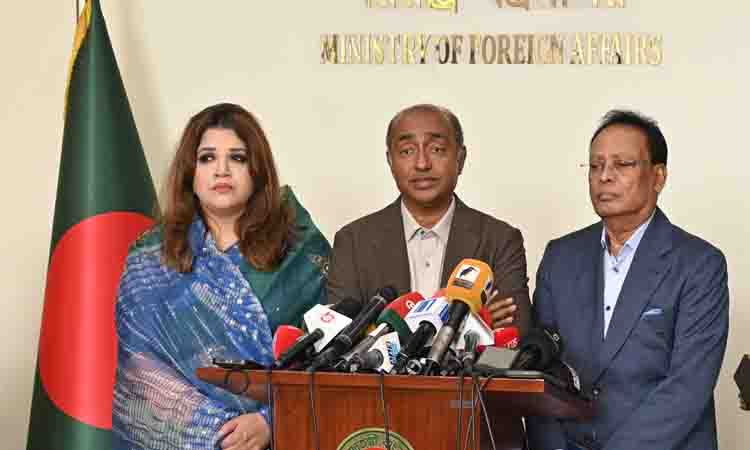
Diplomats and development partners have appreciated several provisions of the proposed Cyber Security (Amendment) Act, 2026 aimed at protecting citizens' rights while offering recommendations for improving other provisions, Law Minister Md Asaduzzaman said today.
The minister made the remarks while speaking to journalists following a consultation with diplomats, United Nations agencies and development partners at the Ministry of Foreign Affairs here.
"Of course, they appreciated several provisions of the proposed law. They also made one or two recommendations, which we immediately took note of," he said.
Asaduzzaman said the participants had been given the draft amendments seven to ten days ahead of the consultation to allow them sufficient time to examine the proposals and prepare their observations.
"The document under discussion today was provided to them about seven to ten days before the consultation so that they could study it and come prepared. And they did come prepared," he said.
The law minister said today’s participants have expressed appreciation for the government's initiatives to safeguard citizens' rights while identifying provisions requiring further consideration.
He said the government had invited diplomats and development partners to submit additional written recommendations within one week, assuring them that their observations would be carefully examined before the draft was finalised.
Explaining the rationale behind the consultation process, Asaduzzaman said the government wanted to hear objections and address legitimate concerns before placing the proposed legislation before Parliament.
"Consultations are being held precisely because there are objections. We have initiated this process because we want to hear those objections," he said.
The minister said Prime Minister Tarique Rahman had referred the proposed amendments back from the cabinet for wider consultations, considering their implications for freedom of expression and freedom of speech.
He said discussions had already been held with newspaper editors and journalists, while further consultations would take place with civil society organisations and the business community.
The day's consultation was held in coordination with the United Nations Development Programme (UNDP) to gather views on the proposed amendments and ensure consistency with international good practices.
Posts, Telecommunications and Information Technology Minister Faqir Mahbub Anam chaired the meeting, while Law Minister Asaduzzaman attended as chief guest.
State Minister for Foreign Affairs Shama Obaed Islam and Adviser to the Prime Minister on Posts, Telecommunications and Information Technology Rehan Asif Asad attended as special guests.
Responding to questions about possible restrictions on independent journalism and freedom of expression, Asaduzzaman said the government would remain within the constitutional and international legal frameworks governing fundamental rights.
He referred to Article 19(3) of the International Covenant on Civil and Political Rights (ICCPR) and Article 39 of Bangladesh's Constitution, saying the provisions permitted restrictions on freedom of expression under specified conditions.
"We are not doing anything beyond those provisions, and we will not do so," he said.
Asked about concerns over provisions empowering authorities to order the removal of online content or take action against organisations, the minister said such decisions would be subject to judicial review.
"The power has not been left unrestricted," he said, urging concerned stakeholders to submit specific recommendations to the ICT Ministry for consideration.
Asaduzzaman also acknowledged concerns over ambiguity in legislative language, saying the government was working to make definitions clearer and eliminate provisions that could create confusion.
"The issue is not simply about providing more elaborate explanations. The real objective is to ensure clarity and eliminate ambiguity," he said.
Addressing the consultation, State Minister for Foreign Affairs Shama Obaed Islam said an effective cyber security law must protect citizens, institutions and critical infrastructure while upholding fundamental rights.
She said digital technology was transforming education, employment, business and public services, creating significant opportunities for Bangladesh.
However, she cautioned that online fraud, cyber attacks on critical systems, misuse of personal data and harmful content posed growing challenges requiring an effective legal framework.
Shama emphasised that cyber security and fundamental rights should reinforce each other, with public trust remaining central to the effective implementation of the law.
She also highlighted the importance of international cooperation in information-sharing, mutual legal assistance and tackling cross-border cyber threats with appropriate safeguards.
Welcoming the observations of development partners, she expressed confidence that their recommendations would receive careful consideration as the government moved towards finalising the amendments.
