
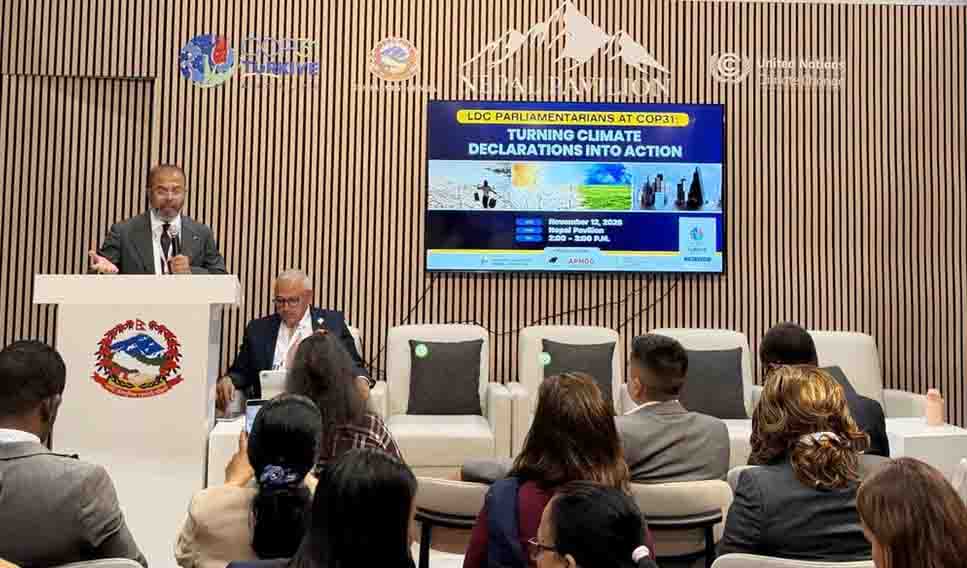
Faridul urges climate action, adequate financing for LDCs at COP31
State Minister for Environment, Forest and Climate Change Shaikh Faridul Islam has called for effective action and adequate financing to ensure the implementation of international climate commitments.
He said declarations and commitments made at international climate conferences must be translated into concrete and effective actions.
In particular, adequate, predictable and accessible climate financing must be ensured for Least Developed Countries (LDCs) and climate-vulnerable nations. Countries bearing greater historical responsibility for the climate crisis must play a more proactive role in fulfilling their international obligations.
The State Minister made the remarks yesterday while addressing a meeting titled "LDC Parliamentarians at COP31: Turning Climate Declarations into Action" at the Nepal Pavilion in the Blue Zone of the 31st Conference of the Parties (COP31) to the United Nations Framework Convention on Climate Change (UNFCCC).
At the meeting, he emphasised climate justice, climate finance and the implementation of the Dili Declaration.
Faridul Islam said that although LDCs, including Bangladesh, contribute relatively little to global greenhouse gas emissions, they are disproportionately affected by the adverse impacts of climate change.
Cyclones, floods, droughts, sea-level rise, salinity intrusion and other climate-induced disasters are threatening food security, livelihoods, agriculture, infrastructure and sustainable development in these countries.
In this context, he said, strengthening international cooperation is essential to ensure climate justice and protect vulnerable communities.
He said the 2026 LDC Dili Ministerial Declaration on Climate Change provides an important foundation for advancing the common interests and priorities of Least Developed Countries in international climate negotiations.
To translate the objectives of the Declaration into action, parliamentarians must play an active role not only in international discussions but also through national legislation, policy reforms, budgetary allocations, accountability mechanisms and effective oversight, he added.
The State Minister further emphasised that climate finance must be consistent with the international commitments of developed countries.
Grant-based and accessible financing must be increased to support climate adaptation, mitigation and efforts to address loss and damage.
Climate finance mechanisms should be made more transparent, equitable and effective without imposing additional debt burdens on climate-vulnerable countries.
At the same time, international support must be strengthened for technology transfer, capacity building and initiatives aimed at enhancing climate resilience at the local level.
He noted that reducing dependence on fossil fuels and transitioning towards a future based on clean and renewable energy are essential for achieving global climate goals.
However, he said, this transition must be just, inclusive and aligned with the development needs and energy security priorities of LDCs.
Developed countries must take the lead in this transition while ensuring adequate financial and technological support for developing countries.
Highlighting the role of parliamentarians, the State Minister said national parliaments could play a significant role in implementing international climate commitments.
Parliamentary cooperation must be strengthened to formulate climate-responsive laws and policies, ensure effective oversight of public expenditure, promote transparency in climate finance and safeguard the interests of marginalised communities.
He stressed the need for greater exchange of experiences and coordinated initiatives among parliamentarians from different countries.
He further said all stakeholders must work to ensure that discussions and decisions at COP31 reflect the actual needs and priorities of Least Developed Countries.
In addressing climate change, implementation matters more than declarations, concrete actions matter more than commitments, and the actual availability of climate finance matters more than financial pledges, he observed.
The meeting, organised by the Parliamentarians for a Fossil-Free Future network, brought together climate negotiators from LDCs and parliamentarians from different countries.
Moderated by Arjun Karki, a Member of Parliament from Nepal, the meeting featured discussions involving Gita Chaudhary, Nepal's Minister for Agriculture, Forest and Environment; Cielo Krisel Lagman, a Member of Parliament from the Philippines and Asia Steering Committee Member of the Parliamentarians for a Fossil-Free Future network; Augusto Manuel Pinto, UNFCCC Focal Point of Timor-Leste; and Carlos Concei ao, Director of Environment and Climate Change of Timor-Leste.
The meeting focused on the key priorities and demands of the 2026 Dili Ministerial Declaration on Climate Change, climate finance, and the role of parliamentarians in safeguarding the interests of LDCs during COP31 and beyond.
Representatives from different countries also exchanged views on strengthening mutual cooperation and sharing experiences.
