
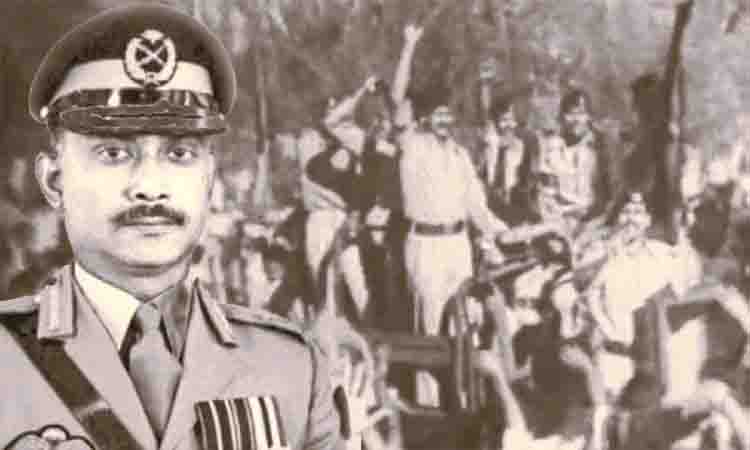
7 November Revolution hailed as turning point in Bangladesh's history.
In the course of history, certain remarkable days emerge that forever alter the destiny of a people. Their significance is not confined to a temporary change of power or a single political event; rather, they carry far-reaching and epoch-making implications. Following the historic Declaration of Independence on 26 March 1971 and the final victory on 16 December of that year, 7 November 1975 was such a unique moment—one that saved the territorial integrity, existence and national dignity of independent Bangladesh from a profound crisis.
On that day, an unprecedented and spontaneous revolution by people from all walks of life, together with patriotic sepoys secured the release of then Major General Ziaur Rahman from captivity.
Ziaur Rahman had, in essence, become the focal point of the hopes and aspirations, affection and deep trust of ordinary people across the country. He was not merely a seasoned military leader; he had also become a symbol of the nation's sovereignty. In the face of his ardent patriotism, prudence, exceptional courage and firm foresight, all attempts to destroy the country crumbled in an instant.
The roots of this trust lay in that blood-soaked night of 1971. When the political leadership had failed to provide direction and a bewildered nation was plunged into profound darkness, Major Ziaur Rahman emerged from the Kalurghat Radio Station as the nation's saviour.
At the risk of certain death, he made the historic Declaration of Independence. It was the call of his resolute voice that inspired a directionless nation to plunge into the Liberation War. He did not stop at reading out the declaration; as commander of Z Force and a sector commander, he led troops in direct combat on the battlefield and set an unprecedented example of bravery. Had Ziaur Rahman not declared independence that day, our struggle for freedom might have been far more protracted.
After independence had been achieved through the Liberation War, one-party BAKSAL rule was established, stripping people of freedom of expression and the press. As boundless anarchy prevailed all around and the country faced the grave threat of losing its sovereignty,
November 1975 arrived. As part of a domestic and foreign conspiracy, a group of conspirators placed Ziaur Rahman under house arrest on 3 November. But they had forgotten how deep the spiritual bond was between Ziaur Rahman and the ordinary sepoys and people of the country.
At midnight on 6 November, ordinary soldiers and freedom-seeking people broke through the walls of the cantonment and took to the streets. The bloodless Revolution of 7 November swept away all the conspirators' attempts and secured Ziaur Rahman's release. The sepoys, the people and every freedom-loving citizen of the country placed their trust in Ziaur Rahman, the Proclaimer of Independence.
National Identity and the Miraculous Rebirth of Bangladesh
Under Ziaur Rahman's timeless leadership, a battered Bangladesh experienced a miraculous rebirth. In the course of time, he raised the nation above narrow-mindedness and brought it together at an unprecedented confluence of national unity. Ending the divisive system imposed after independence, he introduced ‘Bangladeshi nationalism’.
This was not merely a conceptual political phrase; rather, it was a universal philosophy for bringing every citizen of this land under one flag, irrespective of whether they lived in the hills or the plains, and regardless of ethnicity, religion, race, opinion, path or ideology. It is through this philosophy that a member of an ethnic minority community in the hills can also say, with equal civic dignity, “I am Bangladeshi”.
Establishment of Multiparty Democracy
Ziaur Rahman established multiparty democracy. By lifting the black laws and repressive restrictions imposed on newspapers that had been shut down, he ensured full freedom for the media. The far-reaching structural reforms he initiated to ensure equality, human dignity and social justice were epoch-making. In the shortest possible time, he took numerous welfare-oriented measures to establish the fundamental rights of every citizen at every level of society and the economy.
Laying the Foundations of the Economy and Establishing a Self-Reliant and Functioning State on the World Stage
Ziaur Rahman's exceptional statesmanlike administrative foresight freed Bangladesh from the stigma of being a ‘bottomless basket’ and established it on the world stage as a self-reliant and functioning state.
To lay the foundations of institutional structures, he revitalised the civil service and introduced revolutionary reforms to combat corruption and ensure good governance. To take administration beyond bureaucratic whims and bring it to the doorsteps of the people, he ensured grassroots empowerment through the Gram Sarkar and the Village Defence Party. Through the far-sighted plans of the Rural Electrification Board, the neglected villages of Bengal began their transition from the light of traditional lamps to modern electricity facilities.
The two principal driving forces of today's modern Bangladeshi economy both had their strong foundations laid under the leadership of Shaheed President Ziaur Rahman. The first was the ready-made garment (RMG) industry, which today provides livelihoods for millions of people and serves as a major source of foreign exchange earnings.
Through the formulation of the back-to-back letter of credit system and the provision of bonded warehouse facilities, he opened the highway for private enterprise. The second was the export of manpower to the global labour market, particularly the Middle East, which turned our vast demographic dividend into an asset and opened the way for building foreign exchange reserves.
To strengthen the economic foundations of an agrarian Bangladesh, Ziaur Rahman launched the historic ‘Canal Excavation Programme’. Taking millions of people with him, he personally took up a spade to modernise waterways and irrigation systems. He launched the groundbreaking ‘Green Revolution’, through which farmers, receiving fertiliser and seeds on easy terms, succeeded in the struggle to make the country self-sufficient in food.
By ensuring land reforms and access to agricultural credit, he placed farmers at the centre of the modern production system. Alongside this, he initiated a wide-ranging ‘Nationwide Tree Plantation Programme’ to maintain environmental balance and protect the ecosystem.
Commendable Initiatives in Every Fundamental and Institutional Sector
The foresight of Shaheed Ziaur Rahman extended to every fundamental and institutional sector. To build a well-educated and enlightened nation, he introduced a wide-ranging ‘Primary and Mass Education Programme’. To accelerate higher education and scientific research in the country, he overhauled the Bangladesh Council of Scientific and Industrial Research (BCSIR) and various research institutes.
In the cultural sphere, he introduced honours such as the Ekushey Padak and National Film Awards to explore the roots of the country's own heritage. He established separate ministries for women and youth to bring disadvantaged women into the mainstream of state and society and to harness the immense potential of young people.
To help children and adolescents realise their latent talents, he established the Shishu Academy, children's parks and the nationwide talent-search programme ‘Notun Kuri’. He incorporated into the Constitution a reflection of the spiritual and religious values of millions of people in this country, while giving firm institutional shape to the religious freedom and coexistence of people of all faiths.
During his brief four-year tenure in state leadership, Shaheed President Ziaur Rahman had taken Bangladesh forward by at least four decades. Giving priority to religious values in a country with a Muslim majority, he incorporated ‘Bismillahir Rahmanir Rahim’ into the Constitution and introduced ‘absolute trust and faith in Almighty Allah’.
On the international stage, he broke down the barriers of a one-sided and subservient foreign policy and established a self-respecting, sovereign and balanced foreign policy. Alongside building historic bonds of brotherhood with the Muslim Ummah and the Organisation of Islamic Cooperation (OIC), he secured a strong position for Bangladesh in the Non-Aligned Movement and the United Nations Security Council.
The blueprint for SAARC, an enduring and unique forum for regional peace, stability and economic cooperation in South Asia, was also a product of his political wisdom.
A Glorious Legacy: Begum Khaleda Zia and the Restoration of Parliamentary Democracy
Carrying forward that glorious legacy, Begum Khaleda Zia, the nation's leader, assumed office as Bangladesh's first woman Prime Minister following the democratic movement of 1991, with a mandate from the people. She provided historic leadership in restoring parliamentary democracy in the country.
During her three terms in office, former Prime Minister Begum Khaleda Zia introduced free-market economic reforms and brought about a quiet revolution in women's empowerment by introducing compulsory primary education and free education and stipends for girls. She also made historic contributions by dissolving the National Parliament and incorporating the non-party caretaker government system into the Constitution, as well as advancing women's empowerment and rural infrastructure development.
BNP Emerges as the Standard-Bearer of Democracy
In the cruel irony of history, this land has repeatedly faced the onslaught of fascism. Yet, on every occasion, the BNP, founded by Shaheed President Ziaur Rahman, has stood as the standard-bearer of democracy. Just as democracy was restored through the BNP after the darkness of BAKSAL, the sun of democracy also rose under the BNP's leadership following the fall of autocracy.
Following the end of a prolonged and gruelling period of fascist rule, against the blood-soaked backdrop of the July Mass Uprising of 2024, the current BNP Chairman and national leader Tarique Rahman has once again assumed responsibility for governing the country with an overwhelming mandate from the people.
A New Bangladesh under the Far-Sighted Leadership of Prime Minister Tarique Rahman
Under the far-sighted leadership of Prime Minister Tarique R Rahman, head of a government elected by the people's votes with overwhelming public support, Bangladesh has once again returned to the democratic mainstream.
The present government of the working people is firmly committed to ensuring equality, human dignity, self-reliance and justice for citizens. Specific and far-reaching action plans have been adopted to empower every social class, profession and marginalised community. The timely initiatives he has taken, including the Family Card, Farmer Card and modern employment opportunities for young people, represent a modern and digital version of Shaheed Ziaur Rahman's 19-point development philosophy.
Shaheed President Ziaur Rahman may no longer be physically among us, but his ideals, patriotism and the spirit of national solidarity embodied by 7 November remain eternally alive in the hearts of millions of patriotic people. Just as the sepoys and the people united to defend the country's sovereignty by tearing apart the web of domestic and foreign conspiracies, we must unite today with that same spirit of solidarity.
Let us, through firm unity, dedicate ourselves to building, under the leadership of the Honourable Prime Minister Tarique Rahman, a self-reliant, prosperous and accountable Bangladesh—one that will once again stand tall on the world map and firmly secure its rightful place of dignity.
The author is an Adviser to the Honourable Prime Minister and Spokesperson of the Prime Minister's Office.
(The article was originally written in Bengali and translated into English by Harun Al Nasif, City Editor, BSS.)
