
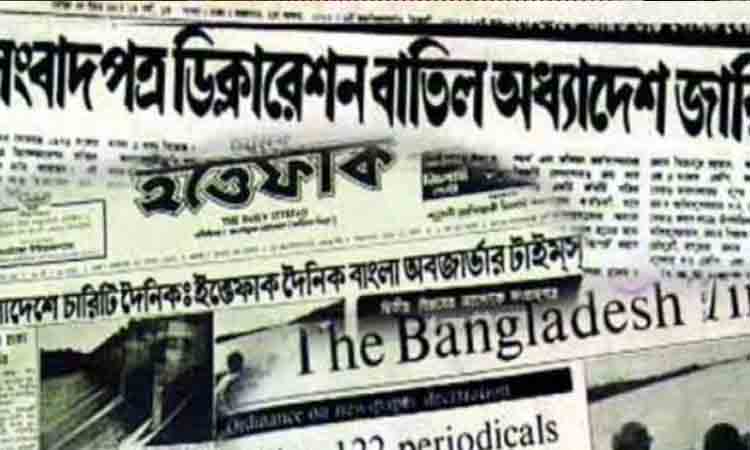
Journalists observe Newspaper Black Day marking press crackdown.
une 16 is marked what the journalists describe as a black day in Bangladesh’s history, commemorating the closure of most newspapers by the then BAKSAL government led by Sheikh Mujibur Rahman in 1975, which they say curtailed press freedom and left thousands of media workers unemployed.
According to a statement, on this day in 1975, the government retained only four newspapers under state management and shut down all others. As a result, thousands of journalists and media workers reportedly lost their jobs overnight and were forced into severe hardship.
The statement said people were deprived of access to accurate information and objective news, while freedom of expression in the media, politics, groups and among individuals was restricted.
Since 1976, the Bangladesh Federal Union of Journalists (BFUJ), the Dhaka Union of Journalists (DUJ), various political parties, social organisations and professional bodies have been observing the day as ‘Newspaper Black Day’ in protest against what they describe as the repressive ordinance issued by the BAKSAL government.
To mark the occasion, BFUJ and DUJ will jointly organise a discussion at 10:30am tomorrow at the Tofazzal Hossain Manik Mia Hall at the Jatiya Press Club.
The statement said Local Government, Rural Development and Cooperatives Minister Mirza Fakhrul Islam Alamgir will attend the programme as the chief guest, while Information and Broadcasting Minister Zahir Uddin Swapan will be present as the special guest.
Journalist leaders, representatives of civil society and prominent intellectuals are also expected to attend the event.
In a joint statement issued today, BFUJ President Obaidur Rahman Shaheen, Secretary General Kader Gani Chowdhury, DUJ President Md Shahidul Islam and Acting General Secretary Didarul Alam said the fourth amendment to the Constitution was introduced in parliament three years after the country's independence.
They said the amendment, which they described as being contrary to democratic values, led to the establishment of the one-party BAKSAL system. As a continuation of that process, the government closed all newspapers on June 16, 1975, while four publications continued under state management as government mouthpieces.
According to the statement, several thousand journalists and media employees became unemployed as a result, making the day a black chapter in the country's history regarding press freedom and freedom of expression. Journalists continue to observe the day annually as a ‘Black Day’ in condemnation of those actions, it added.
The leaders said that Shaheed President Ziaur Rahman assumed state power following what they termed the Sepoy-People's Revolution of November 1975.
They said he restored multi-party democracy through constitutional changes, repealed what they described as undemocratic provisions introduced under the BAKSAL government, and re-established freedom of the press.
Expressing concern, the journalist leaders alleged that whenever the Awami League comes to power, it targets the media first. They claimed that after returning to office in 2009, the party followed a similar path by shutting down numerous newspapers, private television channels and online news portals over the subsequent 16 years, leaving thousands of journalists unemployed.
They also alleged that journalists and media organisations were compelled to surrender under government pressure, making objective and truthful journalism increasingly difficult and placing journalists' livelihoods under severe threat.
The statement said that after assuming responsibility for running the state following the November 7, 1975 events, Ziaur Rahman ensured unrestricted freedom for journalists to write and express opinions.
It added that he first relaxed legal restrictions on newspaper publication and encouraged the publication of newspapers across the country. According to the statement, he believed it was the government's responsibility to help sustain newspapers.
The leaders said Ziaur Rahman facilitated the publication of a first-class newspaper, "The Dainik Barta", from Rajshahi, which they claimed brought about a revolution in information flow across the northern region and created employment opportunities for many journalists.
They said that due to the relaxation of declaration requirements, daily, weekly, fortnightly and monthly newspapers began to be published not only from Dhaka but also from divisional headquarters, districts and even upazila-level areas.
According to the statement, Ziaur Rahman also liberalised the policy governing the distribution of government advertisements to help sustain newspapers. The allocation of advertisements from government, semi-government and autonomous institutions was decentralised, while 60 percent of government advertisements were distributed to newspapers published in Dhaka and the remaining 40 percent to those published outside the capital.
The leaders said these measures created renewed momentum in newspaper publication throughout the country.
