
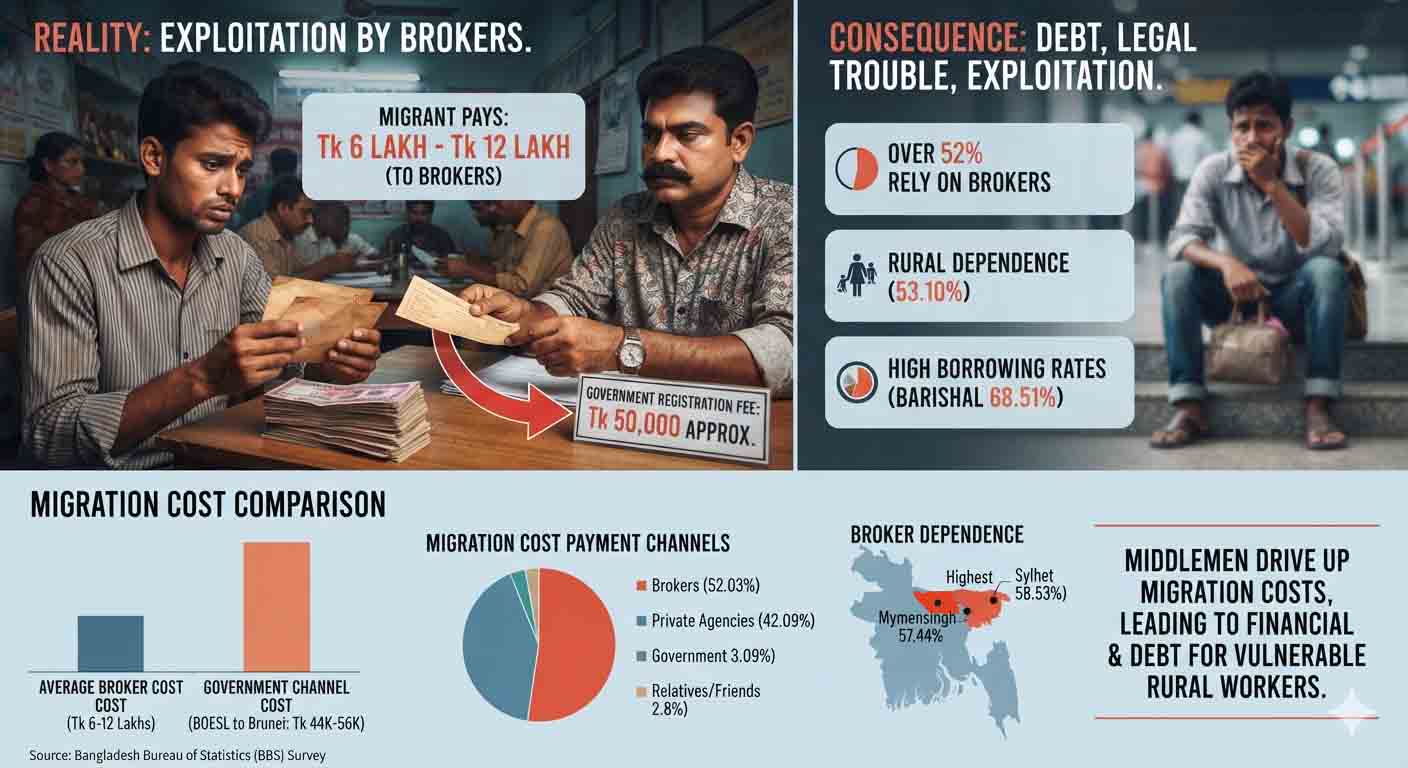
Surging Costs: Over 52% Bangladeshi Migrants Pay Extra to Middlemen
More than 52% of Bangladeshi migrant workers paid brokers to arrange overseas jobs, according to a Bangladesh Bureau of Statistics (BBS) survey, highlighting the continued influence of middlemen in labour migration, particularly among low-skilled workers in rural areas.
According to a recent survey by the Bangladesh Bureau of Statistics (BBS) which has been published in a report titled "Report on Socio-Economic and Demographic Survey" that underscored a widespread reliance on brokers for migration costs across most divisions, except for Rangpur, where private institutions received the highest percentage of migration expenses (54.87%).
According to sector insiders, low-skilled overseas job seekers from Bangladesh to major destinations, including Saudi Arabia, Malaysia, Brunei, Kuwait, Qatar and Singapore, currently range from Tk6 lakh to Tk12 lakh.
The survey revealed that the highest percentage of migrants heading to Saudi Arabia 34.63% spent each. Similarly, a significant portion of migrants go to Malaysia 42.30% and Bahrain 38.10%. For those migrating to Italy, the majority 53.12% faced costs.
The state-run recruiting agency Bangladesh Overseas Employment and Services Ltd (BOESL) is deploying workers to Brunei via a government-to-government agreement, a task previously managed by private agencies.
According to BOESL officials, the migration process began on 1 March with costs ranging between Tk44,000 and Tk56,000.
Brunei is now hiring both skilled and less skilled workers from Bangladesh for masonry, house painting, carpentry, construction labour, chefs and waiters, as well as kitchen assistance.
According to the Bureau of Manpower Employment and Training (BMET), Brunei hired near one lakh Bangladeshi workers between 1992 and January this year.
On average, 5,000 Bangladeshis were employed per year before the Covid pandemic while only 3,473 workers were recruited by Brunei between January 2020 and January 2025.
According to unofficial estimates, around 25,000 Bangladeshi workers are currently doing jobs in various sectors, including construction, cleaning, restaurants, and oil and gas in Brunei.
Many of these migrant workers allegedly endure physical and mental challenges, including imprisonment and financial penalties, as a result of exploitation by human traffickers and illicit middlemen.
BBS survey said that about 52.03% of international migrants paid their migration costs to brokers (migration facilitators), which is higher in rural areas (53.10%) compared to urban areas (48.25%)
According to the survey, migrants from the Sylhet division predominantly used brokers for international migration (58.53%), followed by the Mymensingh division (57.44%). However, Barishal (28.83%) and Khulna (45.38%) exhibit comparatively lower rates of reliance on brokers.
Migration experts noted that the involvement of middlemen or brokers in the labour migration process leads to high expenditures for poor workers.
According to the survey, 42.09% of the total number of migrants paid their migration costs to private companies/agencies, and 3.09% paid to government institutions. Additionally, 2.8% of people migrated with the help of relatives or friends.
Asif Munier, a migration expert and ILO consultant, touched upon a psychological factor: "Limited education and a lack of confidence, particularly among rural workers, can lead to an inferiority complex. They might feel they lack the skills to manage the migration process and rely on brokers initially, hoping to 'figure it out later'."
The survey reveals that most migrants (53.91%) attain an education level between class V and IX, with a majority relying on borrowing to cover migration costs. This is followed by SSC/Equivalent (18.96%) and HSC/Equivalent (10.75%).
The survey revealed that 58.24% of migrants rely on borrowing to cover their migration costs. This dependence is slightly higher in rural areas (60.07%) compared to urban areas (51.83%).
There is a notable gender disparity in borrowing, with a higher percentage (58.74%) of male migrants resorting to borrowing compared to females (37.98%).
Notably, Barishal division has the highest borrowing rate (68.51%), while Sylhet has the lowest (46.37%).
