
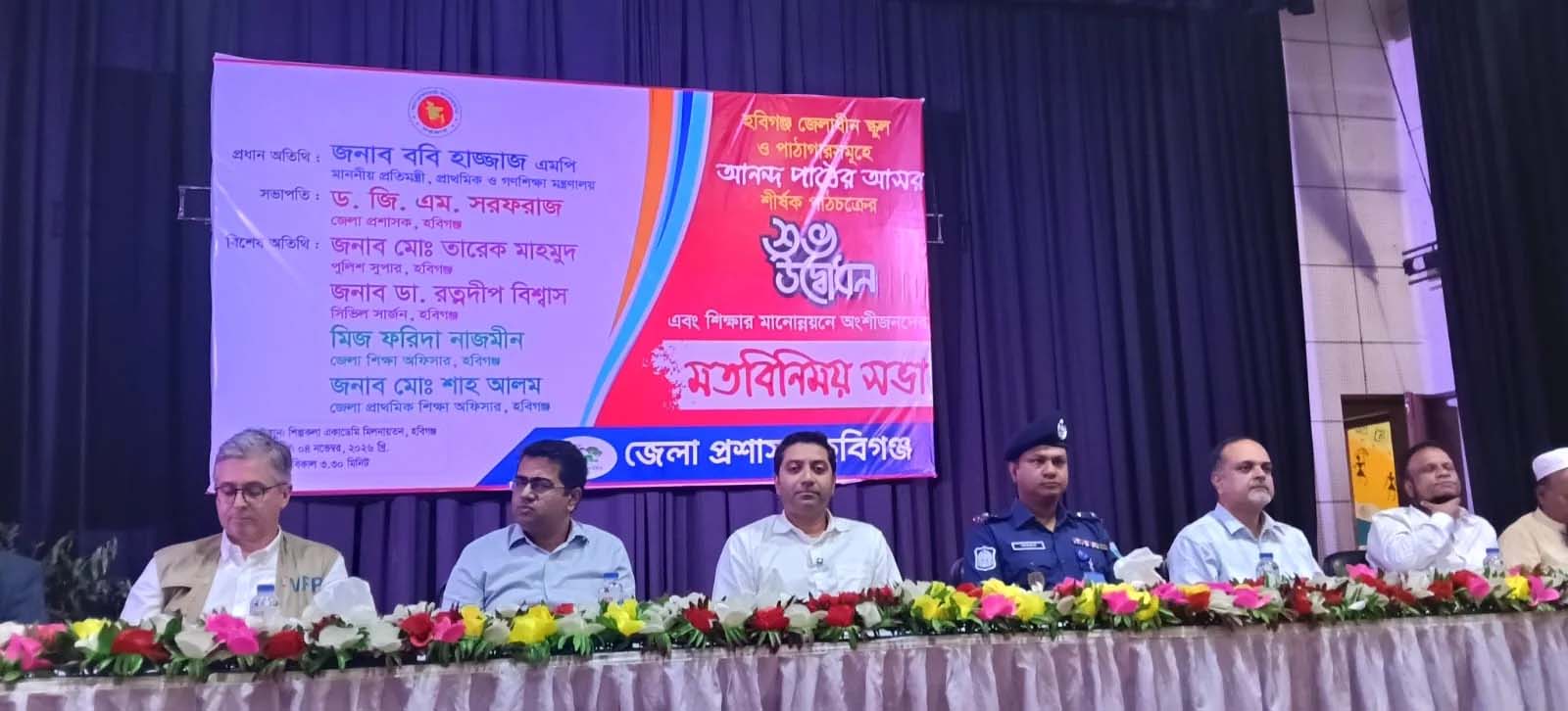
Govt plans new monitoring policy, revised curriculum for primary education.
State Minister for Primary and Mass Education Bobby Hajjaj today said the government has taken initiative to formulate a new monitoring policy and introduce a revised curriculum aiming to bring qualitative and visible change in country’s primary education.
The state minister made the comments while visiting different government primary schools in Madhabpur upazila here.
In addition to ensuring students' attendance at schools, closer monitoring will be carried out to assess how much each child is actually learning, the quality of teaching, and the overall effectiveness of school activities under the new monitoring policy, he said.
At the same time, work is underway to revise the curriculum to ensure scientific and enjoyable learning based on the age and abilities of students.
Praising the sincerity and responsible roles of school founders, local public representatives, members of the School Management Committee (SMC), head teachers and other teachers, the State Minister said, teachers’ close attention to children, the active participation of the management committee in running the school and collective efforts of all concerned at the local level can transform a school’s learning environment.
He sincerely thanked everyone concerned for their contributions.
During the inspection, the State Minister distributed mid-day meals among the second-grade students and observed the food storage and distribution activities.
Besides, he exchanged views with members of the school's Mothers' Association. After visiting the classroom library activities, he spoke with the book captains.
He also exchanged views with members of the school's gardening programme and the ‘Little Agriculturists Club’.
The State Minister highlighted the importance of such initiatives in developing children's reading habits, nutrition, environmental awareness and practical learning.
Regarding the School Feeding Programme, Bobby Hajjaj said that the government has already launched the programme in 100 upazilas and plans to gradually expand it to all government primary schools across the country by next year.
In Madhabpur Upazila, the World Food Programme (WFP) is implementing school feeding activities independently in more than 100 schools. One of the key objectives of the visit was to review firsthand the experiences and differences between the WFP's activities and the government's ongoing programme.
He said that the visit had created an opportunity to directly observe and learn about the good initiatives being taken in different places, the methods through which additional benefits could be ensured for students, and areas where there was scope for improvement.
After reviewing the experiences and activities of the World Food Programme, consideration will be given to incorporating those initiatives into the government's own programme that are effective and suitable for the context of Bangladesh.
Later, the State Minister visited Jagadishpur Tea Garden Government Primary School. On the occasion, he observed the examination activities and enquired about the initiatives being implemented to ensure children's healthcare, nutrition and overall well-being.
Under the McGovern-Dole Food for Education Programme, the World Food Programme (WFP) is implementing school feeding activities in schools across Madhabpur Upazila with funding from the United States Department of Agriculture (USDA).
The Food and Agriculture Organization of the United Nations (FAO), Room to Read and CNRS are working as partner organizations in the programme.
Elaborating about the development of the primary education curriculum, he said that work was underway to formulate a revised and improved curriculum in line with students' age, abilities and learning needs. The National Curriculum and Textbook Board (NCTB) has been assigned the responsibility for this purpose, he added.
The new curriculum places emphasis on eliminating disparities in learning hours among schools, making the teaching and learning materials for each subject more scientific, easy to understand and age-appropriate, and ensuring students’ actual comprehension and acquisition of skills.
At the same time, initiatives are being taken to incorporate moral education, sports and cultural activities more prominently into the curriculum.
Bobby Hajjaj said that the development of primary education is not limited to constructing school buildings or ensuring students' attendance; what matters most is whether each child is actually learning after coming to school.
To achieve this goal, coordinated efforts are needed in all areas, including school management, quality of teaching, nutrition, healthcare, co-curricular activities and accountability.
During the inspection, Jesse Wood, Head of Programme of the World Food Programme (WFP) in Bangladesh, and Emma Lefu, Programme Policy Officer for School Feeding, were present.
Local Member of Parliament, officials from the Directorate of Primary Education, district and upazila administrations, local education department officials, schoolteachers, parents and other concerned persons were also present.
