
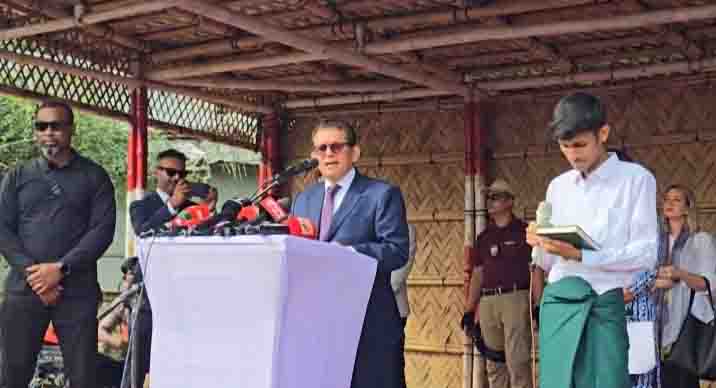
Myanmar must compensate Rohingya, ensure safe repatriation: Foreign Minister
Foreign Minister Dr Khalilur Rahman today said Myanmar must compensate the Rohingya for crimes committed against them and ensure their safe, voluntary and dignified return following the International Court of Justice's genocide ruling.
Dr Rahman, who also presides over the 81st session of the United Nations General Assembly (UNGA), addressed thousands of Rohingya as chief guest at a rally at Refugee Camp No. 4 in Ukhiya, Cox's Bazar, this morning.
People from several refugee camps began gathering at the camp's football ground at dawn.
The ground was filled to capacity by the time the rally began at 9am, with participants carrying placards demanding justice for the genocide, safe repatriation and restoration of their citizenship rights in Myanmar.
Dr Rahman said the International Court of Justice (ICJ) had ruled that Myanmar committed genocide against the Rohingya in 2017.
He said the court found evidence of mass killings, sexual violence, attacks on women and children, and the destruction of villages by Myanmar's security forces. Evidence before the court showed that at least 10,000 people were killed, he added.
He described the judgment as the first in which the court had held a state responsible for committing genocide.
He said the court's recognition of the Rohingya as a distinct ethnic group affirmed their identity and acknowledged their long struggle for justice.
Dr Rahman said establishing the truth was the first step towards justice for those who had lost relatives and suffered persecution.
He called on Myanmar to immediately investigate those suspected of involvement and, where warranted, prosecute and punish them.
The judgment is final and binding and cannot be appealed, he said, urging Myanmar to compensate those affected and take effective measures to prevent a recurrence of the atrocities.
The Rohingya had repeatedly expressed their desire to return home, Dr Rahman said.
He called for guarantees of security, citizenship, freedom of movement and protection from discrimination in Myanmar, adding that no one should be sent back into danger.
He urged the international community and development partners to increase funding for humanitarian assistance in the camps until safe repatriation becomes possible, saying Bangladesh's government and people could not shoulder the responsibility alone.
Dr Rahman told the gathering he would convey the concerns of the Rohingya, particularly those of women, children and young people, to the UN's 193 member states in New York.
He said implementing the judgment was a shared responsibility and that its provisions must make a difference to Rohingya families in the camps of Cox's Bazar and in their home villages in Rakhine State.
Rohingya leaders welcomed the ruling and said guarantees of citizenship and fundamental rights were essential to their return.
Master Mozammel Hossain, a Rohingya leader, said the ruling had affirmed the community's identity as a distinct ethnic group.
"We want to return to our own country in safety, with dignity and respect," he said.
Mohammad Alim, from the Lambabil area of Buthidaung in Myanmar, said persecution had forced him and others to flee to Bangladesh, leaving behind relatives, homes and possessions.
"Bangladesh has given us a great deal of support, and we are grateful for that," he said adding "We want to return to Myanmar with our citizenship and all our fundamental rights guaranteed."
Another Rohingya leader, King Mong, said the ruling had brought international recognition of the genocide.
He urged Dr Rahman to use his position at the United Nations to press for implementation of the judgment and rally international support for repatriation with full rights.
He expressed hope that Nov 19, the day the judgment was delivered, would be remembered as the beginning of the Rohingya's journey home.
