
Inspectors need support to enforce labour laws effectively.
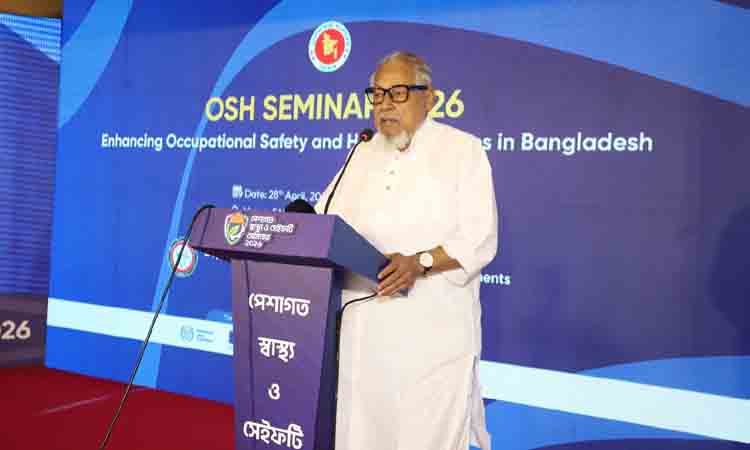
Prime Minister’s Adviser Nazrul Islam Khan today underscored the need to strengthen Bangladesh’s labour inspection system through enhanced training, logistical support and security for inspectors, saying effective enforcement of labour laws cannot be achieved without institutional capacity.
“With only around 436 inspectors for more than 83 thousand factories and establishments, effective enforcement of labour laws requires stronger training, logistics support and security for inspectors,” he said, calling for urgent institutional strengthening to protect workers’ rights and ensure workplace safety.
He was speaking at an Occupational Safety and Health (OSH) seminar titled “Enhancing Occupational Safety and Health Practices in Bangladesh”, jointly organised by the Department of Inspection for Factories and Establishments (DIFE) and the Ministry of Labour and Employment, marking the National Occupational Safety and Health Day 2026 in the capital.
Labour and Employment Minister Ariful Haque Chowdhury chaired the seminar, while PM’s adviser on Education, Labour and Employment affairs Mahdi Amin attended as special guest along with senior government officials, labour leaders and industry stakeholders.
Khan, also member of BNP standing committee, said, “We have laws, we have policies, and we have also ratified many ILO conventions. But the real challenge is implementation. Legal frameworks alone are not sufficient unless they are effectively enforced on the ground.”
Khan said Bangladesh has inherited and adopted a significant number of international labour commitments over the years, saying this reflects the country’s long-standing engagement with global labour standards across different administrations.
“At different stages, BNP led previous governments have contributed to building this framework, and we have moved forward collectively in recognising workers’ rights,” he said, acknowledging continuity in labour policy development.
Highlighting the scale of the challenge, Khan said Bangladesh has over 83,000 factories and establishments, but only around 436 inspectors are responsible for monitoring occupational safety, compliance and labour rights.
“This gap clearly shows why inspectors must be properly trained, adequately equipped, and ensured security so that they can perform their duties effectively,” he said.
He stressed that inspectors often lack logistical support and operational capacity, making field-level enforcement difficult. “They cannot ensure compliance by sitting at home. They must be able to go into the field safely and confidently,” he said.
Khan said, “If we want effective enforcement, we must ensure that inspectors have security, mobility, and professional respect”.
He further said that strengthening labour inspection is not only about compliance but also about protecting industries and the national economy. “If workers suffer due to unsafe workplaces, it is not just a personal tragedy—it affects productivity and national development,” he said.
Ariful Haque Choudhury said, “Factory inspectors need more training and logistical support. They also require security, as ensuring their safety while on duty is the responsibility of the government.”
Inspectors must provide accurate and timely information instead of remaining inactive, he said, adding, “They cannot sit at home; they must be properly equipped and trained to perform their duties effectively.”
Ariful emphasised that both employers and labour leaders need greater awareness to build a worker-friendly environment in the country. “If we truly want to move the country forward and make it labour-friendly, we must ensure all necessary facilities for workers,” he said.
He underscored the importance of collective efforts involving the government, employers and workers to improve labour conditions. “Organising seminars alone is not enough. We must focus on implementing the recommendations,” he said.
The minister hoped that even partial implementation of the issues raised at the seminar could lead to significant progress. “If we can implement even 50 percent of the recommendations discussed today, we will gradually reach full implementation,” he added.
Prime Minister’s Adviser on Education, Expatriate Welfare, Overseas Employment, and Labour and Employment affairs Mahdi Amin reiterated the government’s commitment to building a labour-friendly Bangladesh, saying that workers’ safety and security remain central to national governance.
“Honourable Prime Minister, both in the election manifesto and throughout the electoral journey, has repeatedly emphasized how we aim to build a labour-friendly Bangladesh, where workers’ protection and safety play a very important role in state governance,” he said.
Highlighting the historical role of political leadership in shaping the labour sector, he observed that the country’s garment industry—now a key pillar of the economy—was initiated under the leadership of Shaheed President Ziaur Rahman.
“History bears witness that during BNP-led governments, both Shaheed President Ziaur Rahman and later Prime Minister Begum Khaleda Zia introduced labour-friendly policies that significantly contributed to the sector’s development,” he noted.
Mahdi Amin said the present government also aims to continue strengthening such policies to ensure solutions to workers’ problems and improve livelihoods.
“The core priority of our government is job creation, skill development, and ensuring the highest possible safe and secure working environment for every citizen,” he added.
The adviser emphasized a holistic approach to labour welfare, including health support, education for workers’ children, nutrition, and social protection schemes.
“We need a holistic approach where workers and their families can live with dignity, access healthcare, education, and nutritional support,” he said.
He added that the government is working from grassroots level through initiatives such as family cards and farmer cards, which also include labouring women and agricultural workers.
Mahdi Amin further said that achieving Bangladesh’s development goals requires a unified effort of workers, employers, and the government.
“We aim to build a holistic ecosystem where all stakeholders are part of consultation, and through collective efforts and international cooperation, we will reach our national goals,” he added.
Secretary to labour and employment Md Abdur Rahman Tarafdar and DIFE Inspector general Omar Md Imrul Mohsin also addressed, among others.
