
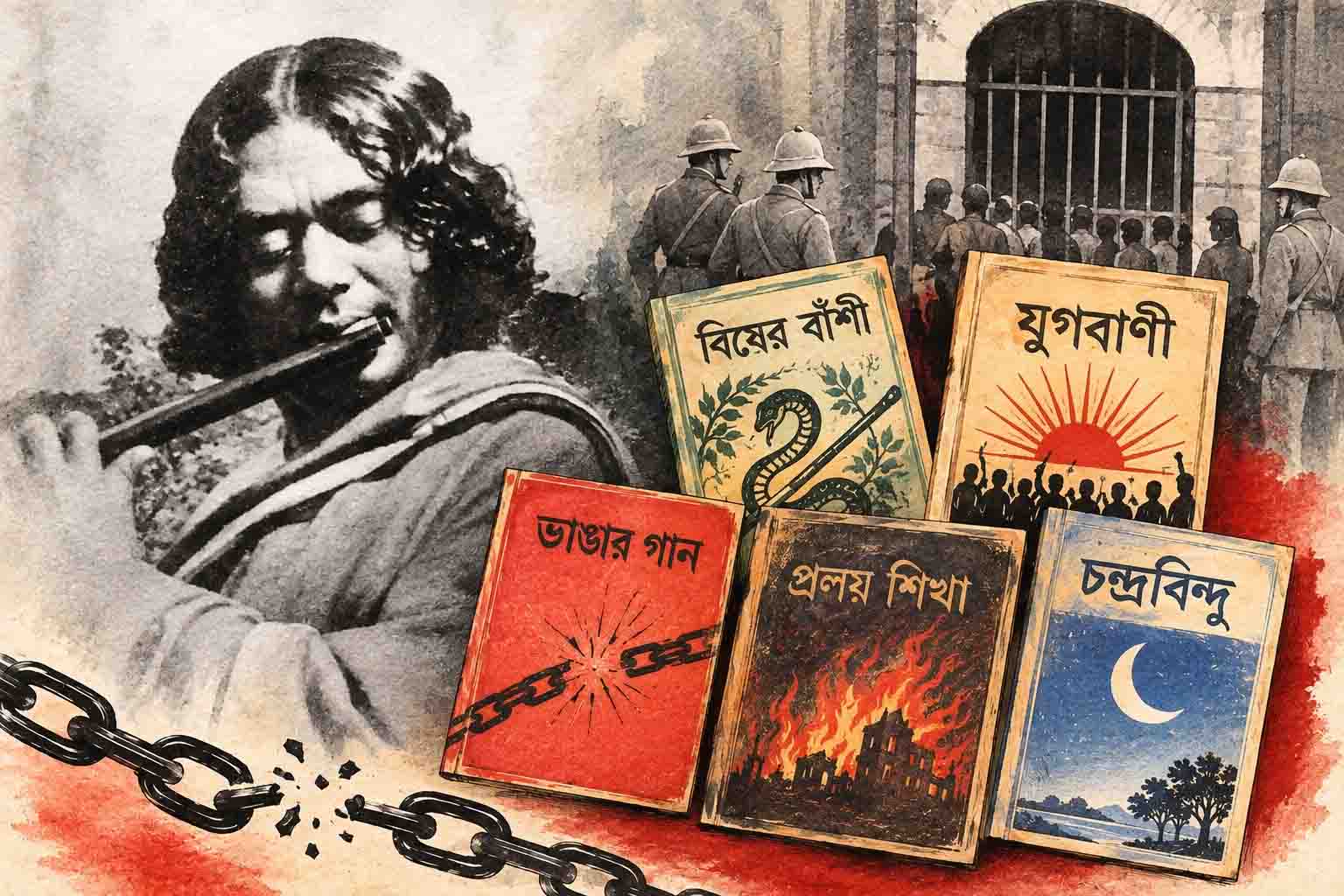
Nazrul’s five books banned by British Raj amid rebellion
The year 1922 was one of the most turbulent years of British rule in the Indian subcontinent. People across the subcontinent were seething with anger against the British Empire. The Non-Cooperation Movement had reached its peak. British police and courts continued their campaigns of arrests, killings, executions, imprisonment and repression. Young people were sacrificing their lives and youth for their motherland.
In protest against the oppression of the British rulers, poet Kazi Nazrul Islam sharpened his pen, at times unleashing the flames of rebellion and at others singing songs of liberation against exploitation and subjugation. The British Raj feared the power of his words. As a result, one after another of the poet’s books was banned. Between 1922 and 1931, the British government confiscated five of Kazi Nazrul Islam’s books.
Nazrul’s poem ‘Anandamoyeer Agamane’ (At the Advent of Anandamoyee) was published in the September 6, 1922 issue of the magazine Dhumketu. From its very opening lines, the poem called on the people of India to rise against the inhuman conduct of British rule.
The British Raj was furious at the rebellious call made by Nazrul. An arrest warrant was issued against the rebel poet. Even before the warrant was issued, however, news had spread that he could be arrested at any moment. Word was sent to him, and he was advised to go abroad or flee. But the poet would not leave the country. Nor was he willing to go into hiding at home. He had left Calcutta and was then in Samastipur. At one point, he had gone to a place to collect some money due to him from the sale of his books. From there, he went to Cumilla, where British police arrested him.
Nazrul was arrested for writing poetry and charged in connection with the Non-Cooperation Movement. He was found guilty of sedition and sent to Hooghly Jail, where he had to remain for nearly a year. In protest against the mistreatment by the prison authorities, the poet went on a hunger strike that lasted 40 days.
News of his fast spread throughout India. Among the many appeals urging him to end the fast was one from Rabindranath Tagore. Meetings and rallies were also organised. Appeals to break the fast came from prominent poets, writers and political leaders, including Nazrul’s mother, Zaheda Khatun, and Birjasundari Devi, who was like a mother to him. Eventually, under pressure from public opinion, Dr Abdullah Suhrawardy, the prison inspector, visited Hooghly Jail on May 22, 1923. Following his assurances and appeal, Nazrul ended his 40-day hunger strike that very day.
The testimony the poet gave in court during the case has also become an important historical document in literature. It was published in Dhumketu on January 27, 1923, under the title ‘Rajbandir Jabanbandi’ (The Deposition of a Political Prisoner). On that day, the poet said:
“I am accused of sedition against the State! That is why I am imprisoned in the State’s prison and accused before the State’s court. ... One is a king, holding the royal sceptre; the other holds the staff of justice, with truth in his hand... I am a poet, sent by God to reveal the unspoken truth and give form to the formless creatioPen
That same year, the poet’s first published collection of prose, Jugabani, was banned. The book was a collection of various prose writings by Nazrul that had appeared in the newspaper Nabajug. In these writings, Nazrul conveyed the message of Hindu-Muslim harmony and called on the people of India to awaken. The rebel poet wrote essays in the book that shook the British Empire from within. Many say the British administration feared Jugabani more than any of his other books.
In 1924, his Bisher Banshi (The Poison Flute) and, in the same year, Bhangar Gan (Songs of Deconstruction) were banned. Bisher Banshi was a continuation of Agnibina. However, by banning Nazrul’s books, the British authorities only made him more popular. Young people’s attraction to him grew considerably.
Comrade Muzaffar Ahmad, a close friend of poet Nazrul and one of the pioneers of the communist movement in the Indian subcontinent, wrote in his memoirs about the poet: “Many people, particularly young men, were immensely eager to obtain the two banned books by Nazrul (Bisher Banshi and Bhangar Gan). I saw many young men coming to Abdul Halim to get these two books.”
Describing how Bisher Banshi was sold, Khan Muhammad Moinuddin, one of Nazrul Islam’s closest younger associates, biographers and a poet and children’s writer, said: “So what if Bisher Banshi was confiscated? Its sale was not affected. In 1925, the provincial conference of the Congress was held in Faridpur. Mahatma Gandhi attended it. It was there that Nazrul met Gandhi for the first time.
At the conference, Nazrul sang his ‘Charkar Gan’ (Song of the Spinning Wheel) and won Gandhi’s special affection. Hundreds of copies of Bisher Banshi were sold discreetly at the conference. To keep the sales secret, the book was given the name ‘Boroboi’. The money raised in this way did not do Nazrul much good. The ‘twelve spirits’ [a Bengali expression suggesting a host of people] squandered it.”

The extent to which Bisher Banshi had become a source of distress for the British rulers was described by Shri Sajanikantha Das. The editor of Shanibarer Chithi wrote: “During the Swadeshi Movement, poets such as Rabindranath and others had inspired Bengali patriotism through numerous songs and poems. For whatever reason, they did not respond in quite the same way during the great upheaval of the Non-Cooperation Movement. Only poet Nazrul had helped the movement triumph through his verse and songs. The emotional and exuberant torrent of life needed to awaken a country as inert and immobile as Bengal found expression in poet Nazrul.”
The ban on his books also forced the rebel poet to face financial and family hardships. Yet neither the British sword, financial difficulties nor adverse political circumstances could deter him. Khan Muhammad Moinuddin wrote: “With the confiscation of Bisher Banshi, his hardship reached its extreme. But was he someone who would give up? He himself began attending meetings and gatherings, singing in his naturally powerful voice and shattering the inertia of the Bengali national life. He was suffering from financial hardship—the rats in his rice pot were boxing with one another. He had no shoes, no clothes. Dressed like a wandering minstrel, he travelled from place to place, singing songs.”
In a reply to a letter from Principal Ibrahim Khan, Nazrul expressed his anguish over the harassment by the British, writing: “I have no money, but have I ever hesitated to spend whatever little means I possess? Whatever others may say against me, I do not think you would make such an accusation. Because of my ‘crimes’ of serving the country and society, the venerable Government Sahib has turned an exceptionally sharp eye on me. My most popular books have been confiscated. Just the other day, the police informed me again that if I continued selling my newly published Rudra-Mangal, I would be arrested on charges of sedition.”
Rudra-Mangal, however, was not banned. The British government also issued warnings concerning Agnibina, Phanimanasa, Sanchita and Sarbahara. The other two books that fell victim to the ban were Pralay-Shikha and, finally, Chandrabindu. Pralay-Shikha was banned in 1930 and Chandrabindu in 1931. The poet was going through an extremely difficult period at the time. His beloved son Bulbul, dearer to him than life itself, had died not long before. It was during this period that the British government revealed the brutal face of its cruelty.
The banning of his books made poet Nazrul an important figure in the anti-British movement. Young people became increasingly inspired by him in their demand for independence. At the same time, the bans multiplied the poet’s financial difficulties.
Prominent poet, essayist, novelist and Nazrul researcher Majid Mahmud told BSS: “Following the disappointment caused by Mohandas Karamchand Gandhi’s withdrawal of the Non-Cooperation Movement, young people found inspiration in rebel poet Nazrul. Nazrul was first imprisoned for writing ‘Anandamoyeer Agamane’. Later, he was sentenced to six months’ imprisonment for Pralay-Shikha. However, under the Gandhi-Irwin Pact, the poet did not have to return to prison. In this way, the banning of his books made Nazrul as important a figure as Gandhi and Muhammad Ali Jinnah.”
Poet Majid Mahmud added that the bans forced Nazrul to face financial difficulties. He could not publish books as he wished. Publishers were reluctant to print his works for fear of bans and official harassment. And even when a book was printed, the British government would ban it soon afterwards. Despite all this, Nazrul continued his rebellion against the British.
