
Research to examine women’s access to jobs, wages, assets and social protection; findings expected by June 2027
DHAKA, November 22, 2026: Norway and the United Nations Population Fund (UNFPA) have signed an agreement to investigate how fairly women share in Bangladesh’s economic growth, with a focus on gender-based inequalities in income, employment, unpaid care work and access to economic opportunities.
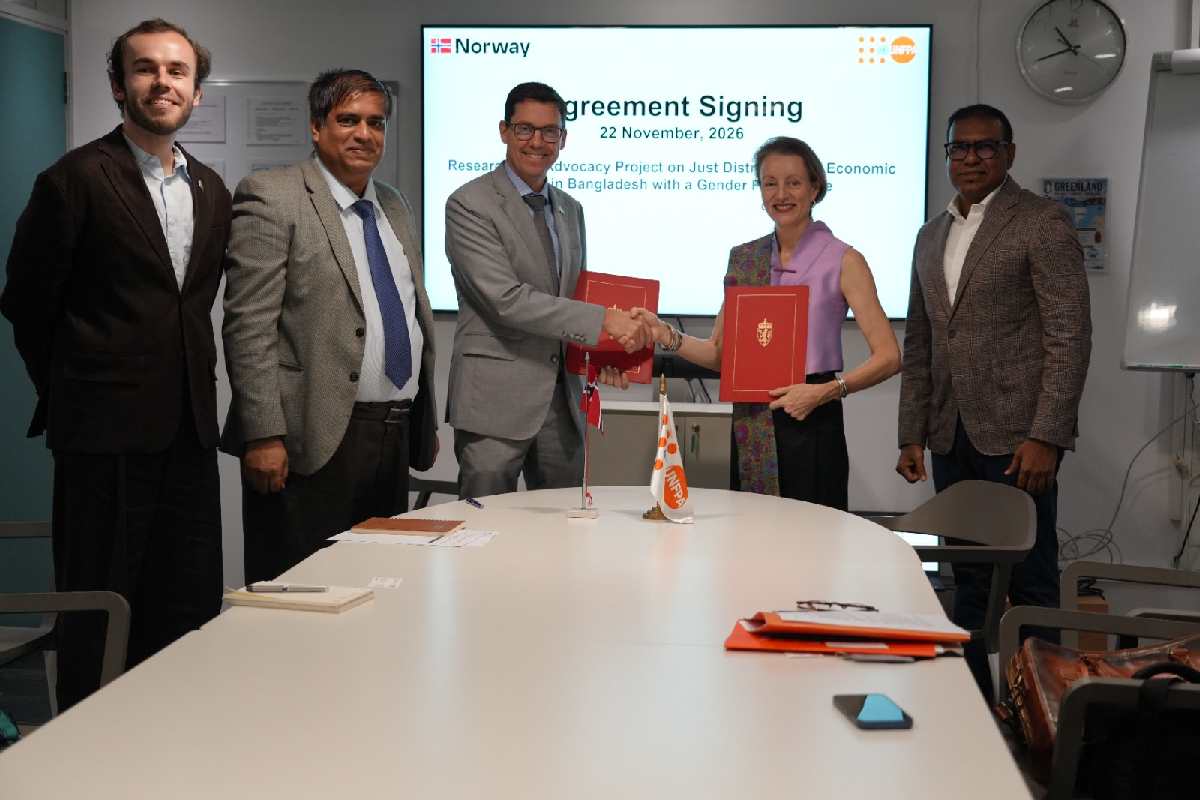
The Royal Norwegian Embassy in Dhaka and UNFPA Bangladesh signed the agreement on Sunday for a research and advocacy project titled Just Distribution of Economic Gains in Bangladesh with a Gender Perspective.
Norwegian Ambassador to Bangladesh Håkon Arald Gulbrandsen and UNFPA Representative in Bangladesh Catherine Breen Kamkong signed the agreement at the Norwegian Embassy in Dhaka.
The initiative comes as Bangladesh has made progress in poverty reduction and girls’ education, while significant gender gaps in employment, income and economic participation persist.
According to the Bangladesh Bureau of Statistics, the country's poverty rate declined from 24.3 per cent in 2016 to 18.7 per cent in 2022. However, income inequality widened during the same period, with the national income Gini coefficient rising from 0.482 to 0.499.
Women continue to face considerable disadvantages in the labour market. Around four in 10 women participate in the labour force, compared with eight in 10 men. Women also spend an average of 5.8 hours daily on unpaid domestic and care work, significantly higher than the 0.8 hours spent by men.
The proposed research will examine how economic growth benefits different groups and what factors determine women's share of the country's economic progress.
It will investigate employment opportunities and wages, unpaid domestic and care responsibilities, ownership of land and other assets, and public expenditure on social protection, healthcare and education.
The study will also assess how technological changes, including automation, and climate-related shocks are reshaping women's economic opportunities and livelihoods.
The findings are expected to be published by June 2027 as a peer-reviewed research paper. UNFPA and Norway will also organise a policy dialogue and a dissemination seminar in Dhaka, bringing together policymakers, researchers, civil society representatives and media professionals to discuss the findings and their policy implications.
"Women have been central to Bangladesh's growth, in garment factories, on farms and in the unpaid work that keeps households running. Whether they share fairly in what they help produce is a question that needs better evidence than we have today," Kamkong said.
She said the economic barriers facing women remain a priority for UNFPA, highlighting issues including violence against women, limited access to family planning, child marriage and barriers to completing education.
Kamkong expressed gratitude to Norway for supporting the research, saying it would help deepen understanding of the challenges and identify possible solutions.
Norwegian Ambassador Gulbrandsen said equitable distribution of economic gains and strong economic growth could reinforce each other.
"Norway's experience is that a fair distribution of gains and strong economic growth go hand in hand," he said. "We are glad to support Bangladeshi researchers in building the evidence for policies that let women share fully in their country's progress."
The agreement also builds on Norway's longstanding partnership with UNFPA and its support for women and girls in Bangladesh and globally.
In 2025, Norway was UNFPA's largest contributor to core resources worldwide, providing $55 million. Unlike project-specific funding, core contributions allow the UN agency to allocate resources flexibly to areas where needs are greatest.
In Bangladesh, Norway also provided NOK 10 million through UNFPA's humanitarian appeal across 2025 and 2026 to help sustain essential services in Cox's Bazar amid severe humanitarian funding constraints.
The latest research partnership reflects a broader development priority: ensuring that Bangladesh's economic progress translates into more equitable opportunities and benefits for women, particularly as the country navigates changing labour markets, technological disruption and climate challenges.
