
Government pursuing reforms, economic recovery and good governance.
Prime Minister's Adviser and his office spokesperson Mahdi Amin has said Bangladesh is undergoing a rapid transformation as the government led by Prime Minister Tarique Rahman pursues a people-centric and reform-oriented agenda focused on good governance, accountability, economic recovery and the rebuilding of state institutions.
"The government is working to rebuild the state structure weakened over the past one and a half decades, establish accountability and move forward with the principle of 'Bangladesh First'," he said.
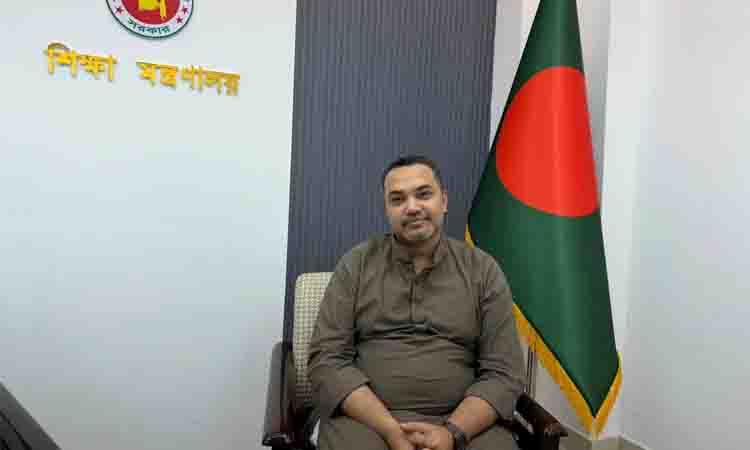
Mahdi Amin made the remarks in an exclusive interview with Bangladesh Sangbad Sangstha (BSS) at his office at the Bangladesh Secretariat.
During the interview, he spoke candidly about the government's first 180 days, its key social and economic initiatives, the energy situation, overseas employment, foreign policy, media freedom and the country's law and order situation.
Reflecting on Bangladesh's political transition, he said the people had gone through a prolonged period marked by controversial elections, restrictions on fundamental rights and an erosion of democratic institutions.
"Bangladesh witnessed the 2014 election without voters, the 2018 'night-time election' and the 2024 'dummy election'. During that period, an unelected government established authoritarian rule and deprived people of their basic freedoms and rights," he said.
According to Mahdi Amin, the present government draws its legitimacy and strength from the people following a free, fair and credible election.
"Breaking the shackles of authoritarianism, an elected and people-oriented government has been formed under the leadership of Prime Minister Tarique Rahman. Its only source of power is the people. With their genuine support, the government is working to bring meaningful change in every sphere and establish good governance," he said.
Pointing to the government's first six months, the adviser said one of the earliest major initiatives was the waiver of agricultural loans of up to Tk 10,000, including principal and interest.
More than 13 lakh farmers have directly benefited from the decision, he said.
The government has also introduced the Family Card, aimed at empowering women and strengthening household economies, while allowances have been introduced for imams, muezzins, khatibs and other religious leaders, he said.
Canal excavation and tree plantation programmes have also been taken to the grassroots, he said.
He described the Family Card as more than a social assistance programme, saying it was designed to give women greater economic independence and dignity.
"Women are using the assistance for their children's education, household expenses and small businesses. It is not simply financial support; it is a quiet revolution aimed at making women self-reliant and dignified," he said.
Mahdi, however, acknowledged that some technical inconsistencies had emerged in the distribution of the cards.
The government is now updating the database and strengthening the "Proxy Means Test" system to ensure that assistance reaches only genuine beneficiaries, he said.
On the cost of living and energy situation, he said the government had managed to keep essential commodity prices under control during Ramadan and two Eid festivals while ensuring timely payment of workers' outstanding wages, salaries and bonuses.
But he admitted that the energy crisis could not be resolved overnight.
"The energy crisis accumulated over the past one and a half decades cannot be completely resolved in six months," he said, adding that the government was pursuing a long-term strategy to secure gas and fuel at affordable prices from alternative sources.
He said discussions were being held with the US-Bangladesh Business Council, Malaysia's Petronas and Chinese investors as part of the effort to diversify energy sources and strengthen energy security.
On overseas employment, the adviser said the government was hopeful of reopening Malaysia's labour market for Bangladeshi workers after intensive negotiations.
"Discussions with Malaysia are at the final stage. If everything goes as planned, we hope the issue will be resolved by the end of August," he said.
Reopening the market could create opportunities for more than 100,000 Bangladeshi workers to travel to Malaysia over the following four months, he said.
Employment opportunities would not be confined to a particular sector, but would include real estate, agriculture and manufacturing, he added.
The government is also preparing skilled workers for new destinations by providing technical and language training and arranging collateral-free special loans for employment in Japan, Oman, Jordan and European countries beyond the Middle East, he stated.
Initiatives are also underway to expand Bangladesh's manpower exports to Eastern European markets, he said.
On freedom of expression and law and order, Mahdi Amin said the government had ensured a significantly more open environment for free expression and journalism during its first six months.
"Even in the face of strong criticism and provocative behaviour, the government has demonstrated the highest level of political restraint," he said.
He said the police and administration were being transformed into service-oriented institutions, moving away from authoritarian mindset.
"From elephant killing to other serious and ordinary crimes, independent and impartial legal proceedings are continuing. No criminal is being given political or partisan protection," he said.
Turning to foreign policy, Mahdi Amin said the government's central principle was "Bangladesh First".
"We want deep economic and strategic relations with all countries, including India, based on equality, justice and mutual respect," he said.
On the government's efforts to bring ousted prime minister Sheikh Hasina back to Bangladesh to face justice, he said India, as a friendly neighbour, was expected to extend full cooperation with the legal process.
On the economic outlook, the adviser said the government was working with the ambition of building a trillion-dollar economy by strengthening the country's economic foundations and making Bangladesh more competitive.
He said the government was taking steps to make doing business easier, including making the "One Stop Service" more effective, introducing 24-hour cargo services at ports and providing tariff concessions on imports of raw materials to encourage domestic production.
"A democratic process allows mistakes to be corrected. By utilising the government's sincerity, goodwill and accountability, Bangladesh will, InshaAllah, emerge as a prosperous and self-respecting nation, standing tall in the global community," Mahdi Amin added.
