
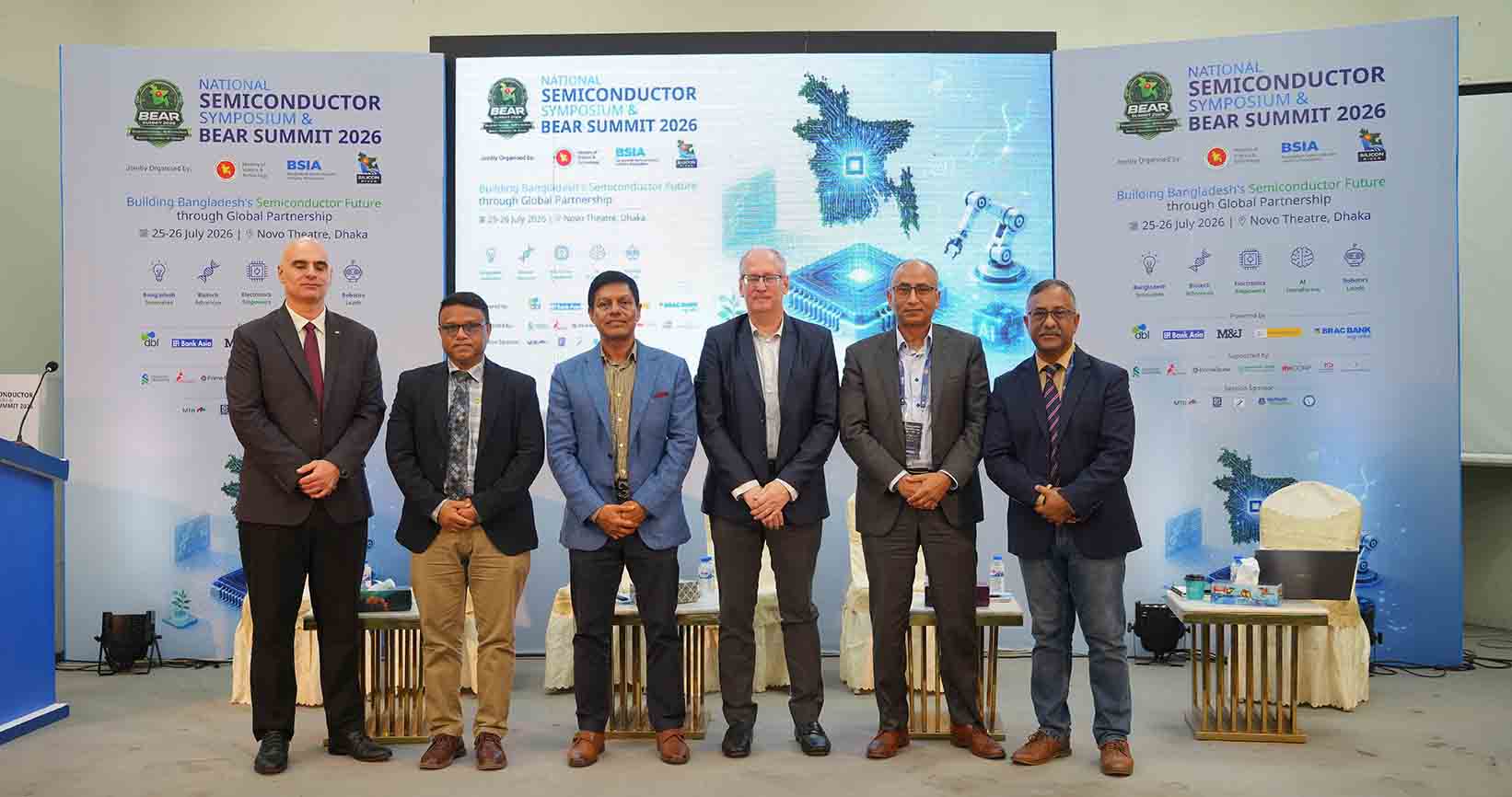
Bangladesh Unveils Semiconductor Roadmap to Attract Global Investment at BEAR Summit 2026
DHAKA, July 27, 2026 — Bangladesh has taken another step toward establishing a domestic semiconductor ecosystem as policymakers, global technology leaders, academics, investors and industry stakeholders concluded the two-day National Semiconductor Symposium & BEAR Summit 2026 in Dhaka, unveiling strategic frameworks aimed at attracting investment, strengthening research commercialization, and developing a globally competitive semiconductor workforce.
Held at the Novo Theatre in Dhaka under the theme "Building Bangladesh's Semiconductor Future through Global Partnership," the summit emphasized transforming Bangladesh from a technology consumer into a future semiconductor design, research and manufacturing destination through stronger international collaboration and industry-academia partnerships.
The second day of the summit focused on "Bangladesh's Deep-Tech Future," with discussions highlighting policy reforms, research commercialization, talent development, startup financing and international cooperation as critical pillars for building the country's semiconductor industry.
Speaking at the opening session, ICT Division and Ministry of Science and Technology Minister Fakir Mahbub Anam Swapan said Bangladesh is committed to developing a knowledge-based economy through investment in advanced technologies and innovation. He stressed that coordinated efforts among government, universities, private industry and international partners would be essential to achieving long-term competitiveness in semiconductor technologies.
Delivering the Global Academic Plenary, Prof. Dimitrios Peroulis, Senior Vice President of Purdue University, outlined how international academic collaboration can accelerate Bangladesh's semiconductor ambitions through joint research, curriculum development, faculty exchanges and technology partnerships.
One of the major business highlights of the summit was the International Partnership Forum, where executives from leading semiconductor companies and universities discussed opportunities for foreign direct investment, technology transfer and supply-chain integration.
Industry leaders from L&T Semiconductor Technologies, Applied Materials, Purdue University, Cactus Materials, BRAC University and Bangladesh-based technology firms explored how Bangladesh can position itself within the rapidly expanding global semiconductor value chain.
Speakers emphasized that competitive labor costs, a growing engineering workforce and supportive government policies could make Bangladesh an attractive destination for semiconductor design services, packaging, testing and advanced electronics manufacturing.
Another key discussion focused on bridging the gap between university research and commercial production.
Experts from GlobalFoundries, NXP Semiconductors, Vietnam Semiconductor Association, Dhaka University, American International University-Bangladesh and government agencies discussed measures needed to commercialize local innovation, strengthen intellectual property protection and encourage greater collaboration between universities and private industry.
Participants also highlighted the importance of tax incentives, customs facilitation and research funding to support emerging deep-tech industries.
The summit placed strong emphasis on leveraging Bangladesh's global technology diaspora.
During the Global Leadership & Diaspora Forum, international technology executives and Bangladeshi professionals working abroad discussed knowledge transfer, mentorship and international networking to accelerate domestic capability building.
Another panel explored the growth of deep-tech startups, where entrepreneurs, venture investors and academic experts called for greater access to venture capital, incubation support and specialized funding mechanisms to nurture semiconductor startups.
Industry leaders noted that developing a vibrant startup ecosystem could complement larger multinational investments while creating high-value employment opportunities for local engineers.
The CREST Fellow Program featured research presentations from young Bangladeshi researchers representing leading universities including the University of Dhaka, BUET, BRAC University, North South University, East West University and United International University.
The presentations demonstrated growing local expertise in semiconductor research and highlighted the country's expanding talent pipeline for advanced technology industries.
The summit concluded with the release of strategic national frameworks and roadmaps designed to guide Bangladesh's semiconductor and deep-tech development over the coming years.
The closing ceremony was attended by M. Anwar Hossain, Secretary of the Ministry of Science and Technology, alongside Prof. Dr. Muhammad Mustafa Hussain of Purdue University, Prof. Dr. ABM Harun-Ur-Rashid of BUET and M A Jabbar, President of the Bangladesh Semiconductor Industry Association (BSIA).
Organizers said the newly released frameworks are expected to support future policy formulation, encourage private investment, strengthen academic collaboration and position Bangladesh as an emerging player in the global semiconductor industry.
Organized by the Bangladesh Semiconductor Industry Association (BSIA), BEAR, and Silicon River Bangladesh, the two-day summit brought together senior government officials, multinational semiconductor executives, researchers, investors and members of the Bangladeshi technology diaspora to chart a long-term strategy for the country's semiconductor ambitions.
With demand for semiconductor chips continuing to rise worldwide, stakeholders believe Bangladesh now has an opportunity to diversify its export base, attract high-value foreign investment and build a sustainable deep-tech economy capable of competing in global technology markets.
