
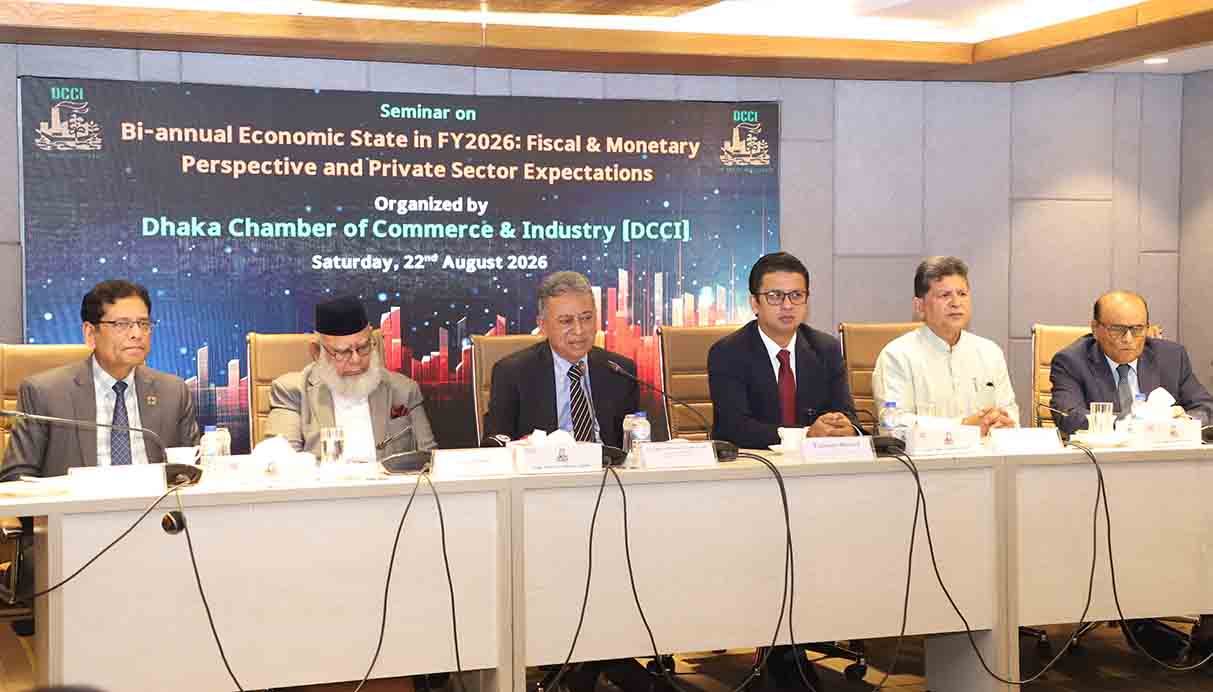
The seminar underscored the need for coordinated fiscal, monetary and structural reforms to restore private-sector confidence and accelerate sustainable economic growth.
Dhaka, August 22, 2026: The Dhaka Chamber of Commerce and Industry (DCCI) organized a seminar titled “Biannual Economic State in FY2026: Fiscal & Monetary Perspective and Private Sector Expectations” at the DCCI Auditorium on Saturday, bringing together policymakers, economists, business leaders and development experts to discuss Bangladesh’s economic outlook and the challenges facing the private sector.
Finance Minister Amir Khosru Mahmud Chowdhury, MP, attended the seminar as the chief guest. Dr. Hossain Zillur Rahman, Executive Chairman of the Power and Participation Research Centre (PPRC) and Chairman of BRAC; Mahbubur Rahman, President of International Chamber of Commerce (ICC) Bangladesh; Dr. Zaidi Sattar, Chairman of the Policy Research Institute of Bangladesh (PRI); and Professor Mustafizur Rahman, Distinguished Fellow at the Centre for Policy Dialogue (CPD), attended as special guests.
Finance Minister Amir Khosru Mahmud Chowdhury said the government is working to create a business-friendly environment, stressing that attracting foreign investment will not be possible without strengthening domestic investment.
He said the government is committed to removing barriers to trade and investment, regardless of how deeply rooted they may be. Although deregulation is difficult to implement, the government will continue the process without providing special consideration to any particular group.
The minister said an initiative is underway to establish a dedicated website through which businesses will be able to identify and report problems, enabling the government to take effective measures to resolve them.
Regarding electricity and gas shortages, he said the problems could not be resolved overnight and would require time. The government is working to maintain a three-month energy reserve to mitigate the impact of potential future crises.
He also said the government has announced a Tk 60,000 crore stimulus package to support distressed businesses, boost investment and help revive the economy. Loan support, he added, would be provided only to eligible businesses that meet the conditions set by the central bank.
The finance minister said the government is also implementing a “Creative Economy” initiative targeting small entrepreneurs, with support for access to finance, skills development, product design and marketing.
He stressed that increasing the tax-to-GDP ratio is essential for the success of government initiatives and said there is no alternative to automating tax administration.
Referring to the ongoing Middle East crisis, Amir Khosru said Bangladesh has incurred an additional US$4–5 billion in energy-related payments. He identified coordination among different energy sources as a government priority, while emphasizing solar power as an immediate area of focus.
He urged entrepreneurs to invest in solar energy by taking advantage of incentives provided in the national budget.
In his keynote presentation, DCCI President Taskeen Ahmed said global economic growth in 2026 has been projected at 3.1%, amid trade barriers, the Middle East crisis, supply-chain disruptions, rising energy prices and a doubling of transportation costs.
These factors, he said, have contributed to a downward trend in investment, business and trade activities.
Taskeen Ahmed highlighted several reform measures included in the FY2026 budget, including completing company registration within 48 hours through digitization, extending bonded warehouse facilities for the leather, footwear and home-textile sectors by three years, introducing duty-free benefits for 10 new sectors, automating tax administration, expediting customs procedures and accelerating negotiations for preferential and free trade agreements with promising export markets ahead of Bangladesh’s LDC graduation.
He expressed hope that effective implementation of these reforms would make doing business easier in Bangladesh.
On inflation and credit, he said private-sector credit growth stood at only 5%, compared with 25.9% growth in public-sector credit, raising concerns over investment.
He stressed that Bangladesh must gradually reduce its dependence on bank financing by strengthening the capital market. He also called for uninterrupted access to essential services in industrial zones to reduce export lead times.
According to the DCCI president, actual credit flow to the CMSME sector is only 16.8%, against a target of 25%, while rising business costs have contributed to an increase in non-performing loans in the sector to 24.1%.
He proposed increasing cash flow through digital credit scoring instead of conventional collateral-based lending and establishing special funds to facilitate affordable machinery and equipment purchases.
Given the energy crisis, he also proposed low-interest financing for small and marginal farmers to invest in solar-powered irrigation systems. He further called for a review of power purchase agreements to reduce unnecessary subsidy burdens while ensuring stable and affordable electricity prices.
Dr. Hossain Zillur Rahman said Bangladesh’s economy is at a critical juncture and that appropriate decisions at this stage could help the economy regain momentum.
He said harassment in different areas of the economy has become a structural problem that is undermining reform initiatives. Reducing such harassment, he noted, is essential for expanding the tax net.
He also called for structural reforms in the financial sector to reduce non-performing loans while ensuring access to credit for SMEs. He proposed establishing an “Economic Reform Acceleration Unit” to monitor implementation of economic reforms.
ICC Bangladesh President Mahbubur Rahman said inflation has yet to decline to the desired level, while private-sector credit growth remains at one of its lowest levels in years. Investment has remained stagnant, and industries are unable to operate at full capacity.
He attributed the rising cost of doing business to high interest rates, increased production and import costs, exchange-rate volatility and uncertainty over energy supplies.
He emphasized the private sector’s role in employment generation, investment, industrialization, exports and revenue mobilization, calling for a stable, predictable and investment-friendly policy environment.
PRI Chairman Dr. Zaidi Sattar said Bangladesh faces a significant gap between policy formulation and implementation, preventing the country from obtaining the expected benefits of many policy measures.
He noted that while Bangladesh maintains relatively liberal policies on export and market diversification, import policies remain restrictive. High tariffs, he said, contribute to domestic inflation and higher consumer prices.
He also called for timely strategies to address the challenges associated with Bangladesh’s LDC graduation.
CPD Distinguished Fellow Professor Mustafizur Rahman said a major transformation in tax collection is necessary to implement the Annual Development Programme (ADP). He expressed doubt about the possibility of achieving the revenue collection target set in the national budget.
Although the budget contains several positive measures, he said these are not adequately reflected in monetary policy, contributing to persistent inflation.
He called for urgent monetary policy reforms and urged the government to exercise greater caution in securing foreign loans and managing debt repayment.
During the discussion session, Dr. A K Enamul Haque, Director General of the Bangladesh Institute of Development Studies (BIDS), said prolonged high inflation is a major concern for a remittance-dependent economy.
Amid global economic uncertainty, he said maintaining economic stability would be challenging and emphasized the need to increase liquidity in the banking sector. He also stressed the importance of creating an overall business-friendly environment.
Simeen Rahman, Group CEO of Transcom Limited, said although the national budget contains business-friendly measures, the desired momentum has yet to return to the private sector.
She attributed the situation to high interest rates and inflation, non-performing loans and excessive government borrowing from the financial sector. Small and medium-sized businesses, she said, are among the worst affected.
She also highlighted the impact of high industrial raw material prices on production and called for greater efficiency in port, customs and logistics services.
Syed Mahbubur Rahman, Managing Director and CEO of Mutual Trust Bank PLC, said there are structural weaknesses in coordination between monetary policy and the national budget.
He called for greater digitalization of tax administration and development of skilled human resources. Without a supportive business environment, including reliable energy supplies, he said neither domestic nor foreign investment would increase significantly, even if interest rates decline.
During the open-floor discussion, former DCCI President Hossain Khaled called for the real estate sector to be formally recognized as an industry, noting its contribution to employment generation and government revenue.
Former DCCI President Abul Kasem Khan said Bangladesh has significant coal reserves and suggested that their use for electricity generation could help increase gas availability for industrial consumers.
He also called for establishing a national logistics authority to develop the country’s logistics sector and urged the government to introduce tax cards for all taxpayers.
Former DCCI President Benajir Ahmed emphasized the need for economic reforms and stronger preparations for the post-LDC graduation period.
Former DCCI President Rizwan Rahman said around 96% of the government’s total revenue comes from Dhaka and Chattogram. Instead of increasing the tax burden on existing taxpayers, he called for expanding the tax net and increasing the use of artificial intelligence in tax administration.
He also proposed establishing cluster-based special economic zones for SMEs.
DCCI Senior Vice President Razeev H Chowdhury, Vice President Md. Salem Sulaiman, members of the Board of Directors and representatives from the public and private sectors attended the seminar.
