
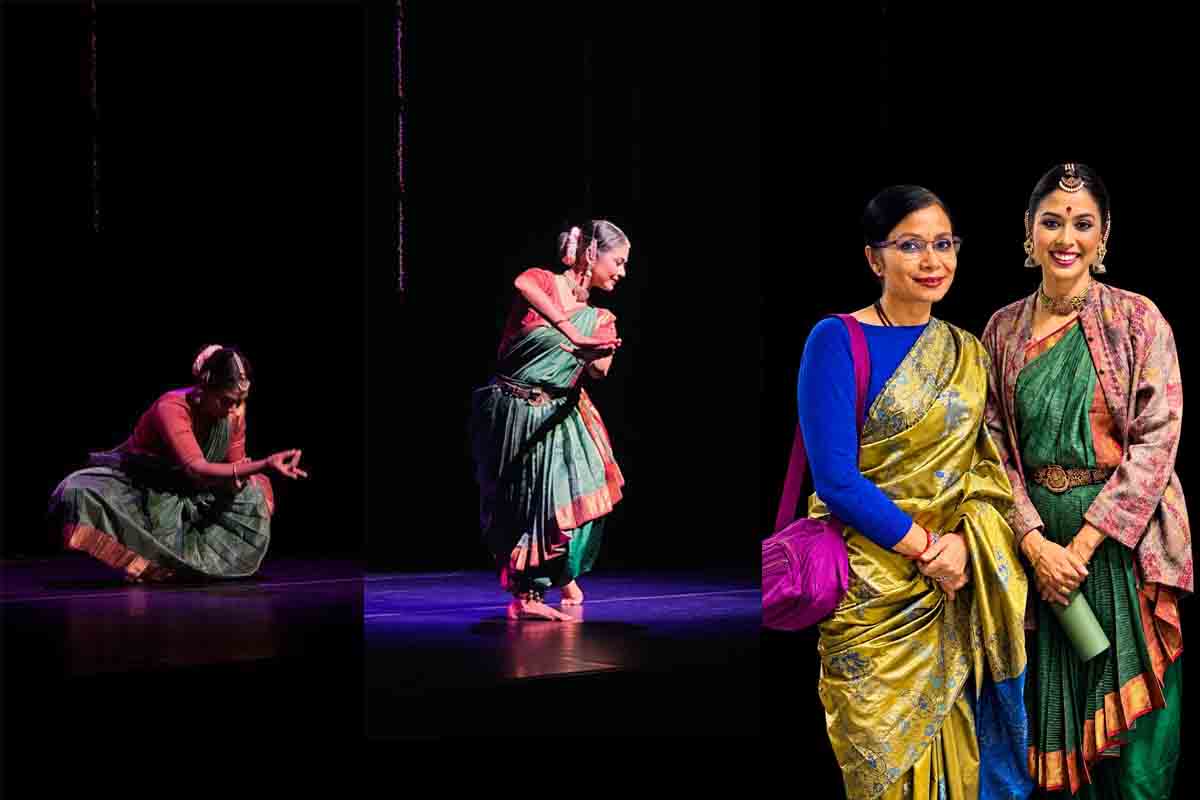
Radhe Jaggi’s solo Bharatanatyam performance in London explores devotion, surrender and the many dimensions of the human spirit
Five performances but only one dancer. Yet throughout the evening, it hardly felt as though she was alone on stage.
Through her body, gaze, gestures and expressions, Bharatanatyam dancer Radhe Jaggi brought a succession of characters and different shades of devotion to life.
I had the opportunity to watch ‘BHAKTA’, Jaggi’s solo Bharatanatyam performance was held at London’s Riverside Studios on September 5. It was her only one performance in the UK this year.
Radhe Jaggi may not yet be a familiar name to audiences in Bangladesh, but she has spent years building a career in the world of Indian classical dance. A disciple of renowned Bharatanatyam exponent Leela Samson, Jaggi trained at Chennai’s celebrated Kalakshetra Foundation. Her artistic journey began with performances at temples across Tamil Nadu before taking her to international stages around the world.
She currently leads Project Samskriti, an initiative focused on preserving, revitalising and bringing Indian classical arts to new generations.
Jaggi is also the daughter of Indian yogi and spiritual teacher Sadhguru. Yet on the stage at Riverside Studios, it was her identity as an accomplished classical dancer that stood out. She appeared not as someone's daughter, but as an artist shaped by her own discipline, training and artistic vocabulary.
One of Jaggi’s greatest strengths is her ability to command an entire stage on her own.
A single performer can suddenly become another character. Her gaze changes. So does her facial expression and physicality. A hand gesture, a slight turn of the head or a subtle shift in posture can be enough to create an entirely new presence.
Through the vocabulary of Bharatanatyam—its mudras, eye movements, physical language, rhythm and abhinaya—Jaggi moved seamlessly between characters and emotional states.
At times, it felt as though the stage was no longer occupied by one dancer. Instead, one dancer had become an entire world.
Before each piece, Jaggi spoke directly to the audience, offering context and introducing the story behind the performance. Her conversational manner, expressive hands and accessible storytelling created an immediate sense of intimacy.
The invisible distance between performer and audience seemed to gradually disappear. We were not simply watching her stories; we were being drawn into them.
‘BHAKTA’ featured five works: ‘Amba Neelambari’, choreographed by Leela Samson; ‘Auchitya’, Jaggi’s own choreography exploring death; ‘Dari Juchuchunadi’, a traditional work associated with the legendary dancer Mylapore Gowri Ammal; ‘Alakh Niranjan’, Jaggi’s choreography based on the story of a wandering ascetic; and ‘Madhuvanti Tillana’, another choreography by Samson.
What made the evening particularly compelling was the dialogue between tradition and individual creation.
In some pieces, Jaggi carried forward the choreographic legacy of her guru. In another, she engaged with an older dance tradition. Elsewhere, her own creative voice came to the fore.
Tradition, therefore, did not appear as something frozen in the past. It felt alive—passed from one generation to another, interpreted anew and given fresh energy.
Among the five works, ‘Alakh Niranjan’ stayed with me the longest.
The story centres on a wandering ascetic who arrives at a woman’s home seeking alms. The woman becomes captivated by his extraordinary eyes. She has a husband and children, yet the ascetic’s gaze becomes fixed in her mind. Fascination gradually turns into desire.
When the ascetic realises that his eyes have become the source of another person’s attachment, the story takes a difficult turn. He decides to give up the very eyes that have caused that attachment.
Jaggi embodied both sides of the story—the woman’s fascination, desire and anguish, and the ascetic’s uncompromising act of surrender—with remarkable control.
Tears came to my eyes.
Even the following morning, recalling the performance sent a shiver through me. It felt as though the story had not ended when the lights went down. It had simply begun another journey inside the audience.
One question kept returning to me:
How far can a devotee go?
Perhaps the piece affected me so deeply because devotion is not merely an abstract idea in my own life. As a Classical Hatha Yoga teacher trained in Sadhguru’s tradition, I have experienced how devotion can transform a person from within. It can give someone the strength to move beyond what they believe to be their own limitations—and, at times, to surrender something that reason alone might find difficult to explain.
‘Alakh Niranjan’ therefore did more than move me emotionally. It prompted a deeper reflection on desire, devotion and surrender.
Jaggi’s rigorous classical training was evident throughout the performance. Yet it was not technical perfection alone that impressed me.
What remained most memorable was the balance between precision and emotion.
There is power in her dancing, but it never feels heavy. There is beauty, but it is never fragile. There is theatricality, yet the intimacy of a solo performance is never lost.
And perhaps that is where the true strength of an artist lies. It is not simply about how perfectly one can perform a classical vocabulary. It is also about how deeply one can take an audience into the emotional world of the work.
Riverside Studios was filled with an attentive audience that evening. But for me, the experience extended beyond what happened on stage.
Through my long association with and training in Isha, I felt a familiar warmth in the way guests were welcomed. The sincerity and hospitality of the volunteers also became a quiet but meaningful part of the evening.
After the performance, I had the opportunity to speak briefly with Jaggi.
I introduced myself by saying, “Sadhguru is my Guru.”
She smiled and replied, “He is my Guru too.”
It was a very brief exchange. Yet after an evening devoted to exploring different dimensions of devotion, the words carried a particular resonance.
Jaggi is Sadhguru’s daughter. But in that moment, her response did not feel like one coming from a daughter acknowledging her father. It felt like the response of a disciple acknowledging her guru.
Getting a ticket to the performance had not been easy. Until the last moment, I was unsure whether I would even make it inside the theatre.
In the end, I did.
But by the time the evening was over, I felt that the real fortune was not simply getting into the theatre.
It was witnessing an artist who, through a classical dance vocabulary and five distinct works, left the audience with an ancient question that remains remarkably alive:
What is devotion?
‘BHAKTA’ does not offer a simple definition. Instead, it makes devotion visible—sometimes gentle, sometimes intense, sometimes joyful, sometimes painful, and at times uncompromising.
Long after the lights came up, one question remained:
When we hold someone or something as truly sacred, how completely are we willing to surrender ourselves to it?
