
Govt eyes overhaul of healthcare system, doubles health budget to Tk 69,409cr
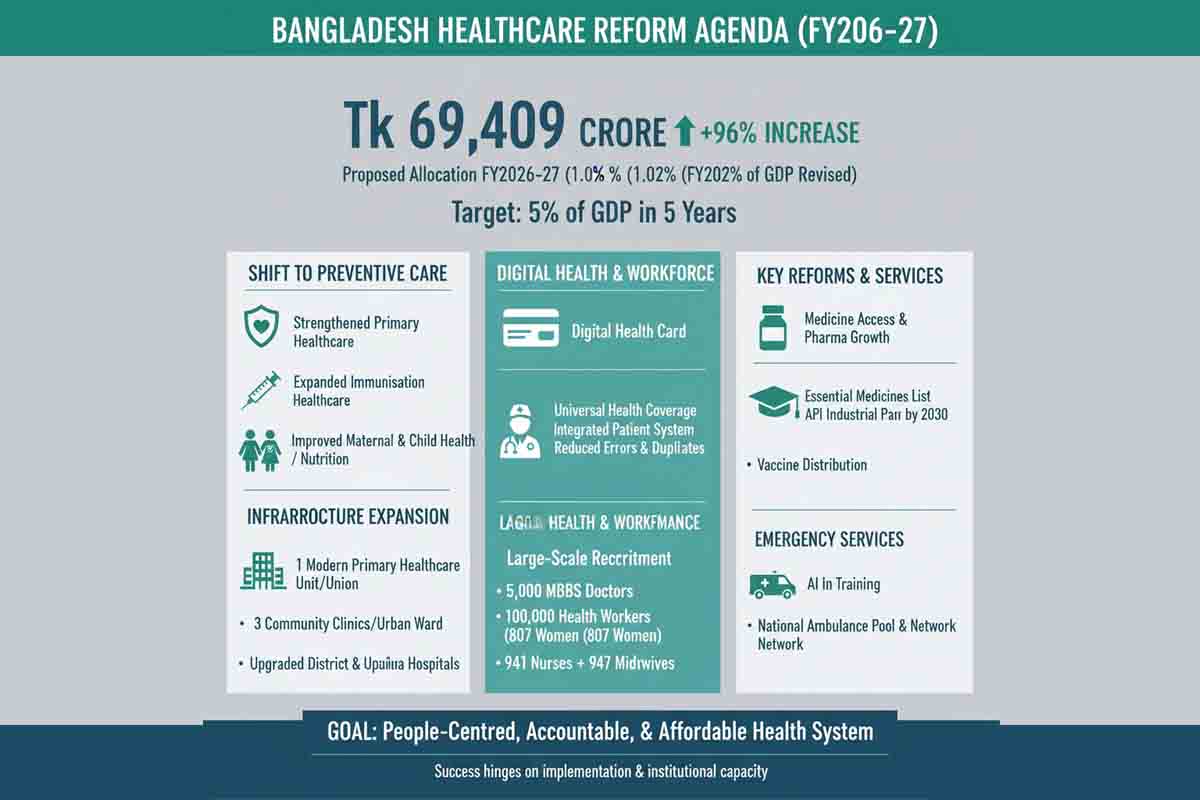
The government has proposed a record allocation of Tk 69,409 crore for the Health and Family Welfare Ministry in the national budget for the 2026–27 fiscal year, nearly doubling the revised allocation of the outgoing fiscal year as part of an ambitious plan to reform and modernise the country’s healthcare system.
Finance Minister Amir Khosru Mahmud Chowdhury announced the allocation while presenting the FY2026–27 national budget in Parliament on Thursday. The proposed allocation accounts for 1.02 percent of gross domestic product (GDP), compared to Tk 35,477 crore (0.58 percent of GDP) in the revised budget for FY2025–26.
The government also reiterated its commitment to gradually increase health spending to 5 percent of GDP over the next five years.
Presenting the budget, the finance minister said that years of neglect, corruption, political interference and lack of accountability have weakened Bangladesh’s health system, resulting in overcrowded hospitals and forcing many citizens to seek treatment abroad.
He said the government’s goal is to shift the healthcare system from a treatment-based model to a prevention-focused system by strengthening primary healthcare, expanding immunisation, improving maternal and child health services, enhancing nutrition programmes, and ensuring early detection of non-communicable diseases.
As part of the reform plan, the government intends to establish a modern primary healthcare unit in every union and at least one or more units in each urban ward. Each unit will be supported by three community clinics to deliver preventive care, maternal and child health services, nutrition support, and basic treatment at grassroots level.
Officials said this model aims to expand universal access to primary healthcare and reduce pressure on secondary and tertiary hospitals.
The budget also includes plans to introduce a nationwide digital “Health Card” under a universal health coverage framework. The card will be linked to an integrated patient management and referral system, enabling healthcare providers to access patients’ medical histories, prescriptions, and test results across all levels of care.
Authorities say the system is expected to reduce medical errors, eliminate duplicate tests, and improve coordination between healthcare facilities while increasing efficiency and accountability in service delivery.
The government plans to upgrade district hospitals and upazila health complexes into integrated healthcare units. Complex treatments, including surgeries, will be concentrated at district hospitals, while upazila facilities will focus on maternal, neonatal, child, and reproductive health services.
A National Ambulance Pool and Emergency Services Network will also be established to improve emergency response and patient transportation across the country.
To address critical shortages in the health workforce, the government plans to recruit 5,000 MBBS doctors for public hospitals and initiate hiring of 100,000 health workers, with around 80 percent expected to be women.
In addition, 941 new posts for senior staff nurses and 947 positions for midwives have already been created to strengthen maternal healthcare services.
The budget prioritises affordable access to essential medicines and proposes updates to the National Essential Medicines List along with a modern drug policy.
Support will also continue for the pharmaceutical sector, including development of an Active Pharmaceutical Ingredient (API) industrial park and expansion of medicine and vaccine distribution networks nationwide.
Referring to recent disease outbreaks, the finance minister said the government had administered measles-rubella vaccines to nearly all eligible children within its first 100 days, highlighting renewed focus on immunisation.
Major reforms in medical education are also planned, including modernisation of the MBBS curriculum, increased use of artificial intelligence in medical training, and the introduction of a competency-based curriculum by 2030.
Student loan facilities for medical and dental students, upgraded medical college infrastructure, expanded nursing education, and specialised teacher training programmes are also included in the reform agenda.
The government has announced plans to develop a domestic medical equipment manufacturing industry to reduce import dependency and boost exports, alongside incentives for export-oriented pharmaceutical companies.
Finance officials said the overall objective of the FY2026–27 health budget is to build a modern, accountable, and people-centred healthcare system that ensures affordable access to quality services while reducing out-of-pocket healthcare expenditure.
Despite the record allocation and ambitious reform agenda, analysts note that successful implementation and institutional capacity will be key to translating budget promises into real improvements in healthcare outcomes across Bangladesh.
