
Bangladesh Nearly Doubles Health ADP Budget, But Weak Implementation Raises Concern
The government has nearly doubled the health sector allocation under the Annual Development Programme (ADP) for the 2026–27 fiscal year, raising hopes for improved healthcare infrastructure and services. However, experts and stakeholders have raised serious concerns over the sector’s persistent inability to implement development funds effectively.
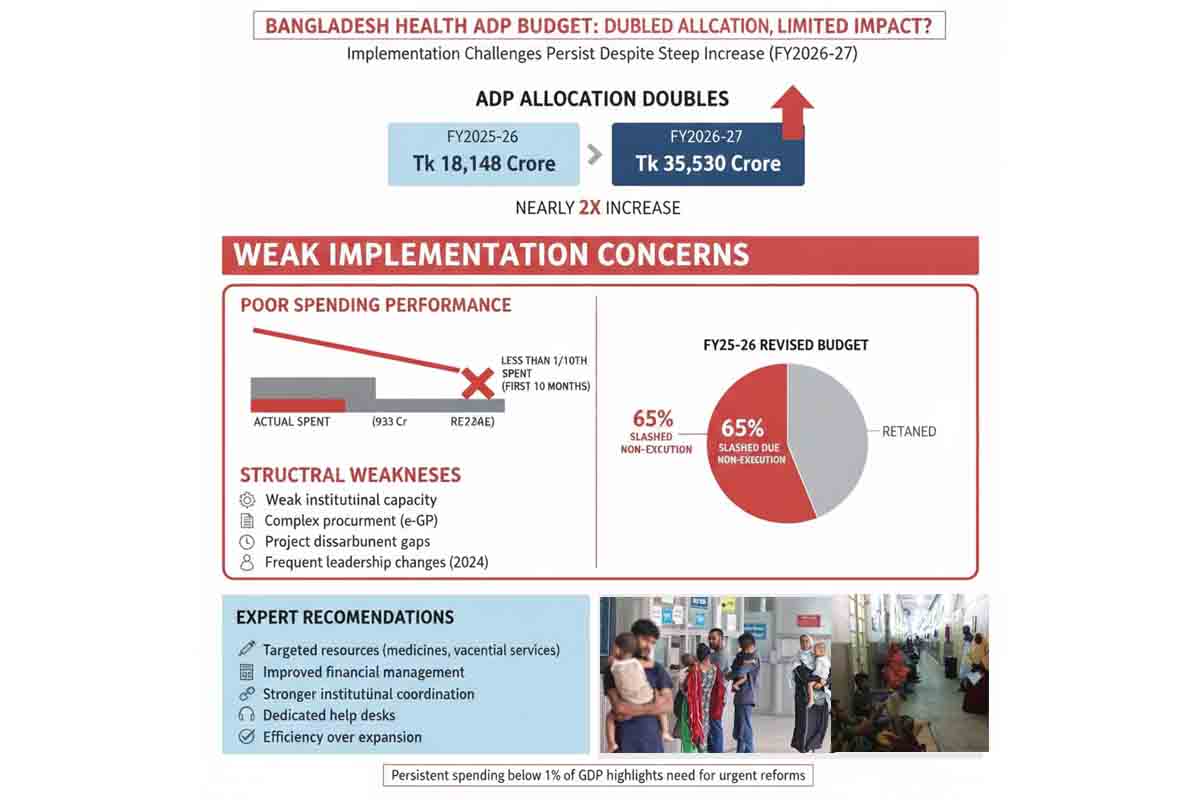
Under the new ADP, the health sector has been allocated Tk 35,530 crore for FY2026–27, up from Tk 18,148 crore in FY2025–26. The allocation represents 11.86 percent of the total ADP outlay, making it the third-largest sector after transport and communication, and education.
The budget increase comes at a time when Bangladesh’s health sector continues to struggle with chronic underperformance in development expenditure, raising doubts about whether the additional funds can be fully utilised.
According to official data, the Health Services Division and the Medical Education and Family Welfare Division collectively spent only around Tk 933 crore in the first 10 months of the current fiscal year—less than one-tenth of their annual allocation.
Although Tk 18,148 crore was allocated under the ADP in FY2025–26, the two divisions were forced to undergo a revision that slashed more than 65 percent of their original allocation due to weak implementation.
Historically, both divisions have ranked among the poorest performers in ADP execution since the health ministry was split into two divisions in 2017, with only rare exceptions reaching national average implementation levels.
Experts attribute the poor performance to weak institutional capacity, complex procurement procedures, and delays in project approval and fund disbursement.
Dhaka University economist Prof. Rumana Huque, Executive Director of ARK Foundation, said lengthy procurement cycles and inadequate technical skills among officials handling electronic government procurement (e-GP) systems significantly delay project execution. She also noted that fragmented fund release procedures and coordination gaps between planning and budgeting authorities further slow down implementation.
She added that frequent changes in project directors following the 2024 political transition also disrupted ongoing development activities.
Meanwhile, Prof. Sayed Abdul Hamid, Institute of Health Economics, University of Dhaka, pointed out that many project officials lack proper training in public financial management, which undermines efficient execution of development projects.
Health Minister Sardar Md Sakhawat Husain acknowledged the challenges but expressed confidence that the government would improve performance in the coming fiscal year. He stated that the interim administration had faced planning limitations but assured that efforts were underway to strengthen implementation capacity.
The ADP was approved by the National Economic Council, chaired by Prime Minister Tarique Rahman, with a total outlay of Tk 3.09 lakh crore on May 19.
While health experts welcomed the increased allocation, they stressed that higher budgets alone will not improve outcomes unless implementation bottlenecks are addressed.
Rumana Huque argued that reducing out-of-pocket healthcare expenditure should be prioritized over large-scale infrastructure expansion. She recommended increasing public spending on medicines, vaccines, and essential services, alongside greater focus on preventive healthcare.
Prof. Sayed Abdul Hamid emphasized the need for stronger institutional coordination, smoother fund disbursement processes, and improved contractor selection. He also suggested establishing a coordination cell within the Ministry of Health and a dedicated help desk at the Directorate General of Health Services to support implementation.
Health campaigners note that Bangladesh has consistently spent less than 1 percent of GDP on health for over a decade, despite repeated calls to raise it to 5 percent of GDP under reform proposals.
They warn that unless administrative inefficiencies are addressed, increased allocations risk remaining underutilized, limiting their impact on healthcare access and quality.
Although the nearly doubled health development budget signals stronger policy intent, experts caution that Bangladesh’s long-standing implementation weaknesses could prevent the sector from fully benefiting from the increased allocation—unless urgent institutional reforms are introduced.
