
Bangladesh Health Budget Rises Over a Decade, But Efficiency Gaps Limit Impact: Study
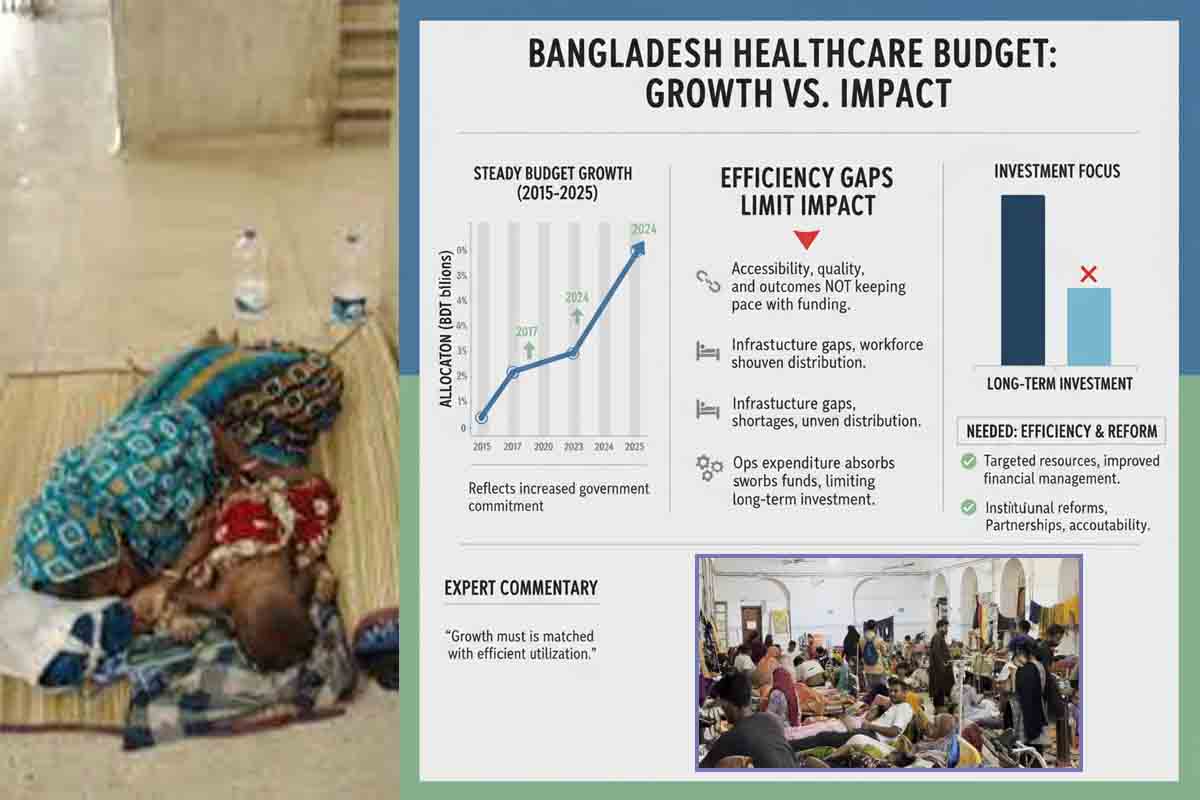
Bangladesh’s health sector budget has shown steady growth over the past decade, reflecting increased government commitment to strengthening healthcare services and infrastructure. However, a new longitudinal analysis suggests that despite rising allocations, systemic inefficiencies continue to limit improvements in health outcomes.
The study, based on national budget documents and data from the Ministry of Health and Family Welfare, examines health sector allocations from 2015 to 2025. It identifies consistent increases in budgetary support, with notable surges in 2017, 2020, and 2024.
While health spending has increased over time, the study finds that improvements in healthcare accessibility, service quality, and public health outcomes have not kept pace with financial growth.
Researchers note that Bangladesh continues to face challenges related to infrastructure gaps, workforce shortages, and uneven distribution of healthcare services, which reduce the effectiveness of increased funding.
The analysis highlights that a significant portion of the health budget is still absorbed by operational expenditures, leaving limited scope for long-term investments in infrastructure, digital health systems, and workforce development.
It argues that without addressing governance challenges and improving efficiency in resource allocation, increased funding alone may not deliver sustainable improvements in healthcare delivery.
The study recommends better targeting of resources, improved financial management, and stronger public–private partnerships to enhance healthcare access and quality.
It also calls for institutional reforms to strengthen planning, monitoring, and accountability systems within the health sector.
Commenting on the findings, Musfiqa Ashraf, PhD, Associate Professor (Sociology), School of Social Sciences, Humanities and Languages (SSHL), Bangladesh Open University, Gazipur-1705, Bangladesh, said that although budgetary growth in the health sector is encouraging, it must be matched with efficient utilization and targeted reforms to achieve meaningful public health improvements.
Lokiat Ullah, MBBS, PGDPM, PGDMM, PGDCM, MBA, PhD (Hon.), Physician, Entrepreneur & Human Rights Worker, Dhaka, Bangladesh, observed that persistent gaps in service delivery and resource distribution continue to hinder the translation of increased budget allocations into improved healthcare outcomes.
Mohammad Abdullah Al Masood, M.Pharm, Senior Deputy Manager, Product Management Department (PMD), Biopharma Limited, Dhaka, Bangladesh, noted that strengthening implementation capacity and ensuring accountability in healthcare spending are essential for improving system performance and ensuring equitable access to services.
The study concludes that while Bangladesh’s health budget has grown steadily over the past decade, achieving long-term sustainability requires more than increased allocations. Experts emphasize that strategic reforms, improved efficiency, and stronger governance are essential to ensure that financial investments translate into better health outcomes for the population.
