
Health Budget Nearly Doubled in FY2026–27, But Spending Still Below Global Standard
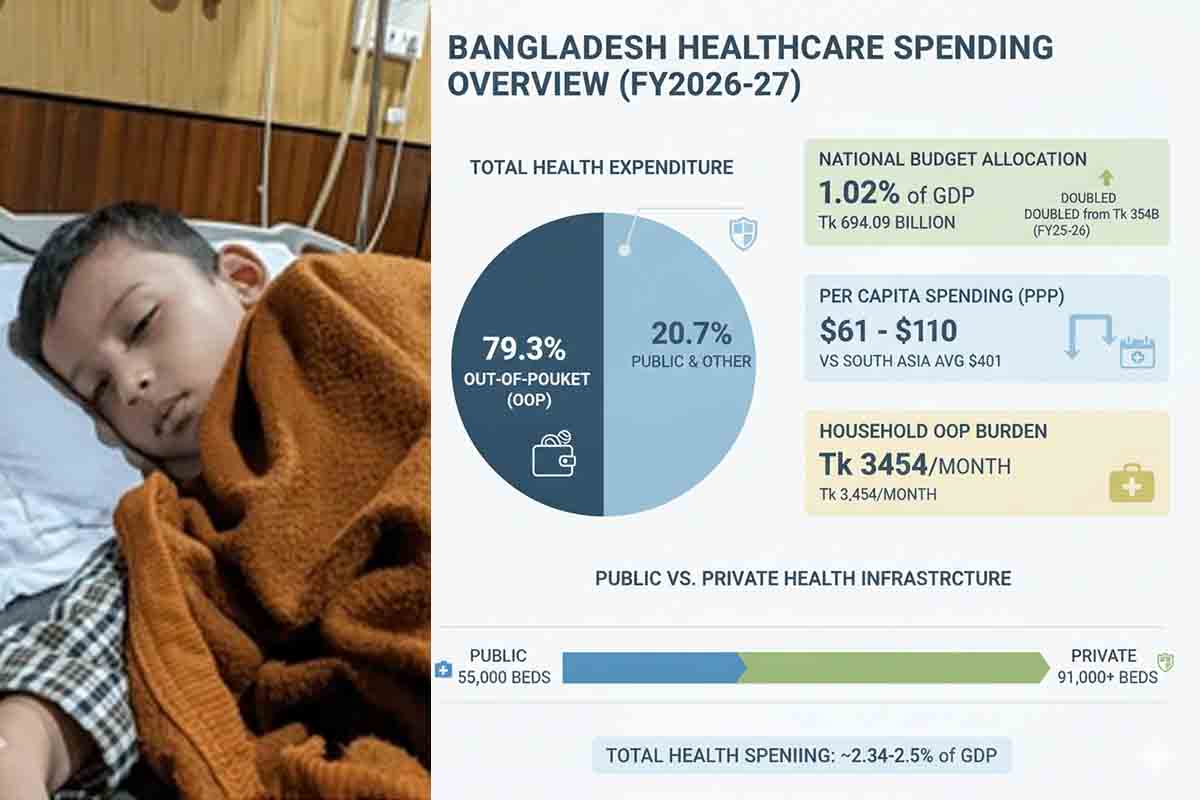
The government has nearly doubled the allocation for the Health Services Division and the Medical Education and Family Welfare Division in the proposed budget for FY2026–27, raising total health sector spending to Tk 694.09 billion, or 1.02 percent of gross domestic product (GDP).
Finance Minister Amir Khosru Mahmud Chowdhury proposed the allocation while presenting the national budget in parliament on Thursday, stating that the government aims to gradually increase public healthcare spending to 5 percent of GDP in the long term.
In the current fiscal year FY2025–26, the health sector received Tk 354.77 billion, accounting for 0.58 percent of GDP, meaning the new allocation represents a significant nominal increase.
The finance minister also outlined plans to strengthen primary healthcare services by establishing at least one modern primary healthcare unit in every union and one or more facilities in each urban ward. The initiative is aimed at expanding access to basic healthcare services across rural and urban areas.
Despite the increased allocation, health sector spending in Bangladesh remains below 1 percent of GDP, a trend that has persisted for nearly two decades. Analysts note that such low investment has left the country’s healthcare system under significant pressure, Centre for Policy Dialogue (CPD) said.
CPD Executive Director Dr Fahmida Khatun said that Bangladesh’s health system continues to face structural challenges, including weak infrastructure, inadequate governance, and shortages of medical equipment and skilled personnel.
Data shows that as of 2024, Bangladesh had one hospital bed for every 1,196 people, while only 5.1 percent of health facilities had emergency transportation services. Other basic service gaps included limited access to disinfectants, medical masks, laboratory facilities, and reliable electricity in many health centers.
The country also faces a critical human resource shortage. In 2018, Bangladesh had one registered physician for every 1,581 people, while only 28 percent of facilities had specialists and less than 80 percent had nurses.
One of the most pressing concerns is the high level of out-of-pocket healthcare expenditure. Bangladesh remains among the highest globally in this category, with nearly 73–74 percent of total health costs paid directly by households.
This trend places a significant financial burden on families and increases the risk of medical poverty. The proportion of people pushed below the international poverty line due to healthcare expenses has also increased over time.
Although health allocation has increased in absolute terms, Bangladesh’s public health spending remains among the lowest in the least developed country (LDC) group when measured as a share of GDP.
Recent comparisons show that Bangladesh spends less on healthcare than most regional peers, including India, Pakistan, Nepal, Bhutan, and Sri Lanka. It also ranks at the bottom among LDCs in government health expenditure as a share of GDP.
Experts also point to a structural imbalance in health financing, where non-development expenditure consistently outweighs development spending. This means a larger share of the budget is used for operational costs rather than infrastructure expansion, technology upgrades, and system improvement.
Analysts warn that without rebalancing spending priorities, increased allocations alone may not significantly improve healthcare outcomes.
Public health experts argue that achieving Sustainable Development Goal 3 (SDG 3), which aims to ensure healthy lives and promote well-being for all, will require significantly higher investment from government, private sector, and development partners.
They stress that increased funding must be matched with improved governance, better resource utilization, and stronger healthcare infrastructure.
Without sustained reforms and higher investment, experts warn that Bangladesh’s health system may struggle to meet growing demand and deliver equitable, quality healthcare services for its population.
