
Shehbaz Sharif hails historic space mission as milestone in 75-year Pakistan-China relations; four Pakistani university experiments underway in orbit
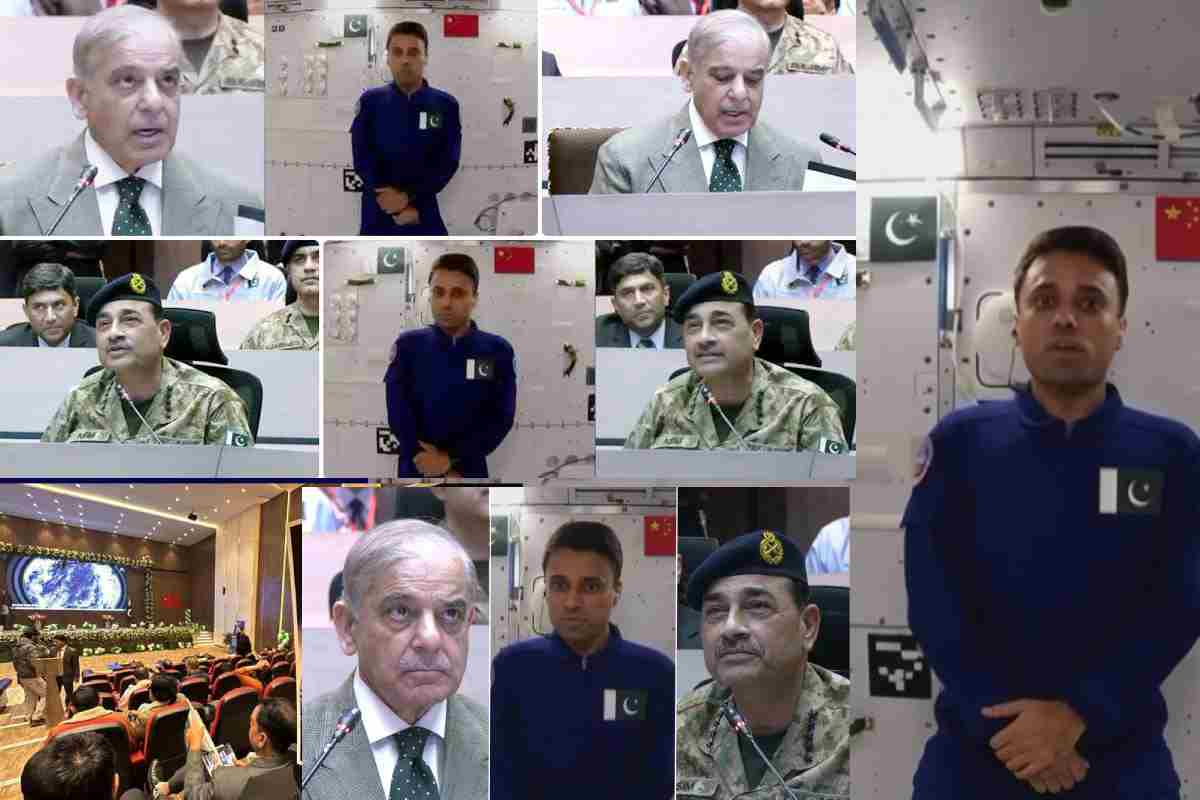
ISLAMABAD, November 28, 2026: Pakistan Prime Minister Shehbaz Sharif on Saturday held a historic live conversation with the country's first astronaut, Wing Commander Muhammad Zeeshan Ali, aboard China's Tiangong Space Station, describing the mission as a major breakthrough in Pakistan's scientific and technological ambitions.
The conversation took place at the headquarters of Pakistan's Space and Upper Atmosphere Research Commission (SUPARCO) in Islamabad, with Chief of Defence Forces and Chief of Army Staff Field Marshal Syed Asim Munir, Deputy Prime Minister and Foreign Minister Ishaq Dar, and Chinese Ambassador to Pakistan Jiang Zaidong also in attendance.
The interaction marked a significant moment in Pakistan-China space cooperation, as the two countries celebrate 75 years of diplomatic relations.
Wing Commander Zeeshan Ali made history on November 25 after travelling aboard China's Shenzhou-24 spacecraft, launched on a Long March-2F rocket from the Jiuquan Satellite Launch Centre. He became the first Pakistani to enter Earth's orbit and the first foreign astronaut to join China's crewed space programme aboard the Tiangong Space Station.
During his mission, Ali is participating in scientific research, including four experiments developed by Pakistani universities. The experiments focus on advanced materials, agriculture and biological research, offering Pakistani researchers an opportunity to contribute to scientific investigations in the space environment.
Speaking during the live interaction, Prime Minister Shehbaz Sharif expressed immense pride in the achievement, saying the knowledge and experience gained through the mission would create new opportunities for Pakistan in science, technology and space exploration.
He also acknowledged China's support and cooperation, while appreciating the contributions of SUPARCO, Pakistani scientists, academic institutions and the armed forces in making the mission possible.
Sharif expressed confidence that the landmark achievement would inspire young Pakistanis to pursue scientific research, innovation and technological excellence.
Field Marshal Asim Munir also congratulated the astronaut, describing his presence aboard the Chinese space station as a reflection of the enduring strategic partnership between Pakistan and China.
The prime minister said the longstanding friendship between the two countries, traditionally described as higher than the Himalayas and deeper than the oceans, had now soared beyond the skies.
The mission represents an important expansion of bilateral cooperation beyond traditional areas of diplomacy, trade, infrastructure and defence into human spaceflight, advanced scientific research and emerging technologies.
With four Pakistani university-developed experiments being conducted aboard Tiangong, the mission is also expected to strengthen academic collaboration, scientific knowledge-sharing and research capabilities.
The development comes as Pakistan and China mark 75 years of diplomatic relations, highlighting the growing strategic and technological dimensions of their partnership.
The two countries see the historic space mission as opening further opportunities for joint exploration, innovation and scientific cooperation, with potential benefits extending beyond their national interests to the wider international scientific community.
