
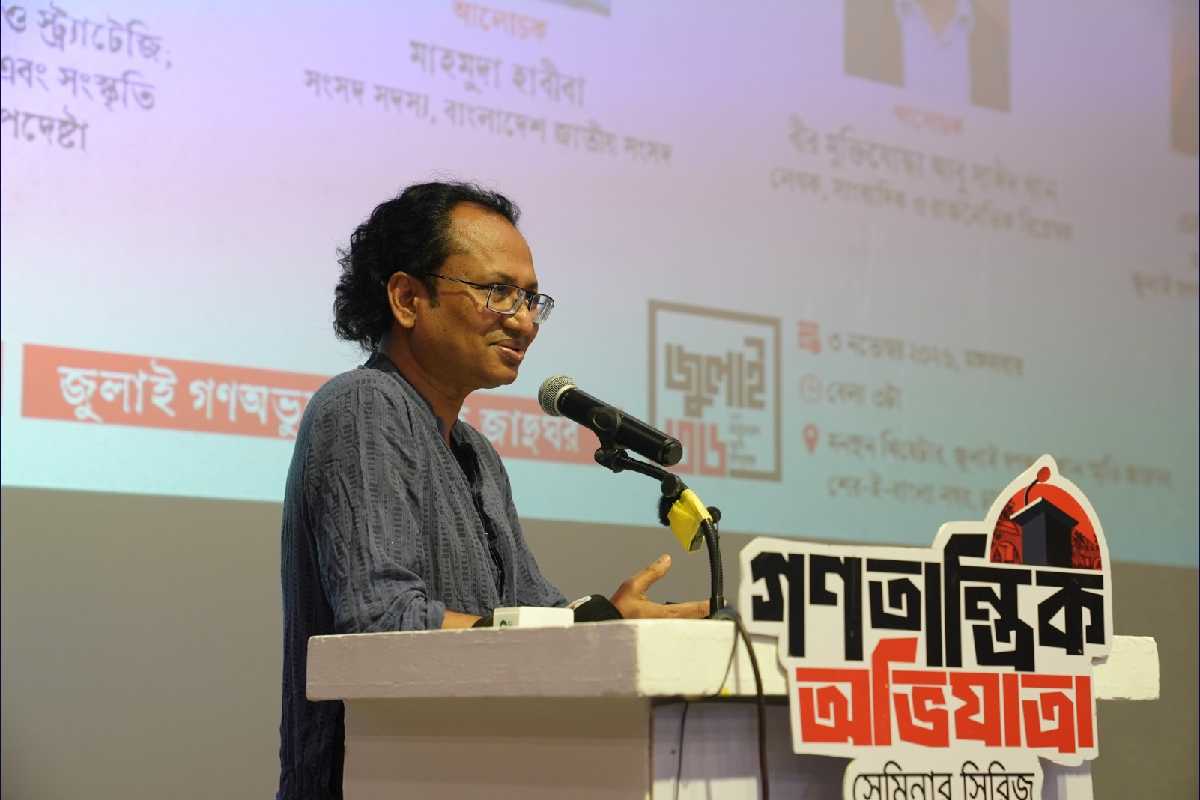
Destroying the Electoral System Leaves Citizens with Nowhere to Turn: Zahed Ur Rahman
Despite Sheikh Mujibur Rahman’s significant contributions from the Pakistan movement to the War of Liberation, he destroyed Bangladesh's democratic practice through vote rigging in the independent nation's first election, stated Zahed Ur Rahman.
Zahed Ur Rahman, Adviser to the Honorable Prime Minister for Policy and Strategy, the Ministry of Information and Broadcasting, and the Ministry of Cultural Affairs, made these remarks today, Tuesday, while addressing a discussion titled ‘The 1973 Election: The Genesis of AL’s Vote-Rigging Model.’ The seminar was organized by the July Uprising Memorial Museum as the third episode of its Democratic Journey Seminar Series.’
‘Sheikh Mujibur Rahman had virtually no chance of losing the 1973 election, yet he rigged the votes,’ Zahed Ur Rahman said. ‘On the other hand, Sheikh Hasina knew she faced an opposition party against whom she would lose in a fair election, which led her to hijack the elections to retain power. In contrast, despite knowing he would win, Sheikh Mujib subverted the very first election of independent Bangladesh.’
Highlighting Sheikh Mujib's pre-liberation political role, he added, ‘Although Sheikh Mujibur Rahman contributed immensely from the Pakistan movement to the Liberation War, he destroyed Bangladesh’s democratic practice through electoral fraud in the first general election.’
Dr. Zahed Ur Rahman further remarked, ‘When the electoral system is destroyed, ordinary citizens are left with nowhere to turn. Many criticize the BNP, alleging they focus solely on elections. In reality, such claims are made to deny the voting rights of the general public.’
Member of Parliament Mahmuda Habiba attended the seminar as a panelist. She stated, ‘Given Sheikh Mujib's popularity, he could have easily formed the government following the 1973 election. Dr. Azhar Uddin Ahmed ran against him in the Bakerganj-4 constituency as a JSD candidate. To ensure Sheikh Mujib's victory, the JSD candidate was abducted right before the election, and Sheikh Mujib was declared the winner through widespread fraud.’
She continued, ‘The Awami League monopolized and laid sole claim to the history of the sacrifices, blood, and struggle of millions during the Glorious Liberation War. The 1973 election was a clear manifestation of this mindset. The Awami League sought to run the country not just under a one-party system, but under one-man rule—a legacy that continued through Sheikh Hasina’s 16-year regime. Sheikh Mujib once stood in parliament and claimed there was no opposition in the country, while Sheikh Hasina propagated that she had no alternative.’
Referring to the July Charter, she noted, ‘Although objections were deliberated during the Consensus Commission discussions, the notes of dissent were omitted when the July Charter was signed. Given the country's situation, we welcomed the interim government upon taking charge. However, at the time of their departure, the July Charter issued via a presidential order without those notes of dissent attempted to bind the future democratically elected parliament.’
Freedom Fighter Abu Sayeed Khan, another speaker at the event, said, ‘After the Liberation War, we heard many rumors. At one point, it was said Sheikh Mujibur Rahman would act as a guardian of the nation and refrain from active politics. Later, we saw him return, remove Tajuddin Ahmad, and head the government. He subsequently led the drafting of the Constitution. The first test of that Constitution was the national election, which turned out to be a single-party contest. Independent Bangladesh's first parliament was formed without a formal opposition, which was a disservice to democracy.’
He added, ‘Many claim that Bangabandhu himself did not order these misdeeds. However, his failure lay in his inability to restrain his party members or stop their wrongdoings.’
Asserting that the mass uprising against Sheikh Hasina was inevitable, he remarked, ‘Fair elections have never taken place under a party government, which is why we adopted the Caretaker Government system. However, the 15th Amendment abolished that system, making the mass uprising against Sheikh Hasina inevitable and ultimately overthrowing the autocratic regime.’
Presiding over the event, Ehasan Mahamud, Director General of the July Uprising Memorial Museum, stated, ‘The July Uprising Memorial Museum provides a platform where diverse voices can be heard from a single stage. We will listen to everyone and reach decisions based on consensus, without imposing anything. This is the core strength of July. Through this ongoing series, we aim to look back. If we forget the past, our path forward and our destination will remain unclear.’
He added, ‘As you know, the period from 1972 to 1975 was a dark era. I call it dark because, as a journalist, I know media outlets were shut down under state directives. In today's era of social media, it is unimaginable that the country had only one television channel and four daily newspapers, all state-controlled. News published in the evening was prescribed by the government.’
Ehasan Mahamud further observed, ‘Today, in the age of Facebook, X (formerly Twitter), and Instagram, events are live-streamed instantly for the entire nation to see, leaving no room to conceal information. But during that era, ballot boxes from elections in Comilla were flown to Dhaka by helicopter to declare their preferred candidate the winner. The seeds of the fascist regime that Bangladesh endured for over a decade and a half were planted during 1972–1975. We want to discuss these historical truths so that future champions of Bangladesh’s democratic journey—those active in the July uprising, the 2018 road safety movement, and the quota reform movement—can understand what was previously kept in the dark. We view the July Uprising Memorial Museum as a platform to hear diverse opinions and collectively shape Bangladesh's future path.’
The seminar was moderated by author and researcher Tuhin Khan. University faculty members, researchers, lawyers, students, and civil society representatives participated in the event.
The fourth episode of the seminar series, titled ‘A Comparative Review of Bangladesh's Foreign Policy in the First Decade Post-Independence,’ will take place tomorrow, Wednesday, at 3:00 PM at the Monsoon Theater of the July Museum.
