
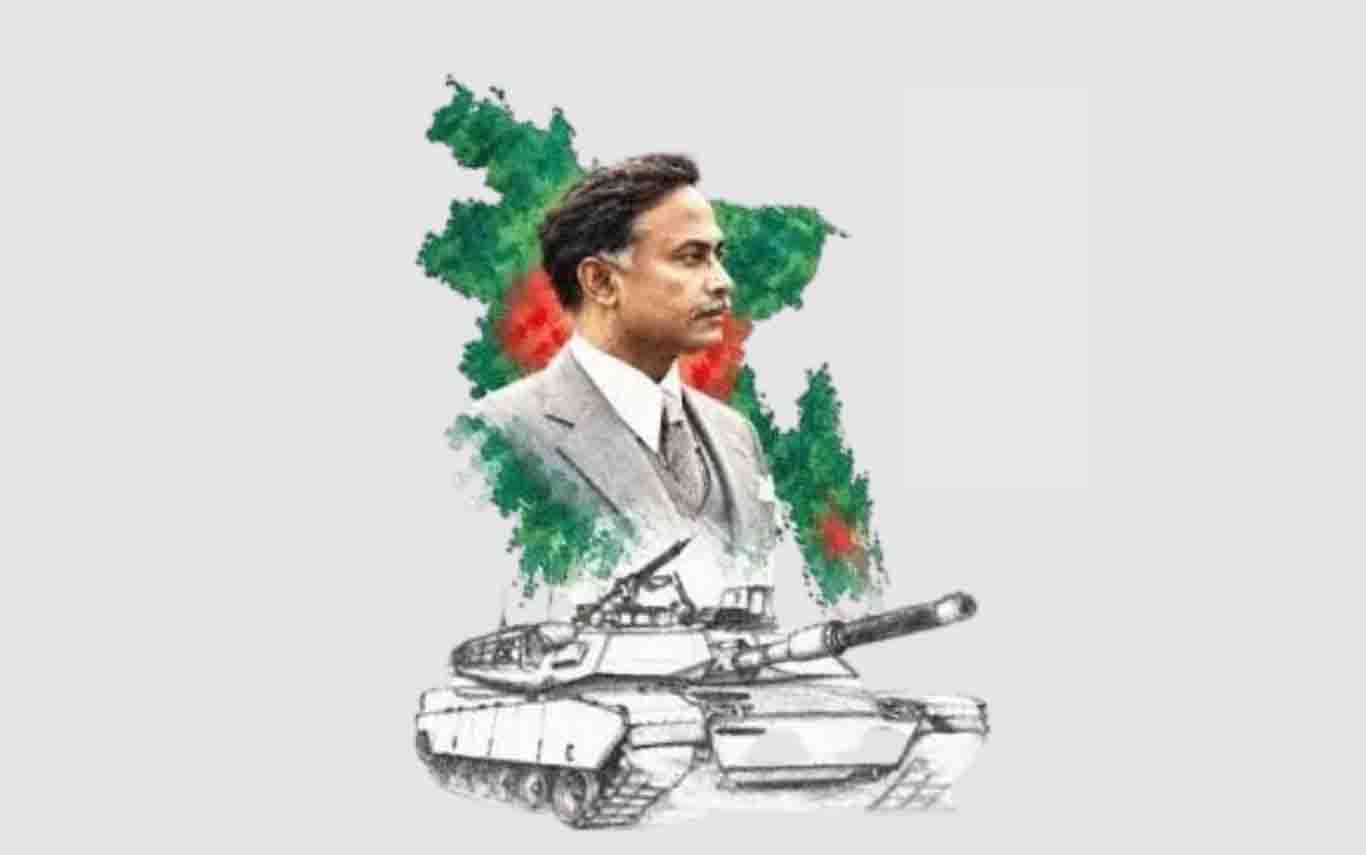
7 November: Bangladesh’s political history, Zia’s legacy and democratic aspirations.
Max Weber identified the legitimacy of state authority as one of the fundamental foundations of political stability. Hannah Arendt’s theory of revolution, on the other hand, reminds us that the true significance of a revolution lies not merely in changing existing power structures, but also in its potential to establish freedom and create a new political space.
Viewed through the lens of these political philosophies, 7 November 1975 stands out as a historically significant day in the history of Bangladesh. It carries particular importance in the sequence of political instability, military coups and counter-coups. In the political tradition of the Bangladesh Nationalist Party (BNP), the day is observed as ‘National Revolution and Solidarity Day’.
However, understanding its significance requires consideration of the political realities preceding it, the subsequent conduct of the state and the democratic aspirations of present-day Bangladesh. In particular, the July 2024 mass uprising and the efforts towards state reform in 2026 have added new dimensions to this discussion.
7 November, the crisis and the transfer of state power: Bangladesh’s journey towards its anticipated destination
After independence, a war-ravaged economy, administrative weaknesses, deteriorating law and order and political conflict plunged Bangladesh into a severe crisis. Brutality towards political opponents, enforced disappearances, killings, the famine of 1974 and the establishment of the one-party political system known as BAKSAL through the Fourth Amendment to the Constitution in 1975 further complicated the situation. The democratic avenues for a peaceful transfer of power became increasingly restricted.
On 3 November, another coup took place under the leadership of Brigadier Khaled Mosharraf. On the same day, the four national leaders were killed inside Dhaka Central Jail. Army Chief Major General Ziaur Rahman was placed under house arrest.
It was against this backdrop that, on 7 November, he was freed, by the grace of the Almighty Allah,, through a revolt by a section of the armed forces and the activities of associated political forces. Meanwhile, several military officers, including Khaled Mosharraf, A.T. M. Haider and Khondaker Nazmul Huda, were killed in the aftermath of the coup. Colonel Abu Taher and the military organisation associated with Jatiya Samajtantrik Dal (JSD) also played an important role in these events.
The interpretations of 7 November are therefore multifaceted. For BNP and many others, it represents a day of soldiers’ and people's solidarity and the defence of national sovereignty. For JSD, it was a Sepoy-People’s uprising. Various other political quarters, including the Awami League, place particular emphasis on the killing of military officers in describing the events.
Nevertheless, the configuration of state power changed after that day, and Shaheed President Ziaur Rahman emerged at the centre of national leadership. This was an event of profound significance in Bangladesh's history.
Shaheed President Ziaur Rahman: political philosophy of solidarity and statecraft
Shaheed President Ziaur Rahman was a sector commander in the Liberation War, a military officer awarded with the title of Bir Uttam and, subsequently, President and political organiser. His declaration of independence from Kalurghat Radio Station in 1971 and his active leadership during the Liberation War constitute significant chapters in the country's history. On that day, a bewildered nation found a clear sense of what it needed to do.
Following 7 November, he became Deputy Chief Martial Law Administrator and assumed the office of President on 21 April 1977. The principal foundation of his political philosophy was ‘Bangladeshi nationalism’, which placed particular emphasis on the identity of an independent state, its territory, citizenship and national unity.
National sovereignty, economic self-reliance, agricultural and rural development and people's participation were important components of his vision of the state. His 19-point programme, initiatives to reintroduce multiparty politics, the establishment of the BNP in 1978 and the parliamentary election of 1979 were significant developments in the country's political reconstruction.
However, the military realities and democratic limitations of his tenure are also part of history. Democracy is not complete through elections alone; it also depends on civil liberties, the rights of dissenting voices and institutional accountability. It is on this basis that he is regarded as the first successful statesman in the history of Bangladesh.
Political philosophy of revolution and solidarity
In political science, revolution refers to a fundamental transformation of the established power structure, while solidarity means establishing a shared sense of responsibility towards the state among people of different opinions and identities. Revolution generates the aspiration for change; solidarity provides that change with a lasting foundation.
In John Locke's theory of the social contract, the legitimacy of government is linked to the consent of the people and the protection of their rights. In Rousseau's philosophy, too, the collective will of the people forms the basis of state authority.
Viewed in this light, 7 November poses important questions for us: how can freedom and sovereignty be protected, and how can political change be transformed into accountable institutions?
An attempt to find a political answer to these questions can be seen in Shaheed President Ziaur Rahman's concept of Bangladeshi nationalism. One of its principal objectives was to establish national unity by transcending differences of religion, region and social status.
In considering tolerance towards differing opinions, one may recall Sheikh Hasina's return to Bangladesh on 17 May 1981. In other words, genuine solidarity does not mean eliminating differences of opinion; rather, it means ensuring equal rights, dignity and security for all despite those differences. The challenge today, therefore, is to connect the concept of solidarity associated with 7 November with the rule of law, political tolerance and civil rights.
July 2024: continuation of history
Throughout Bangladesh's history, crises of state power and political legitimacy have repeatedly generated aspirations for change. In this historical continuum, the student-people's mass uprising of July 2024 represents an important chapter.
What began as a movement demanding reform of the quota system gradually developed into a broader movement against discrimination, state repression and the absence of democratic accountability. Following extensive loss of life and violence, Sheikh Hasina's authoritarian rule came to an end on 5 August.
A 2025 report by the United Nations High Commissioner for Human Rights estimated that approximately 1,400 people may have been killed during the violence surrounding the movement.
The events of 7 November 1975 and July 2024 were not identical in character. The former was primarily associated with a military coup and the reconfiguration of state power, while the latter was a broad-based mass movement led by students. Nevertheless, the two events belong to a wider political continuum. Both confront us with questions about the desire for change during a state crisis and the need for national solidarity and institutional stability after that change.
Can a change of power also transform the character of the state? The answer lies in tangible progress in democratic institutions, the rule of law and the protection of citizens' rights.
Bangladesh in 2026: challenges of national solidarity and leadership
Following the July mass uprising, the interim government led by Professor Dr Muhammad Yunus undertook initiatives to reform the state. Discussions on reforming the Constitution, electoral system, judiciary, police and public administration culminated in the formulation of the July National Charter.
BNP secured a parliamentary majority in the election held on 12 February 2026, and Tarique Rahman assumed office as Prime Minister on 17 February. Prime Minister Tarique Rahman is, on the one hand, the inheritor of the political legacy of Shaheed President Ziaur Rahman and, on the other, faces the democratic expectations of the generation that emerged from the July mass uprising. The opportunity to bring these two political currents together for national unity and state reconstruction has thus presented itself to him.
The principal challenges in this regard are to establish tolerance and dialogue instead of political vengeance; keep the police, judiciary and public administration free from partisan influence; ensure economic stability, employment and social security; and translate the aspirations for reform generated by July into effective institutional change.
National solidarity should be founded on an inclusive civic identity that respects religious, cultural and ethnic diversity. The success of leadership will be determined less by political commitments than by their implementation, administrative efficiency, protection of citizens' rights and the responsible exercise of power.
I believe the Prime Minister will succeed in this regard. The assurances of cooperation he received during his visits to China and Japan are a testament to this.
From legacy of history to a vision for future
7 November is an important chapter in Bangladesh's political history and is closely associated with the political rise of Shaheed President Ziaur Rahman. The true value of history, however, lies in learning from both its achievements and its limitations in shaping the future.
A meaningful connection can be found between Shaheed President Ziaur Rahman's nationalist philosophy and initiatives for state reconstruction, and the aspirations for an anti-discrimination, democratic and accountable state system that emerged from July 2024.
The responsibility of future leadership, including Prime Minister Tarique Rahman, is to build a state in which power changes hands through democratic processes, the rights of dissenting voices are protected and state institutions function above and beyond the interests of individuals and political parties.
Revolution awakens the desire for change, solidarity transforms that desire into collective strength, and democratic institutions provide it with a lasting foundation. The lesson of this historical journey—from 1975 to 2024 and onwards to 2026—is that the true strength of a state does not lie in its incumbent leadership, but in public confidence, the capacity of constitutional institutions and the peaceful coexistence of differing opinions.
The most meaningful way to honour history, therefore, is to build a future in which national unity is inclusive, freedom belongs to everyone and democracy remains the enduring foundation of state governance.
The writer is Vice-Chancellor of Islamic University, Kushtia.
(The article was originally written in Bengali and translated into English by Harun Al Nasif, City Editor BSS.)
