
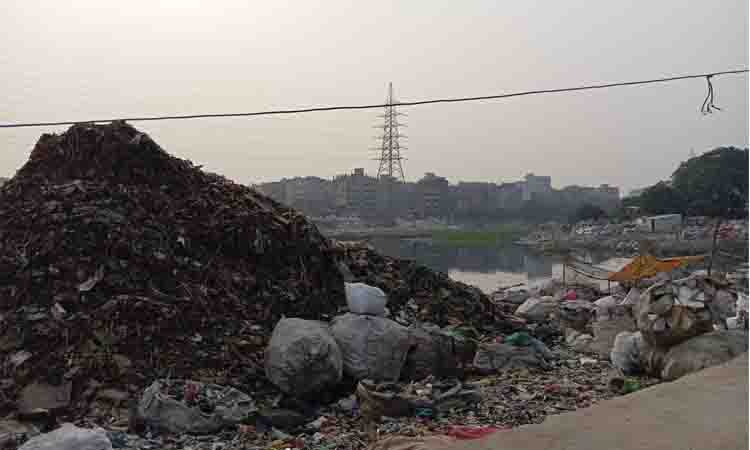
Five-kilometre stretch of Buriganga bank buried under plastic waste.
Huge piles of plastic waste have accumulated along the banks of the Buriganga River in the capital, stretching nearly five kilometres from Babubazar Bridge to Kholamora Ghat in Kamrangirchar.
Although 300 tonnes of waste have recently been removed from the Islambagh section of the area, enormous piles of garbage still remain, raising concerns over the river's environment, aquatic biodiversity and public health.
A visit to the area revealed huge heaps of plastic waste along the riverbank, resembling small and large hills. A narrow road used by local people runs beside the riverbank, while rows of plastic factories stand on the other side.

According to locals, there are numerous small and large factories in nearly 12,000 alleys on the opposite side of the road. These factories process discarded plastic to produce new products.
Workers said the factories use discarded plastic bottles, broken pieces of plastic jugs, polythene and various types of scrap collected from different parts of the city as raw materials.
The collected waste is first dumped in vacant spaces along the riverbank. It is then sorted, and the recyclable plastic is separated for processing. The materials are subsequently taken to factories across the road, where they are melted and processed into new products. Plastic waste unsuitable for recycling is left along the riverbank. Over time, the accumulated waste has formed huge heaps, some of which eventually enter the river.
Environmentalists say the accumulated plastic waste is gradually entering the river, adversely affecting water quality, aquatic biodiversity and the overall ecosystem.

Sharif Jamil, member secretary of the environmental organisation Dhoritri Rokhhay Amra (DHORA), told BSS that the Buriganga water is so polluted that it had no dissolved oxygen during the winter, leaving no aquatic life in the river.
Referring to the risks posed by microplastics formed as plastic waste breaks down over time, he said various studies had found harmful microplastics in fish and other aquatic organisms. These particles enter the human body through the food chain and have serious adverse effects on public health, he added.
On measures to prevent pollution and restore the Buriganga, Sharif Jamil said that during the previous BNP government, initiatives to clean and dredge the river had revealed a layer of polythene seven to 10 feet thick on its bed. He feared that the situation had deteriorated further since then.
He said a participatory, science-based and integrated plan should be formulated and implemented impartially to protect the river. Pollution must be stopped before any cleaning operation, he said, adding that once pollution is controlled, the river could gradually clean itself to a considerable extent through the flow of monsoon water.

Workers employed at plastic factories along the Buriganga are also exposed to pollution-related risks.
Zakir Hossain, a worker who came from Netrokona, told BSS that a large number of workers at these factories came from haor areas, including Sunamganj and Netrokona. Many of them lose their livelihoods when the haor areas are inundated during the monsoon and come to work at these factories in search of employment.
Zakir said he had been working at a factory in the area for three years. The working conditions are so harsh that he often found it difficult to breathe. The smell of plastic dyes caused a burning sensation in his chest, he said.
Welcoming the government's recent initiative to remove plastic waste from the area, he said alternative employment opportunities for factory workers would help them leave such work.
Meanwhile, the High Court recently directed the complete removal of all plastic waste from the riverbank in the Islambagh area under Lalbagh and Kamrangirchar to stop pollution of the Buriganga.
The court also directed the concerned authorities to take effective measures to prevent anyone from dumping plastic or any other waste along the riverbank in the future and submit a comprehensive report on the steps taken. The court fixed December 14 for the next hearing and order in this regard.

Relevant government agencies are carrying out operations to remove the waste from the riverbank. The Bangladesh Inland Water Transport Authority (BIWTA) and Dhaka South City Corporation (DSCC) are conducting regular drives.
BIWTA Joint Director and officer-in-charge of Dhaka River Port Md Mobarak Hossain Majumder told BSS that 300 tonnes of waste had already been removed. Waste removal and eviction drives are continuing, and work is currently underway in Kamrangirchar.
He said around 25 lakh people lived in the area and waste from the locality was being dumped into the river. The riverbank would be cleaned and trees planted there. Iron fencing would also be installed along the riverbank to prevent people from dumping waste, he added.
Mobarak Hossain said the Prime Minister had directed the launch of waterways around Dhaka's rivers, and BIWTA is working to implement the initiative.
Dhaka South City Corporation Chief Waste Management Officer Air Commodore Md Mahbubur Rahman Talukder outlined a new initiative for urban waste management.
He told BSS that DSCC had launched a campaign titled "Shopping in Exchange for Waste". Three campaigns had already been held, allowing people to exchange plastic waste for items of their choice, including rice, flour, oil, sugar, eggs and educational materials.
He also said a permanent stall is being set up to make the initiative sustainable and would be inaugurated next week.

Describing the existing waste collection system, he said household waste was collected and taken to designated locations before being transported away by trucks. As a result, waste did not enter the river, and no waste is currently left lying anywhere in the city, he claimed.
However, local residents said regular waste removal alone would not solve the problem unless public awareness improved and the practice of dumping waste along the riverbank stopped.
Md Jamir Ali, who runs a tea stall beside the fish wholesale market at Swarighat on the Buriganga, told BSS that waste is removed regularly, but people continued to dump it there.
"If people are not aware, no initiative will be effective. The riverbank is cleaned in the morning, but by the afternoon waste is dumped there again," he said, adding that people ignored warning signs asking them not to dump waste.
Local boat workers also stressed the need to stop further dumping and clean the riverbed, rather than relying solely on waste removal from the riverbank.
Saleh Majhi, who has been ferrying passengers between Tankirghat and Kamrangirchar for the past 20 years, told BSS that dumping waste into the river must stop and its bed must also be cleaned to restore the Buriganga.
Meanwhile, a meeting chaired by the prime minister on August 2 this year discussed the launch of waterways around Dhaka. The meeting decided to make the waterways operational and instructed the relevant authorities to prevent river pollution, improve drainage systems and maintain the navigability and normal flow of water in the rivers.
