
‘Awami League used Rakkhi Bahini for political interests after independence’
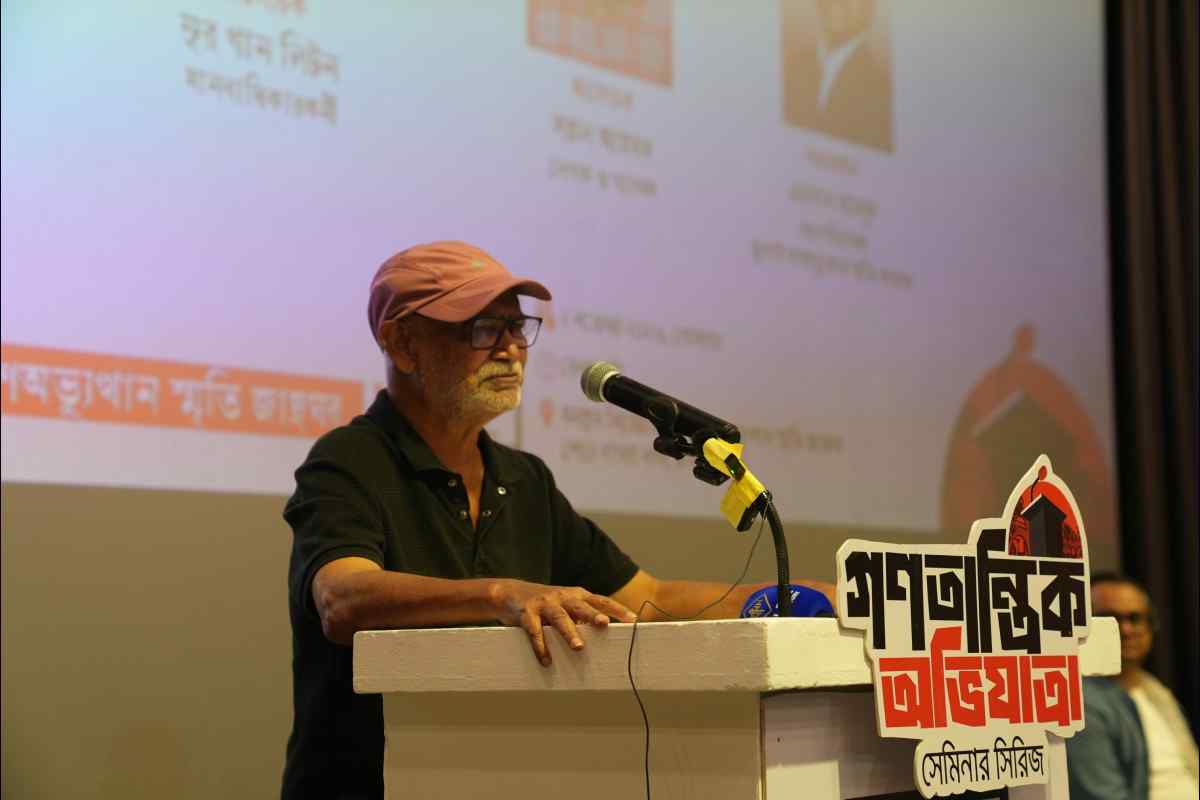
DHAKA, November 2, 2026: Speakers at a seminar organized by the July Mass Uprising Memorial Museum on Monday observed that following 1972, the Awami League weaponized the Rakkhi Bahini to suppress opposition political parties and advance its narrow political agenda.
The observations came during the second session of the seminar series titled ‘Democratic Journey Seminar Series’ which focused on ‘Rakkhi Bahini and Extrajudicial Killings.’
Addressing the event as the keynote speaker, prominent writer and researcher Mohiuddin Ahmad pointed out that many erroneously identify the murder of Siraj Sikder in January 1975 as the first extrajudicial killing in independent Bangladesh. He stated that this narrow view essentially erases and denies the hundreds of extrajudicial killings perpetrated by the Rakkhi Bahini since 1972.
Mohiuddin Ahmad said that the Awami League turned the Rakkhi Bahini into a partisan force to serve its regime’s political interests immediately after the Liberation War. He recalled that while the force was deployed to recover land occupied from Hindu communities by Amir Hossain Amu, it was simultaneously turned into the ruling party's private enforcement wing to persecute opposition figures. Leaders and activists of the Jatiya Samajtantrik Dal (JASAD) were the worst victims of the force’s widespread atrocities during that era, he added.
Highlighting how an entrenched culture of impunity continues to sustain extrajudicial killings, Mohiuddin Ahmad noted that the Rakkhi Bahini should have faced trial after 1975. Instead, subsequent political actors merely exploited the force for political rhetoric without seeking justice. He drew a parallel with Sheikh Hasina’s repeated political allegations accusing Ziaur Rahman of conspiring in her father Sheikh Mujibur Rahman's assassination, pointing out that despite staying in power for 16 years, she never formed an inquiry commission into the matter because it was treated strictly as a political tool.
Human rights activist and former member of the Commission of Inquiry on Enforced Disappearances, Nur Khan Liton, stated that the Rakkhi Bahini conducted brutal torture on people regardless of gender. He noted that their operations were conspicuously heavy in areas where opposition groups, particularly JASAD, had strong organizational footholds.
Liton further highlighted that the uniform of the Rakkhi Bahini closely resembled that of the Indian Army at the time, which generated widespread fear among citizens that they might be targeted in joint operations with Indian forces. He added that between 1972 and 1975, numerous unidentified bodies were frequently found dumped on the street connecting Rokeya Hall and Shamsunnahar Hall at Dhaka University, suggesting that the Rakkhi Bahini most likely discarded them there to instill widespread panic.
Panelist, writer, and researcher Sohul Ahmed urged the formation of an independent Truth Commission to bring out the complete truth behind extrajudicial killings carried out across the country over the last five decades. He observed that from the Rakkhi Bahini down to contemporary law enforcement agencies, the exact same scripted narrative—recovering arms and opening fire in self-defense—is repeatedly fed to the public. He criticized the tendency of security forces to treat self-defense and extrajudicial executions as interchangeable terms, which exposes critical loopholes in the existing Penal Code.
Presiding over the seminar, Ehasan Mahamud, Director General of the July Mass Uprising Memorial Museum, remarked that the two most dreaded terms among the masses after independence were the ‘Rakkhi Bahini’ and ‘BAKSAL.’ He explained that the museum initiated the ‘Democratic Journey seminar series’ to revisit these historical realities, beginning with BAKSAL and moving on to the Rakkhi Bahini in the second session.
Ehasan Mahamud stressed that the July Mass Uprising has offered the vision of a transformed Bangladesh, but constructing a sustainable democratic future requires an honest reckoning with the past. He said that following independence, one-man rule was instituted, all independent newspapers were shut down, and state-sponsored extrajudicial violence began with the raising of the Rakkhi Bahini. He affirmed that the July Museum will continue these discussions to keep historical facts alive.
University teachers, researchers, legal experts, students, and civil society representatives attended the event. Further seminars under this series will be organized in phases.
