
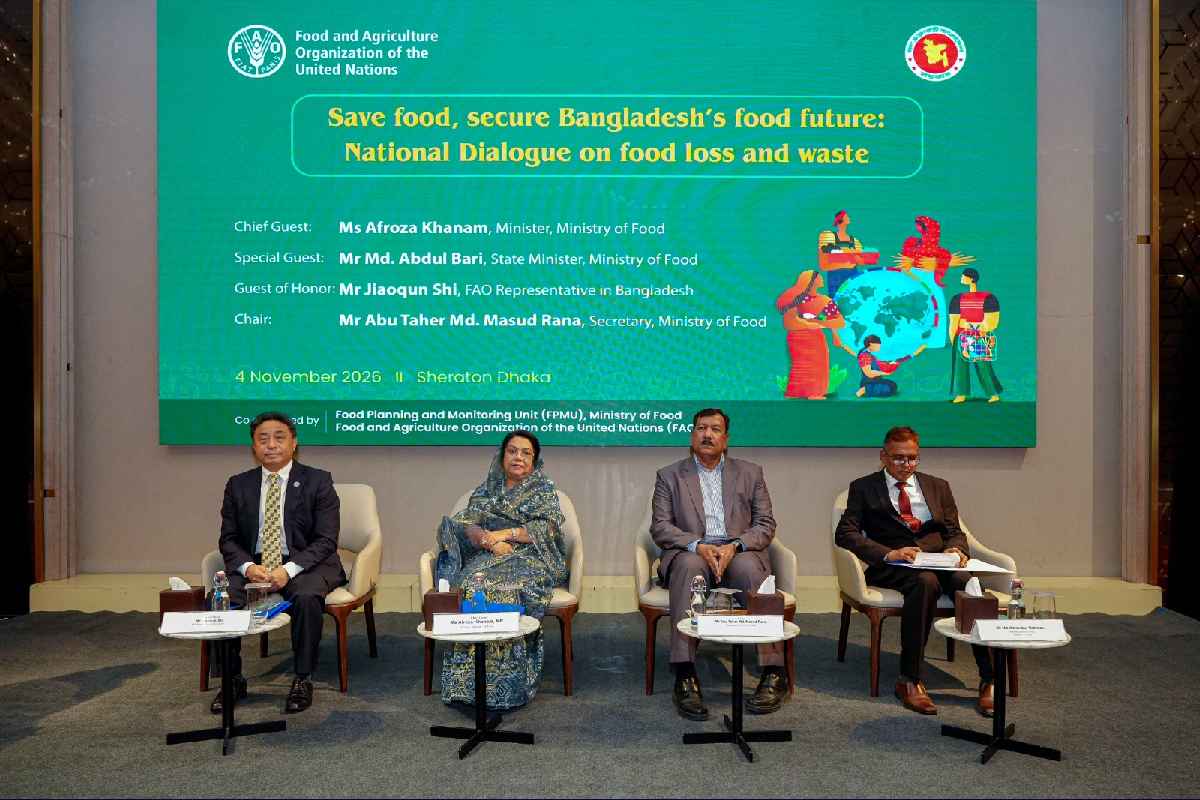
National dialogue focuses on evidence-based strategy, better storage, technology and public-private partnerships
DHAKA, November 5, 2026: Bangladesh has called for coordinated national action to reduce food loss and waste, with the government and the Food and Agriculture Organization of the United Nations (FAO) working together to develop a national strategy aimed at strengthening food security and making the country's agrifood systems more sustainable.
The Ministry of Food's Food Planning and Monitoring Unit (FPMU), in collaboration with the FAO, organised a national dialogue at a city hotel on Thursday to identify policy priorities, investment needs and institutional mechanisms for reducing food loss and waste across the supply chain.
The dialogue was held under the FAO's Technical Cooperation Programme (TCP) project titled "Enhancing Food Systems in Bangladesh with Emphasis on the Availability of Safe Foods".
Food Minister Afroza Khanam attended the event as chief guest, while FAO Representative in Bangladesh Jiaoqun Shi was the guest of honour. Food Secretary Abu Taher Md. Masud Rana chaired the programme, which began with welcome remarks from FPMU Director General Md Mahbubur Rahman.
Addressing the gathering, the food minister said reducing food loss and waste had become a national development priority despite Bangladesh's significant progress in agricultural production and food availability.
"The Government of Bangladesh is committed to strengthening food security through coordinated action across the entire food supply chain," she said.
She emphasised the need for improved technologies, stronger infrastructure, evidence-based policies and partnerships among stakeholders to ensure that more food reaches consumers, farmers receive greater value for their efforts and the country's food systems become more resilient and sustainable.
FAO Representative Jiaoqun Shi said the organisation was working with the Ministry of Food and FPMU to support the formulation of an evidence-based national strategy.
"By strengthening data, identifying priority areas for action and fostering coordinated efforts across the food system, we can help ensure that more of the food Bangladesh produces reaches the people who need it," she said.
She added that reducing food loss and waste would also support farmers' livelihoods, improve nutrition and ensure better use of valuable natural resources.
Despite improvements in food production, Bangladesh continues to face challenges in post-harvest handling, storage, transportation and processing, as well as food waste at retail markets and household levels.
Participants at the dialogue stressed the importance of reliable data, modern post-harvest technologies, targeted investments, stronger public-private partnerships and clearly defined institutional responsibilities.
They also discussed the need for stronger coordination among ministries and relevant institutions to ensure that interventions across crops, fisheries and livestock are effectively implemented.
The keynote presentations were delivered by Professor Dr Md Monjurul Alam, Senior Precision Agriculture Specialist at FAO; Professor Dr Nowsad Alam of the Department of Fisheries Technology at Bangladesh Agricultural University; and Dr A.B.M. Khaleduzzaman, Director of the Department of Livestock Services.
The presentations focused on food loss and waste challenges in the crop, fisheries and livestock sectors, respectively.
Dia Sanou, Deputy FAO Representative in Bangladesh, moderated the keynote presentations and sessions involving development partners.
In his concluding remarks, Food Secretary Abu Taher Md. Masud Rana said the ministry would translate the dialogue's outcomes into a practical and measurable roadmap.
"We will work closely with relevant ministries, technical experts, development partners and other stakeholders to strengthen coordination, prioritise interventions and support the formulation and implementation of Bangladesh's National Strategy for Reducing Food Loss and Waste," he said.
The outcomes of the dialogue are expected to inform the ongoing development of the national strategy and contribute to broader priorities concerning food security, nutrition and sustainable agrifood systems.
Through its partnership with the Ministry of Food and FPMU, the FAO is supporting Bangladesh's efforts to build more resilient, inclusive and sustainable food systems, ensuring that food produced in the country is better preserved, utilised and made available to consumers.
