
China expertise could accelerate Bangladesh's textile transformation
DHAKA, Aug 17: Bangladesh is looking to deepen technological and academic cooperation with China to transform its textile and jute sectors into high-value, technology-driven and globally competitive industries, Commerce, Industries, and Textile and Jute Minister Khandaker Abdul Muktadir said on Monday.
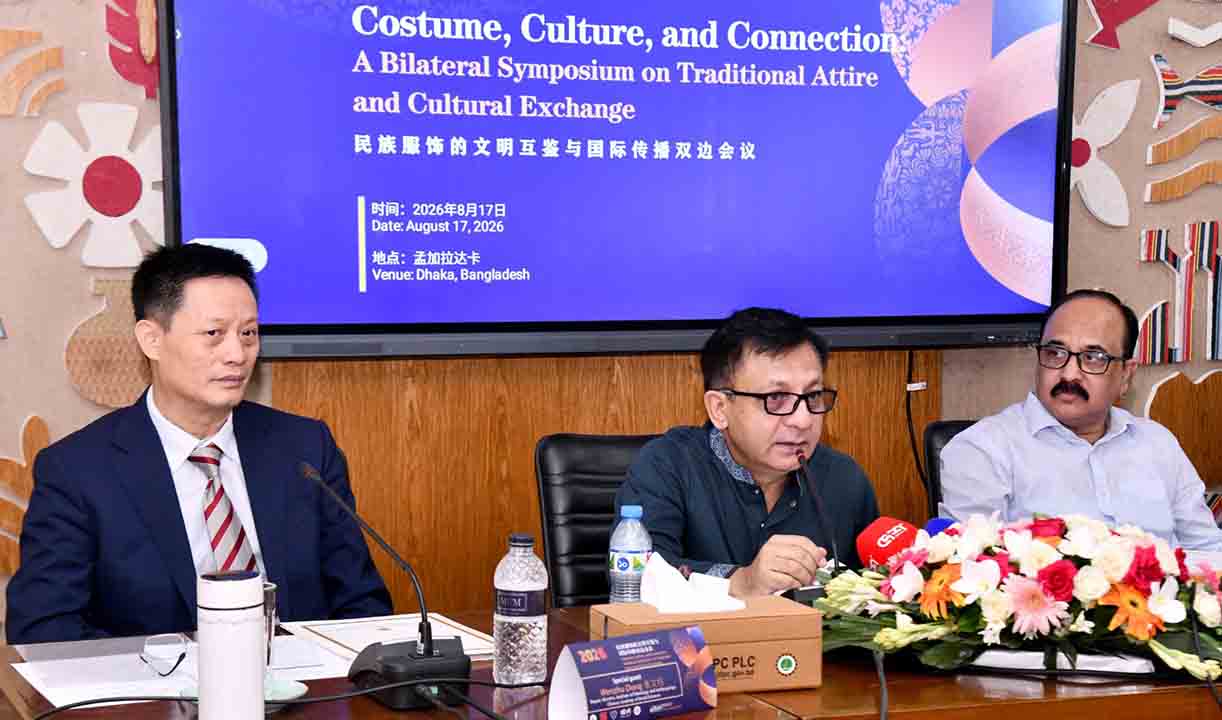
The minister made the remarks as the chief guest at a bilateral symposium titled “Costume, Culture, and Connection: A Bilateral Symposium on Traditional Attire and Cultural Exchange,” organised by China's Zhejiang Sci-Tech University at the Jute Diversification Promotion Center (JDPC) in Dhaka.
He stressed that closer collaboration among the government, industry and academia is essential to modernising Bangladesh's textile and jute industries.
“China's experience, technology and academic expertise can open new opportunities for Bangladesh's textile sector,” the minister said, highlighting the potential for cooperation with Zhejiang Sci-Tech University in textile education, research and technological development.
He said Bangladesh plans to review the curricula of its textile institutes and align them with modern international standards, including China's advanced textile education system.
The government also plans to expand skills development through training by Chinese teachers and industry experts, while Bangladeshi faculty members will have opportunities to receive training in China, he said.
The minister underlined the growing importance of artificial intelligence, digital management and advanced technologies in the global economy, saying students, teachers and industry professionals must adapt to the rapid technological transformation.
Bangladesh's ready-made garment sector currently earns around $38 billion to $39 billion annually from exports, according to the minister.
However, he said the country could generate substantially more foreign exchange without necessarily increasing export volumes if it shifts towards high-value and value-added textile products.
“Bangladesh's textile sector must move towards man-made fibres and value-added products,” he said, stressing the need to diversify beyond traditional garment manufacturing.
The minister also pointed to China's experience in using textiles as part of its industrial transformation. While several industrialised economies gradually moved away from textiles as their economies developed, Bangladesh still has significant room for expansion in the sector.
He said greater access to Chinese technology, expertise and research could help Bangladesh accelerate this transformation.
Turning to jute, Khandaker Abdul Muktadir described the natural fibre as an important part of Bangladesh's heritage and economy.
He called for greater productivity, product innovation and investment in high-value jute goods to revive and expand the sector.
Joint research with Chinese institutions, he said, could help Bangladesh improve jute productivity, introduce modern technologies and develop new value-added products.
Converting raw jute into blended fibres, fabrics and other advanced materials could significantly expand the sector's export potential, he added.
Increasing jute yields would also benefit farmers by raising returns and encouraging greater cultivation, according to the minister.
The symposium brought together senior government officials, academics, researchers and industry representatives. Textile and Jute Ministry Secretary Sharaf Uddin Ahmad Chowdhury, the Director General of the Department of Textiles, representatives of Zhejiang Sci-Tech University and the Chinese Academy of Social Sciences, the Vice-Chancellor of BGMEA University of Fashion & Technology, and entrepreneurs from the textile and garment industries attended the event.
The discussions highlighted the growing scope for China-Bangladesh cooperation in textile technology, academic research, skills development and jute diversification, with participants stressing stronger links between universities, policymakers and industry.
